Practise 17 exam-style questions on Geometric proof for AQA Level 2 Further Maths (Non-calculator). Write your answer as you would in the exam and get it marked in seconds against the mark scheme, point by point, with the Study Helper on hand if you get stuck.
17 questions
1–6 marks each
Instant marking
No sign-up needed
17 questions, marked as you go
Sample questions with model answers
Here are 4 of the questions in this topic, each with a model answer, an explanation of why it earns the marks and the mark scheme an examiner would use.
Question 1
2 marks
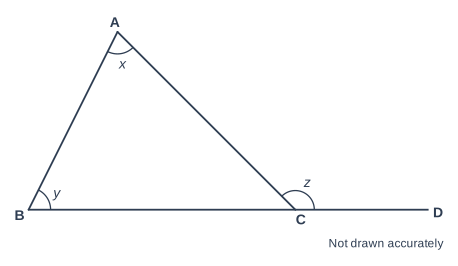
The diagram shows triangle ABC. BC is extended to D. Angle BAC \(= x\), angle ABC \(= y\) and angle ACD \(= z\).
Prove that \(z = x + y\).
Model answer
Angle ACB \(= 180 - z\) (angles on a straight line add up to 180°) Angle ACB \(= 180 - x - y\) (angles in a triangle add up to 180°) So \(180 - z = 180 - x - y\) \(z = x + y\)
Explanation
Find angle ACB in two different ways, once from the straight line BCD and once from the triangle, and set the two expressions equal. Each step needs its reason. A common mistake is to quote the exterior angle theorem, which is exactly what has to be proved.
Mark scheme
1 mark
M1 for angle ACB \(= 180 - z\) or angle ACB \(= 180 - x - y\)
With the reason: angles on a straight line add up to 180°, or angles in a triangle add up to 180°. May be seen on the diagram.
1 mark
A1 for both expressions for angle ACB with both reasons and \(180 - z = 180 - x - y\), so \(z = x + y\)
oe eg \(x + y + (180 - z) = 180\) leading to \(z = x + y\). Quoting 'the exterior angle of a triangle equals the sum of the interior opposite angles' is the result to be proved and scores 0. An answer that only restates the result scores 0; every step must be shown.
Question 2
3 marks
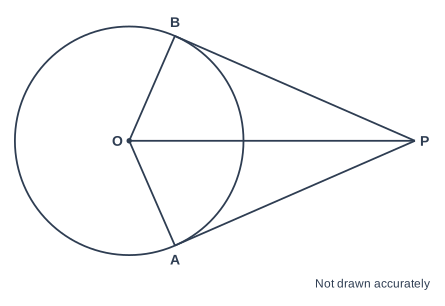
A and B are points on a circle, centre O. PA and PB are tangents to the circle.
Prove that \(PA = PB\).
Model answer
Angle OAP = angle OBP = 90° (tangent is perpendicular to the radius) In right-angled triangle OAP: \(PA^2 = OP^2 - OA^2\) (Pythagoras) In right-angled triangle OBP: \(PB^2 = OP^2 - OB^2\) (Pythagoras) \(OA = OB\) (radii) So \(PA^2 = PB^2\), and as lengths are positive, \(PA = PB\)
Explanation
Join O to P to make two right-angled triangles, with the right angles where the radii meet the tangents. They share the hypotenuse OP and have equal radii as one side, so Pythagoras gives the same value for \(PA^2\) and \(PB^2\). Congruent triangles (RHS) is an equally good argument; quoting the equal tangents fact is circular.
Mark scheme
1 mark
M1 for angle OAP = angle OBP = 90° (the tangent is perpendicular to the radius)
May be seen on the diagram; the reason is needed for the A mark.
1 mark
M1 for \(PA^2 = OP^2 - OA^2\) and \(PB^2 = OP^2 - OB^2\) (Pythagoras) oe
Alternative: triangles OAP and OBP are congruent (RHS: right angles, OP common hypotenuse, OA = OB).
1 mark
A1 for \(OA = OB\) (radii), so \(PA^2 = PB^2\) and \(PA = PB\), fully correct with reasons
dep on both M marks. Quoting 'tangents from an external point are equal in length' is the result to be proved and scores 0. An answer that only restates the result scores 0; every step must be shown.
Question 3
4 marks
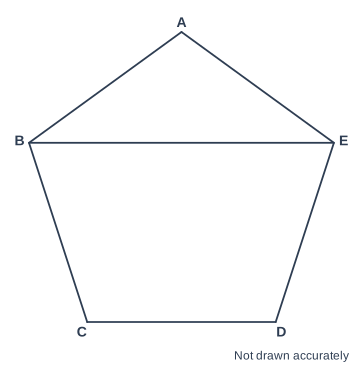
The diagram shows a regular pentagon ABCDE.
Prove that BE is parallel to CD.
Model answer
Interior angle of a regular pentagon \(= \dfrac{(5 - 2) \times 180}{5} = 108^\circ\) AB = AE (sides of a regular pentagon), so triangle ABE is isosceles Angle ABE = angle AEB \(= \dfrac{180 - 108}{2} = 36^\circ\) Angle EBC = angle ABC − angle ABE \(= 108 - 36 = 72^\circ\) Angle EBC + angle BCD \(= 72 + 108 = 180^\circ\) Co-interior angles add up to 180°, so BE is parallel to CD
Explanation
To prove two lines are parallel, show a pair of co-interior angles adds to 180° (or that alternate or corresponding angles are equal). The isosceles triangle ABE gives angle ABE = 36°, so angle EBC = 72°, and with the 108° at C the co-interior angles add to 180°. Saying 'it looks parallel' or using symmetry alone is not a proof.
Mark scheme
1 mark
M1 for an interior angle of the pentagon \(= 108^\circ\)
eg \((5 - 2) \times 180 \div 5\) or \(180 - 360 \div 5\). May be seen on the diagram.
Triangle ABE is isosceles because AB = AE (sides of a regular pentagon). ft their interior angle. Angle AEB = 36° is equivalent.
1 mark
A1 for angle EBC \(= 108 - 36 = 72^\circ\) and angle EBC + angle BCD \(= 72 + 108 = 180^\circ\), so BE is parallel to CD
dep on both M marks. oe eg angle BED = 72° and angle BED + angle EDC = 180°. The conclusion must be stated.
1 mark
B1 for reasons: base angles of an isosceles triangle (AB = AE), angles in a triangle add up to 180°, and co-interior angles add up to 180° so the lines are parallel, stated and used correctly
Award only for reasons attached to correct angle statements. Accept 'allied angles' or 'interior angles' for co-interior angles. Saying the lines look parallel or using symmetry without angles scores 0. An answer that only restates the result scores 0; every step must be shown.
Question 4
5 marks
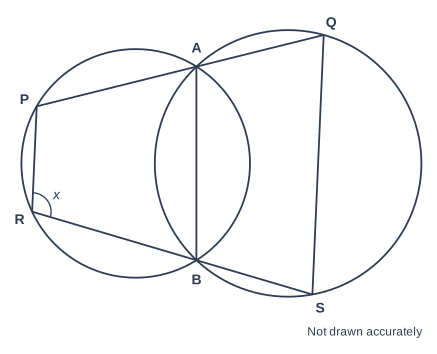
Two circles meet at A and B. P and R are points on one circle. Q and S are points on the other circle. PAQ and RBS are straight lines. Angle PRS \(= x\)
Prove that PR is parallel to QS.
Model answer
PABR is a cyclic quadrilateral, so angle PAB \(= 180 - x\) (opposite angles of a cyclic quadrilateral add up to 180°) PAQ is a straight line, so angle BAQ \(= 180 - (180 - x) = x\) (angles on a straight line) ABSQ is a cyclic quadrilateral, so angle BSQ \(= 180 - x\) (opposite angles of a cyclic quadrilateral) Angle PRS + angle RSQ \(= x + (180 - x) = 180^\circ\) Co-interior angles add up to 180°, so PR is parallel to QS
Explanation
The common chord AB makes a cyclic quadrilateral in each circle: PABR in one and ABSQ in the other. Chasing the angle \(x\) through the first quadrilateral, the straight line PAQ and the second quadrilateral gives angle RSQ \(= 180 - x\). The co-interior angles at R and S then add to 180°, so the lines are parallel. A common error is to treat PRSQ as cyclic.
Mark scheme
1 mark
M1 for angle PAB \(= 180 - x\)
Opposite angles of cyclic quadrilateral PABR add up to 180°. May be seen on the diagram.
1 mark
M1dep for angle BAQ \(= x\)
Angles on the straight line PAQ add up to 180°. Alternative: the exterior angle of cyclic quadrilateral PABR equals the interior opposite angle (this gives angle BAQ \(= x\) directly and scores M2).
1 mark
M1dep for angle BSQ \(= 180 - x\)
Opposite angles of cyclic quadrilateral ABSQ add up to 180°. Angle RSQ = angle BSQ.
1 mark
A1 for angle PRS + angle RSQ \(= x + 180 - x = 180^\circ\), so PR is parallel to QS because co-interior angles add up to 180°
The conclusion must be stated. Accept 'allied angles'.
1 mark
B1 for opposite angles of a cyclic quadrilateral (twice), angles on a straight line and co-interior angles, stated and used correctly
Award only for reasons attached to correct angle statements. Treating PRSQ as a cyclic quadrilateral is wrong (its vertices are not on one circle): no marks for steps that use it. An answer that only restates the result scores 0; every step must be shown.
Ready to try the rest? Every answer you write is marked against the mark scheme, so you can see exactly where the marks are.
Ctrl + Enter to check
Study HelperHints first, answers after you try
Stuck on this one? Ask for a hint and I’ll point you in the right direction, without giving the answer away. Once you’ve checked your answer, I’ll show you how the marks are awarded.