
Level:
Correct: 0
Incorrect: 0
Marks: 0/0
Exam Practice
Course:
Topics:
AQA Level 2 Further Maths (Non-calculator) Smart practice A mixed round aimed at your weak spots
Unit 1
Number
Unit 2
Algebra
Unit 3
Coordinate Geometry (2 dimensions only)
Unit 4
Calculus
Unit 5
Matrix Transformations
Unit 6
Geometry
Avg
score:
–
Topics
done:
0/43

Manipulation of surds and rationalising the denominator

Practise 20 exam-style questions on Manipulation of surds and rationalising the denominator for AQA Level 2 Further Maths (Non-calculator). Write your answer as you would in the exam and get it marked in seconds against the mark scheme, point by point, with the Study Helper on hand if you get stuck.

  • 20 questions
  • 1–6 marks each
  • Instant marking
  • No sign-up needed
20 questions, marked as you go

Sample questions with model answers

Here are 4 of the questions in this topic, each with a model answer, an explanation of why it earns the marks and the mark scheme an examiner would use.

Question 1

2 marks

Write \(\sqrt{75} + \sqrt{300} - 2\sqrt{27}\) in the form \(a\sqrt{3}\) where \(a\) is an integer.

Type square roots as sqrt( ), for example 2sqrt(3).

Model answer

\(\sqrt{75} = \sqrt{25 \times 3} = 5\sqrt{3}\)
\(\sqrt{300} = \sqrt{100 \times 3} = 10\sqrt{3}\)
\(2\sqrt{27} = 2\sqrt{9 \times 3} = 2 \times 3\sqrt{3} = 6\sqrt{3}\)
\(5\sqrt{3} + 10\sqrt{3} - 6\sqrt{3} = 9\sqrt{3}\)

Explanation

Write each surd as a multiple of \(\sqrt{3}\) by taking out the largest square factor (25, 100 and 9), then collect the like surds. Surds can only be added or subtracted once they are multiples of the same root; \(\sqrt{a} + \sqrt{b}\) is not \(\sqrt{a + b}\).

Mark scheme
  1. 1 mark

    M1 for two of \(5\sqrt{3}\), \(10\sqrt{3}\) and \(6\sqrt{3}\) correct

    \(\sqrt{75} = 5\sqrt{3}\), \(\sqrt{300} = 10\sqrt{3}\), \(2\sqrt{27} = 6\sqrt{3}\) (or \(\sqrt{27} = 3\sqrt{3}\))

  2. 1 mark

    A1 for \(9\sqrt{3}\)

    accept \(a = 9\). \(\sqrt{75 + 300 - 54}\) (adding inside the roots) is M0A0. A fully correct answer with no working scores full marks.
Question 2

3 marks

A cube has edges of length \((\sqrt{3} + 1)\) cm.

Work out the volume of the cube.
Give your answer in the form \((a + b\sqrt{3})\) cm³ where \(a\) and \(b\) are integers.

Type square roots as sqrt( ), for example 2sqrt(3).

Model answer

Volume \(= (\sqrt{3} + 1)^{3}\)
\((\sqrt{3} + 1)^{2} = 3 + 2\sqrt{3} + 1 = 4 + 2\sqrt{3}\)
\((4 + 2\sqrt{3})(\sqrt{3} + 1) = 4\sqrt{3} + 4 + 2 \times 3 + 2\sqrt{3}\)
\(= 10 + 6\sqrt{3}\)
Volume \(= (10 + 6\sqrt{3})\) cm³

Explanation

The volume is the edge cubed, so square the bracket first and then multiply by the bracket again, using \(\sqrt{3} \times \sqrt{3} = 3\). The most common error is to cube each term separately, \((\sqrt{3})^{3} + 1^{3}\), which misses all the cross terms.

Mark scheme
  1. 1 mark

    M1 for \((\sqrt{3} + 1)^{2} = 4 + 2\sqrt{3}\) oe

    eg \(3 + \sqrt{3} + \sqrt{3} + 1\). Alternative method (binomial): M1 for \((\sqrt{3})^{3} + 3(\sqrt{3})^{2} + 3\sqrt{3} + 1\)

  2. 1 mark

    M1dep for \((4 + 2\sqrt{3})(\sqrt{3} + 1)\) expanded with at least three of the four terms correct

    \(4\sqrt{3} + 4 + 6 + 2\sqrt{3}\). Alternative method: M1dep for \(3\sqrt{3} + 9 + 3\sqrt{3} + 1\)

  3. 1 mark

    A1 for \(10 + 6\sqrt{3}\)

    accept \(a = 10\), \(b = 6\). Ignore missing units. \(3\sqrt{3} + 1\) (cubing each term) is M0A0. A fully correct answer with no working scores full marks.

Question 3

3 marks

Show that \(\dfrac{1}{\sqrt{7} - \sqrt{5}} - \dfrac{1}{\sqrt{7} + \sqrt{5}} = \sqrt{5}\)

Type square roots as sqrt( ), for example 2sqrt(3).

Model answer

\(\dfrac{1}{\sqrt{7} - \sqrt{5}} \times \dfrac{\sqrt{7} + \sqrt{5}}{\sqrt{7} + \sqrt{5}} = \dfrac{\sqrt{7} + \sqrt{5}}{7 - 5} = \dfrac{\sqrt{7} + \sqrt{5}}{2}\)
\(\dfrac{1}{\sqrt{7} + \sqrt{5}} \times \dfrac{\sqrt{7} - \sqrt{5}}{\sqrt{7} - \sqrt{5}} = \dfrac{\sqrt{7} - \sqrt{5}}{7 - 5} = \dfrac{\sqrt{7} - \sqrt{5}}{2}\)
\(\dfrac{\sqrt{7} + \sqrt{5}}{2} - \dfrac{\sqrt{7} - \sqrt{5}}{2} = \dfrac{\sqrt{7} + \sqrt{5} - \sqrt{7} + \sqrt{5}}{2}\)
\(= \dfrac{2\sqrt{5}}{2} = \sqrt{5}\)

Explanation

Rationalise each fraction with its conjugate; both denominators become \(7 - 5 = 2\), so the fractions can be subtracted directly. The minus sign must apply to the whole of \(\sqrt{7} - \sqrt{5}\): losing the bracket makes the \(\sqrt{5}\) terms cancel wrongly. Every step must be written out for a 'show that'.

Mark scheme
  1. 1 mark

    M1 for \(\dfrac{\sqrt{7} + \sqrt{5}}{2}\) or \(\dfrac{\sqrt{7} - \sqrt{5}}{2}\), or a common denominator \((\sqrt{7} - \sqrt{5})(\sqrt{7} + \sqrt{5})\)

    one fraction rationalised correctly, or both fractions written over a common denominator

  2. 1 mark

    M1dep for \(\dfrac{\sqrt{7} + \sqrt{5}}{2} - \dfrac{\sqrt{7} - \sqrt{5}}{2}\) or \(\dfrac{(\sqrt{7} + \sqrt{5}) - (\sqrt{7} - \sqrt{5})}{7 - 5}\) oe

    both fractions correct, with the denominator evaluated as 2

  3. 1 mark

    A1 for \(\dfrac{2\sqrt{5}}{2} = \sqrt{5}\) with a fully correct, complete argument

    An answer that only restates the result scores 0; every step must be shown. Missing brackets must be recovered: \(\sqrt{7} + \sqrt{5} - \sqrt{7} - \sqrt{5} = 0\) is A0.

Question 4

5 marks

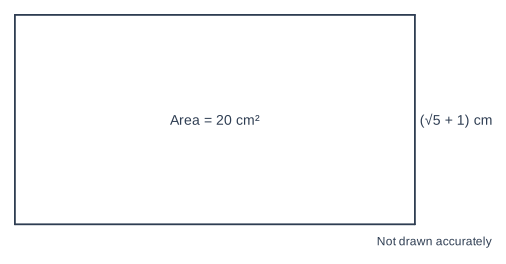
The diagram shows a rectangle.
The area of the rectangle is 20 cm².
One side of the rectangle has length \((\sqrt{5} + 1)\) cm.

Work out the perimeter of the rectangle.
Give your answer in the form \((a\sqrt{5} + b)\) cm where \(a\) and \(b\) are integers.

Type square roots as sqrt( ), for example 2sqrt(3).

Geometry diagram, marked "Not drawn accurately". A rectangle (its vertices are not labelled). The unlabelled side going upwards is labelled (√5 + 1) cm. The text "Area = 20 cm²" is written inside the shape.

Model answer

Other side \(= \dfrac{20}{\sqrt{5} + 1} \times \dfrac{\sqrt{5} - 1}{\sqrt{5} - 1}\)
\(= \dfrac{20(\sqrt{5} - 1)}{5 - 1}\)
\(= 5(\sqrt{5} - 1) = 5\sqrt{5} - 5\)
Perimeter \(= 2(\sqrt{5} + 1) + 2(5\sqrt{5} - 5)\)
\(= 2\sqrt{5} + 2 + 10\sqrt{5} - 10\)
\(= (12\sqrt{5} - 8)\) cm

Explanation

Divide the area by the known side to find the other side, rationalising the denominator with the conjugate \(\sqrt{5} - 1\). The perimeter is twice the sum of the two different sides. Common errors are \(5 + 1\) in the denominator and adding only two of the four sides.

Mark scheme
  1. 1 mark

    M1 for \(\dfrac{20}{\sqrt{5} + 1}\)

    the length of the other side

  2. 1 mark

    M1dep for \(\dfrac{20}{\sqrt{5} + 1} \times \dfrac{\sqrt{5} - 1}{\sqrt{5} - 1}\) oe

    or denominator \(5 - 1\) or 4 seen

  3. 1 mark

    A1 for \(5\sqrt{5} - 5\)

    the other side, oe eg \(\dfrac{20\sqrt{5} - 20}{4}\)

  4. 1 mark

    M1 for \(2(\sqrt{5} + 1) + 2(5\sqrt{5} - 5)\) oe

    ft their other side if it contains a surd; \(2(\sqrt{5} + 1) + 2 \times \dfrac{20}{\sqrt{5} + 1}\) is also M1

  5. 1 mark

    A1 for \(12\sqrt{5} - 8\)

    accept \(a = 12\), \(b = -8\). Ignore missing units. Adding only two sides, \(6\sqrt{5} - 4\), is M1M1A1M0A0. A fully correct answer with no working scores full marks.

Ready to try the rest? Every answer you write is marked against the mark scheme, so you can see exactly where the marks are.

Study Helper Hints first, answers after you try

Stuck on this one? Ask for a hint and I’ll point you in the right direction, without giving the answer away. Once you’ve checked your answer, I’ll show you how the marks are awarded.