
Level:
Correct: 0
Incorrect: 0
Marks: 0/0
Exam Practice
Course:
Topics:
AQA Level 2 Further Maths (Non-calculator) Smart practice A mixed round aimed at your weak spots
Unit 1
Number
Unit 2
Algebra
Unit 3
Coordinate Geometry (2 dimensions only)
Unit 4
Calculus
Unit 5
Matrix Transformations
Unit 6
Geometry
Avg
score:
–
Topics
done:
0/43

The equation of a tangent at a point on a circle

Practise 17 exam-style questions on The equation of a tangent at a point on a circle for AQA Level 2 Further Maths (Non-calculator). Write your answer as you would in the exam and get it marked in seconds against the mark scheme, point by point, with the Study Helper on hand if you get stuck.

  • 17 questions
  • 1–6 marks each
  • Instant marking
  • No sign-up needed
17 questions, marked as you go

Sample questions with model answers

Here are 4 of the questions in this topic, each with a model answer, an explanation of why it earns the marks and the mark scheme an examiner would use.

Question 1

2 marks

The point \((-3, 6)\) lies on the circle \(x^2 + y^2 = 45\)

Work out the gradient of the tangent to the circle at \((-3, 6)\)

Model answer

Gradient of the radius \(= \dfrac{6 - 0}{-3 - 0} = -2\)
The tangent is perpendicular to the radius.
Gradient of the tangent \(= -1 \div (-2) = \dfrac{1}{2}\)

Explanation

The radius from the centre (0, 0) to the point has gradient −2, and the tangent is perpendicular to the radius, so its gradient is the negative reciprocal, 1/2. Common errors are giving −2 or −1/2.

Mark scheme
  1. 1 mark

    M1 for gradient of the radius \(= \dfrac{6 - 0}{-3 - 0}\) or \(-2\)

    oe

  2. 1 mark

    A1 for \(\dfrac{1}{2}\)

    accept 0.5. \(-2\) (the radius) is M1A0; \(-\dfrac{1}{2}\) is M1A0. A fully correct answer with no working scores full marks.
Question 2

3 marks

The point \((-2, 3)\) lies on the circle \(x^2 + y^2 = 13\)

Work out the equation of the tangent to the circle at \((-2, 3)\)
Give your answer in the form \(y = mx + c\)
Type fractions with /, for example (x + 1)/(x - 2).

Model answer

Gradient of the radius \(= \dfrac{3 - 0}{-2 - 0} = -\dfrac{3}{2}\)
Gradient of the tangent \(= \dfrac{2}{3}\)
\(y - 3 = \dfrac{2}{3}(x - (-2))\)
\(y - 3 = \dfrac{2}{3}x + \dfrac{4}{3}\)
\(y = \dfrac{2}{3}x + \dfrac{13}{3}\)

Explanation

Find the gradient of the radius to the point, take the negative reciprocal for the tangent, then use y − y₁ = m(x − x₁). Adding 3 to 4/3 gives 13/3. Common errors are sign slips with x − (−2) and leaving the answer in a different form from the one asked for.

Mark scheme
  1. 1 mark

    M1 for gradient of the radius \(= -\dfrac{3}{2}\)

    oe eg \(\dfrac{3 - 0}{-2 - 0}\)

  2. 1 mark

    M1dep for gradient of the tangent \(= \dfrac{2}{3}\) and \(y - 3 = \dfrac{2}{3}(x + 2)\) oe

    oe eg \(3 = \dfrac{2}{3} \times (-2) + c\)

  3. 1 mark

    A1 for \(y = \dfrac{2}{3}x + \dfrac{13}{3}\)

    oe in the form asked, eg y = 2x/3 + 13/3. \(3y = 2x + 13\) (not in the form asked) is M2A0. A fully correct answer with no working scores full marks.

Question 3

4 marks

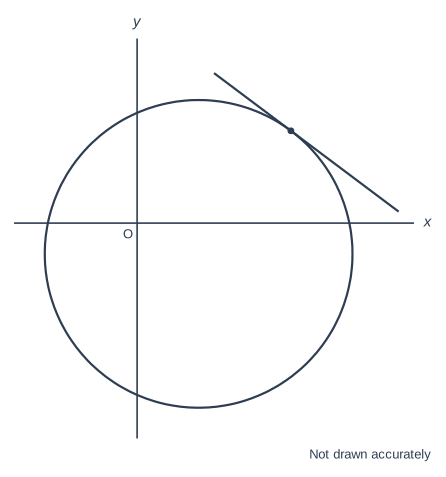
The diagram shows the circle \((x - 2)^2 + (y + 1)^2 = 25\) and the tangent to the circle at the point P \((5, 3)\)

The equation of a circle with centre \((a, b)\) and radius \(r\) is \((x - a)^2 + (y - b)^2 = r^2\)

Work out the equation of the tangent at P.
Give your answer in the form \(px + qy = k\) where \(p\), \(q\) and \(k\) are integers.

A sketch on a pair of axes (x across, y up) with no scale marked, the axes crossing at the origin O. It is marked "Not drawn accurately". The circle is a circle with centre (2, −1) and radius 5. The tangent is a straight line touching the circle at (5, 3), drawn from x = 2.5 to x = 8.5; its position cannot be read off, as the sketch has no scale. Point P is marked with a dot at (5, 3), labelled "P(5, 3)".

Model answer

The centre is \((2, -1)\)
Gradient of the radius \(= \dfrac{3 - (-1)}{5 - 2} = \dfrac{4}{3}\)
Gradient of the tangent \(= -\dfrac{3}{4}\)
\(y - 3 = -\dfrac{3}{4}(x - 5)\)
\(4y - 12 = -3x + 15\)
\(3x + 4y = 27\)

Explanation

The centre (2, −1) comes from the equation; the radius to P has gradient 4/3, so the tangent, perpendicular to it, has gradient −3/4. Multiply through by 4 to clear the fraction. Check: 3(5) + 4(3) = 27. Common errors are taking the centre as (−2, 1) and using the gradient of the radius for the tangent.

Mark scheme
  1. 1 mark

    B1 for centre \((2, -1)\)

    may be implied by a correct gradient of the radius

  2. 1 mark

    M1 for gradient of the radius \(= \dfrac{3 - (-1)}{5 - 2}\) or \(\dfrac{4}{3}\)

    ft their centre

  3. 1 mark

    M1dep for gradient of the tangent \(= -\dfrac{3}{4}\) and \(y - 3 = -\dfrac{3}{4}(x - 5)\) oe

    oe eg \(3 = -\dfrac{3}{4} \times 5 + c\)

  4. 1 mark

    A1 for \(3x + 4y = 27\) oe

    oe with integers, eg \(6x + 8y = 54\). \(y = -\dfrac{3}{4}x + \dfrac{27}{4}\) is B1M2A0. A fully correct answer with no working scores full marks.

Question 4

5 marks

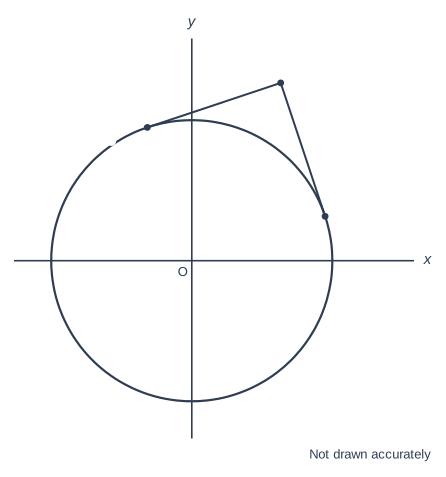
The diagram shows the circle \(x^2 + y^2 = 10\)
A \((-1, 3)\) and B \((3, 1)\) are points on the circle.
The tangents to the circle at A and B meet at T.

Work out the coordinates of T.
Give the coordinates, typed as (x, y).

A sketch on a pair of axes (x across, y up) with no scale marked, the axes crossing at the origin O. It is marked "Not drawn accurately". The circle labelled "x² + y² = 10" is a circle centred at (0, 0); its radius cannot be read off, as the sketch has no scale. Point A is marked with a dot at (−1, 3), labelled "A(−1, 3)". Point B is marked with a dot at (3, 1), labelled "B(3, 1)". Point T is marked with a dot; its coordinates cannot be read off, as the sketch has no scale. A straight line segment joins A (−1, 3) to T. A straight line segment joins B (3, 1) to T.

Model answer

Gradient of OA \(= -3\), so the tangent at A has gradient \(\dfrac{1}{3}\)
Tangent at A: \(y - 3 = \dfrac{1}{3}(x + 1)\), so \(y = \dfrac{x + 10}{3}\)
Gradient of OB \(= \dfrac{1}{3}\), so the tangent at B has gradient \(-3\)
Tangent at B: \(y - 1 = -3(x - 3)\), so \(y = -3x + 10\)
At T: \(\dfrac{x + 10}{3} = -3x + 10\)
\(x + 10 = -9x + 30\)
\(10x = 20\), so \(x = 2\) and \(y = -3(2) + 10 = 4\)
T is \((2, 4)\)

Explanation

Each tangent is perpendicular to its radius, so find both tangent equations and solve them simultaneously. Here OA and OB are themselves perpendicular, so OATB is a square and T can be checked by adding the steps: (−1, 3) + (3, 1) = (2, 4). Common errors are sign slips in the tangent at A and solving with one tangent and one radius.

Mark scheme
  1. 1 mark

    M1 for the gradients of both tangents, \(\dfrac{1}{3}\) at A and \(-3\) at B

    from the radii OA (gradient \(-3\)) and OB (gradient \(\dfrac{1}{3}\))

  2. 1 mark

    M1 for the tangent at A, eg \(y - 3 = \dfrac{1}{3}(x + 1)\)

    ft their gradient. oe eg \(x - 3y = -10\)

  3. 1 mark

    M1 for the tangent at B, eg \(y - 1 = -3(x - 3)\)

    ft their gradient. oe eg \(y = -3x + 10\)

  4. 1 mark

    M1dep for solving their two tangent equations together, eg \(\dfrac{x + 10}{3} = -3x + 10\)

    dep on the second and third M marks

  5. 1 mark

    A1 for \((2, 4)\)

    accept x = 2, y = 4. Alternative method: OA and OB are perpendicular (gradients \(-3\) and \(\dfrac{1}{3}\)) and equal, so OATB is a square and T \(= (-1 + 3, 3 + 1)\); this scores full marks only with the perpendicular radii shown. A fully correct answer with no working scores full marks.

Ready to try the rest? Every answer you write is marked against the mark scheme, so you can see exactly where the marks are.

Study Helper Hints first, answers after you try

Stuck on this one? Ask for a hint and I’ll point you in the right direction, without giving the answer away. Once you’ve checked your answer, I’ll show you how the marks are awarded.