
Level:
Correct: 0
Incorrect: 0
Marks: 0/0
Exam Practice
Course:
Topics:
AQA Level 2 Further Maths (Non-calculator) Smart practice A mixed round aimed at your weak spots
Unit 1
Number
Unit 2
Algebra
Unit 3
Coordinate Geometry (2 dimensions only)
Unit 4
Calculus
Unit 5
Matrix Transformations
Unit 6
Geometry
Avg
score:
–
Topics
done:
0/43

Second derivatives, and maxima and minima on a curve

Practise 18 exam-style questions on Second derivatives, and maxima and minima on a curve for AQA Level 2 Further Maths (Non-calculator). Write your answer as you would in the exam and get it marked in seconds against the mark scheme, point by point, with the Study Helper on hand if you get stuck.

  • 18 questions
  • 1–6 marks each
  • Instant marking
  • No sign-up needed
18 questions, marked as you go

Sample questions with model answers

Here are 4 of the questions in this topic, each with a model answer, an explanation of why it earns the marks and the mark scheme an examiner would use.

Question 1

2 marks

The curve \(y = 2x^{3} - 3x^{2} - 2\) has a stationary point at \((1, -3)\)

Use \(\dfrac{d^2y}{dx^2}\) to determine the nature of this stationary point.
You must show your working.

Model answer

\(\dfrac{dy}{dx} = 6x^{2} - 6x\)
\(\dfrac{d^2y}{dx^2} = 12x - 6\)
At \(x = 1\): \(\dfrac{d^2y}{dx^2} = 12 - 6 = 6\)
\(6 > 0\), so \((1, -3)\) is a minimum point.

Explanation

Differentiate twice and substitute the x-coordinate of the stationary point. A positive second derivative means the gradient is increasing through zero, so the point is a minimum; a negative one means a maximum. Remember to substitute \(x = 1\), not the y-coordinate \(-3\).

Mark scheme
  1. 1 mark

    M1 for \(\dfrac{d^2y}{dx^2} = 12x - 6\)

    from \(\dfrac{dy}{dx} = 6x^{2} - 6x\); \(12x - 6\) with no other terms

  2. 1 mark

    A1 for \(12(1) - 6 = 6 > 0\), so minimum

    or 'positive, so minimum'; any evaluation of the second derivative must be correct. Accept min or local minimum. Considering only the sign of \(\dfrac{dy}{dx}\) either side of \(x = 1\) does not answer the question as set: M0A0. Correct answer with no working scores 0.
Question 2

3 marks

The curve \(y = x^{3} - 6x^{2} + 9x + 2\) has a stationary point at \((3, 2)\)

By considering the gradient of the curve either side of \(x = 3\), determine the nature of this stationary point.

Model answer

\(\dfrac{dy}{dx} = 3x^{2} - 12x + 9 = 3(x - 1)(x - 3)\)
The stationary points are at \(x = 1\) and \(x = 3\), so test values between them and beyond 3
At \(x = 2\): \(\dfrac{dy}{dx} = 12 - 24 + 9 = -3\) (negative)
At \(x = 4\): \(\dfrac{dy}{dx} = 48 - 48 + 9 = 9\) (positive)
The gradient goes from negative to positive, so \((3, 2)\) is a minimum point.

Explanation

At a minimum the curve goes down then up, so the gradient changes from negative to positive; at a maximum it changes from positive to negative. Choose test values close to \(x = 3\), with no other stationary point between them and 3. Using \(x = 0\) here would cross the stationary point at \(x = 1\) and give the wrong sign.

Mark scheme
  1. 1 mark

    M1 for \(\dfrac{dy}{dx} = 3x^{2} - 12x + 9\)

  2. 1 mark

    M1dep for the gradient (or its sign) at a value of x between 1 and 3 and at a value of x greater than 3

    eg at \(x = 2\): \(-3\), and at \(x = 4\): 9. The value to the left must be between 1 and 3, because there is another stationary point at \(x = 1\): eg \(x = 0\) (gradient 9) is not valid.

  3. 1 mark

    A1 for gradient negative then positive, so minimum

    both gradients correct. Using \(\dfrac{d^2y}{dx^2}\) instead of the gradient either side does not answer the question as set: that test scores no marks (max M1, for \(\dfrac{dy}{dx}\)). A fully correct answer with no working scores 0, as the method is named.

Question 3

4 marks

A curve has equation \(y = 12x - x^{3}\)

Work out the coordinates of the maximum point on the curve.
You must show that it is a maximum.

Give the coordinates, typed as (x, y).

Model answer

\(\dfrac{dy}{dx} = 12 - 3x^{2}\)
At stationary points: \(12 - 3x^{2} = 0\), so \(x^{2} = 4\) and \(x = 2\) or \(x = -2\)
\(\dfrac{d^2y}{dx^2} = -6x\)
At \(x = 2\): \(\dfrac{d^2y}{dx^2} = -12 < 0\), so maximum
(At \(x = -2\): \(\dfrac{d^2y}{dx^2} = 12 > 0\), so that point is a minimum)
When \(x = 2\): \(y = 24 - 8 = 16\)
The maximum point is \((2, 16)\)

Explanation

Find both stationary points from \(\dfrac{dy}{dx} = 0\), then use the second derivative (or the gradient either side) to decide which one is the maximum. A negative second derivative means a maximum. Students sometimes find only \(x = 2\) and assume it is the maximum without showing it.

Mark scheme
  1. 1 mark

    M1 for \(\dfrac{dy}{dx} = 12 - 3x^{2}\)

  2. 1 mark

    M1dep for \(12 - 3x^{2} = 0\) leading to \(x = 2\) or \(x = -2\)

    oe eg \(x^{2} = 4\)

  3. 1 mark

    A1 for \((2, 16)\)

    accept x = 2, y = 16

  4. 1 mark

    A1 for \(\dfrac{d^2y}{dx^2} = -6x = -12 < 0\) at \(x = 2\), so maximum

    or the gradient either side, eg 9 at \(x = 1\) and \(-15\) at \(x = 3\). \((-2, -16)\) is the minimum point: giving it as the answer, or giving both points without identifying the maximum, scores max M2. The question asks students to show that the point is a maximum, so this A1 needs a correct test to be seen: \((2, 16)\) with no working scores M1M1A1A0.

Question 4

5 marks

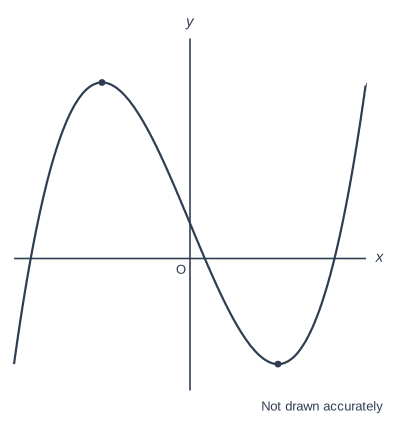
Here is a sketch of the curve \(y = x^{3} + px + q\), where \(p\) and \(q\) are constants.
The curve has turning points at \((-2, 20)\) and at T.

Work out the values of \(p\) and \(q\).
Work out the coordinates of T.

Give the coordinates, typed as (x, y).

A sketch on a pair of axes (x across, y up) with no scale marked, the axes crossing at the origin O. It is marked "Not drawn accurately". The curve labelled "y = x³ + px + q" is an S-shaped cubic curve, rising from bottom left to top right: it meets the x-axis 3 times; these points cannot be read off, as the sketch has no scale; it crosses the y-axis at a point that cannot be read off, as the sketch has no scale; it has turning points (maximum and minimum), which cannot be read off, as the sketch has no scale. A dot at (−2, 20) is labelled "(−2, 20)". Point T is marked with a dot; its coordinates cannot be read off, as the sketch has no scale.

Model answer

\(\dfrac{dy}{dx} = 3x^{2} + p\)
At the turning point \(x = -2\): \(12 + p = 0\), so \(p = -12\)
\((-2, 20)\) is on the curve: \(-8 + 24 + q = 20\), so \(q = 4\)
\(\dfrac{dy}{dx} = 3x^{2} - 12 = 0\) gives \(x = -2\) or \(x = 2\)
When \(x = 2\): \(y = 8 - 24 + 4 = -12\)
T is \((2, -12)\)

Explanation

A turning point gives two facts: the gradient is zero there (giving p) and the point lies on the curve (giving q). Then solve \(\dfrac{dy}{dx} = 0\) again for the other turning point. Common errors are using \((-2, 20)\) in \(\dfrac{dy}{dx}\) as if 20 were the gradient, and sign slips with \((-2)^{3} = -8\) and \(p \times (-2)\).

Mark scheme
  1. 1 mark

    M1 for \(3x^{2} + p = 0\) when \(x = -2\)

    oe eg \(3(-2)^{2} + p = 0\) or \(12 + p = 0\)

  2. 1 mark

    A1 for \(p = -12\)

  3. 1 mark

    M1 for \(-8 - 2p + q = 20\)

    substituting \((-2, 20)\) into the equation of the curve; may use their p, eg \(-8 + 24 + q = 20\)

  4. 1 mark

    A1 for \(q = 4\)

  5. 1 mark

    A1 for T \((2, -12)\)

    from \(3x^{2} - 12 = 0\), \(x = 2\); accept x = 2, y = -12. All answers correct with no working scores full marks.

Ready to try the rest? Every answer you write is marked against the mark scheme, so you can see exactly where the marks are.

Study Helper Hints first, answers after you try

Stuck on this one? Ask for a hint and I’ll point you in the right direction, without giving the answer away. Once you’ve checked your answer, I’ll show you how the marks are awarded.