Area, volume, angle properties and circle theorems
Practise 17 exam-style questions on Area, volume, angle properties and circle theorems for AQA Level 2 Further Maths (Non-calculator). Write your answer as you would in the exam and get it marked in seconds against the mark scheme, point by point, with the Study Helper on hand if you get stuck.
17 questions
1–6 marks each
Instant marking
No sign-up needed
17 questions, marked as you go
Sample questions with model answers
Here are 4 of the questions in this topic, each with a model answer, an explanation of why it earns the marks and the mark scheme an examiner would use.
Question 1
2 marks
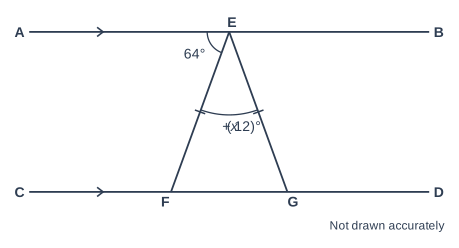
In the diagram, AB is parallel to CD. E is a point on AB. F and G are points on CD. \(EF = EG\)
Alternate angles between the parallel lines give angle EFG = 64°, and because \(EF = EG\) the triangle is isosceles, so angle EGF is also 64°. The angles of the triangle add to 180°, so angle FEG = 52° and \(x = 40\). Some students give 52, the size of the angle, instead of the value of \(x\).
Mark scheme
1 mark
M1 for angle EFG \(= 64^\circ\) or angle EGF \(= 64^\circ\) or \(180 - 2 \times 64\) (\(= 52\)) oe
Angles may be seen on the diagram. Angle EFG = 64° by alternate angles; angle EGF = 64° as the base angles of an isosceles triangle are equal. Also implied by \(x + 12 = 52\).
1 mark
A1 for \(x = 40\)
A fully correct answer with no working scores full marks. 52 on its own (the size of angle FEG, not \(x\)) is M1A0. \(x = 104\) from \(x + 12 = 180 - 64\) is M0A0.
Question 2
3 marks
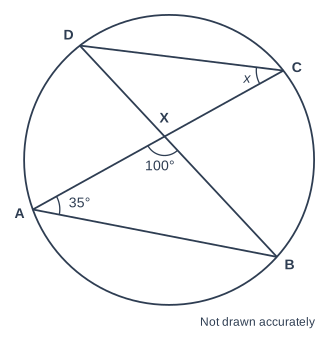
A, B, C and D are points on a circle. The chords AC and BD meet at X. Angle BAC = 35° Angle AXB = 100°
Work out the value of \(x\).
Model answer
Angle BDC = angle BAC = 35° (angles in the same segment) Angle DXC = angle AXB = 100° (vertically opposite angles) In triangle DXC: \(x = 180 - 100 - 35 = 45\) (angles in a triangle)
Explanation
Angles BAC and BDC both stand on the arc BC, so they are equal (angles in the same segment). Vertically opposite angles give angle DXC = 100°, and the triangle DXC then gives \(x = 45\). Another route is to find angle ABD = 45° in triangle ABX and use the same-segment theorem on arc AD.
Mark scheme
1 mark
B1 for angle BDC \(= 35^\circ\) or angle ABD \(=\) angle ACD
Angles in the same segment are equal. May be seen on the diagram.
1 mark
M1 for \(180 - 100 - 35\) oe
Angle sum of triangle DXC (with angle DXC = 100° as vertically opposite angles) or of triangle ABX (angle ABX = 45°). Implied by 45 seen.
1 mark
A1 for \(x = 45\)
A fully correct answer with no working scores full marks. 35 (assuming angle ACD = angle BAC) is B0M0A0.
Question 3
3 marks
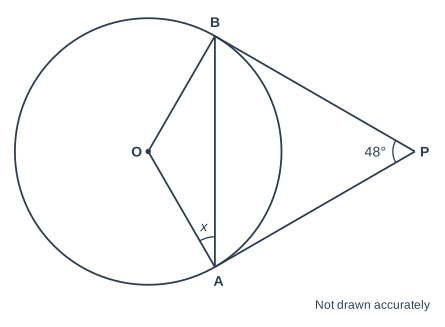
A and B are points on a circle, centre O. PA and PB are tangents to the circle. Angle APB = 48°
Work out the value of \(x\).
Model answer
Angle OAP = angle OBP = 90° (tangent is perpendicular to the radius) Angle AOB = \(360 - 90 - 90 - 48 = 132^\circ\) (angles in a quadrilateral) OA = OB (radii), so triangle OAB is isosceles \(x = (180 - 132) \div 2 = 24\)
Explanation
The radius meets each tangent at 90°, so the quadrilateral OAPB gives angle AOB = 132°. Triangle OAB is isosceles because OA and OB are radii, so each base angle is \(\dfrac{180 - 132}{2} = 24^\circ\). A quick check: angle OAB + angle PAB = 24 + 66 = 90°.
Mark scheme
1 mark
B1 for angle OAP \(= 90^\circ\) or angle OBP \(= 90^\circ\) or angle PAB \(= 66^\circ\)
The tangent is perpendicular to the radius; or triangle PAB is isosceles because tangents from a point are equal (angle PAB = (180 − 48) ÷ 2). May be seen on the diagram.
1 mark
M1 for \(360 - 90 - 90 - 48\) (\(= 132\)) or \(90 - 66\) oe
Angle AOB = 132° from the angles of quadrilateral OAPB, then \((180 - 132) \div 2\); or angle OAB = angle OAP − angle PAB. Implied by 24.
1 mark
A1 for \(x = 24\)
A fully correct answer with no working scores full marks. 132 (angle AOB) on the answer line from \(360 - 90 - 90 - 48\) is B1M1A0; 66 (angle PAB) on the answer line is B1M0A0, unless 24 is also clearly selected.
Question 4
4 marks
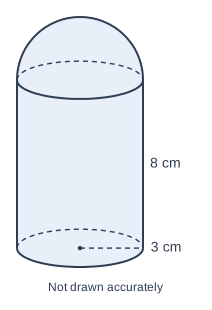
The diagram shows a solid made from a cylinder and a hemisphere. The cylinder and the hemisphere both have radius 3 cm. The height of the cylinder is 8 cm.
Surface area of a sphere \(= 4\pi r^2\)
Work out the total surface area of the solid. Give your answer in terms of \(\pi\).
Type π as pi.
Model answer
Curved surface of hemisphere \(= \dfrac{1}{2} \times 4\pi \times 3^2 = 18\pi\) Curved surface of cylinder \(= 2\pi \times 3 \times 8 = 48\pi\) Base of cylinder \(= \pi \times 3^2 = 9\pi\) Total surface area \(= 18\pi + 48\pi + 9\pi = 75\pi\) cm²
Explanation
The surface of the solid is made of three parts: the curved half of a sphere (half of \(4\pi r^2\)), the curved surface of the cylinder (\(2\pi r h\)) and the circular base. The circle where the hemisphere meets the cylinder is inside the solid, so it is not part of the surface; including it, or using the whole sphere's area, are the common errors.
Mark scheme
1 mark
M1 for \(\dfrac{1}{2} \times 4 \times \pi \times 3^2\) or \(18\pi\)
Curved surface of the hemisphere
1 mark
M1 for \(2 \times \pi \times 3 \times 8\) or \(48\pi\)
Curved surface of the cylinder. oe eg \(\pi \times 6 \times 8\)
1 mark
M1 for \(\pi \times 3^2\) or \(9\pi\)
The circular base of the cylinder (one circle only)
1 mark
A1 for \(75\pi\)
Needs all three M marks. Accept 75pi. A fully correct answer with no working scores full marks. \(84\pi\) (adding a second circle where the hemisphere joins the cylinder) is M3A0. \(93\pi\) (using \(4\pi r^2\) for the hemisphere) is M0M1M1A0. A decimal answer only (235.6...) is A0.
Ready to try the rest? Every answer you write is marked against the mark scheme, so you can see exactly where the marks are.
Ctrl + Enter to check
Study HelperHints first, answers after you try
Stuck on this one? Ask for a hint and I’ll point you in the right direction, without giving the answer away. Once you’ve checked your answer, I’ll show you how the marks are awarded.