
Level:
Correct: 0
Incorrect: 0
Marks: 0/0
Exam Practice
Course:
Topics:
OCR GCSE Biology (Paper 1) Smart practice A mixed round aimed at your weak spots
Avg
score:
–
Topics
done:
0/29

The structure and function of the brain

Practise 10 exam-style questions on The structure and function of the brain for OCR GCSE Biology (Paper 1). Write your answer as you would in the exam and get it marked in seconds against the mark scheme, point by point, with the Study Helper on hand if you get stuck.

  • 10 questions
  • 1–3 marks each
  • Instant marking
  • No sign-up needed
10 questions, marked as you go

Sample questions with model answers

Here are 4 of the questions in this topic, each with a model answer, an explanation of why it earns the marks and the mark scheme an examiner would use.

Question 1

1 mark

Which two activities are both controlled mainly by the cerebrum?

Choose your answer.

  • A breathing and planning a journey
  • B keeping your balance and breathing
  • C keeping your balance and learning the words of a song
  • D learning the words of a song and planning a journey

Model answer

D (learning the words of a song and planning a journey)

Explanation

The cerebrum controls conscious activities such as thinking, planning, learning and memory. Balance and the coordination of movement are controlled by the cerebellum, and automatic activities such as breathing are controlled by the medulla.

Mark scheme
  1. 1 mark

    D / learning the words of a song and planning a journey

    The only correct answer is D: learning (and remembering) the words of a song and planning a journey are conscious activities (learning, memory and thinking) controlled by the cerebrum. A is not correct because breathing is controlled by the medulla; B is not correct because balance is controlled by the cerebellum and breathing by the medulla; C is not correct because keeping your balance is controlled by the cerebellum. ALLOW the letter or the option. If more than one option is given, do not award the mark.
Question 2

2 marks

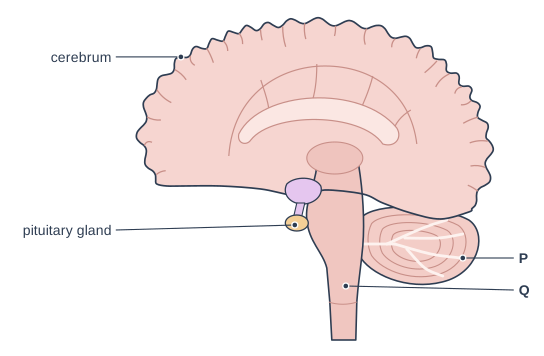
The diagram shows a section through the middle of a human brain.

Name the parts labelled P and Q.

Diagram of a section through the middle of the human brain, seen from the side (the front of the brain is on the left). A large, deeply folded region fills the top. Underneath it at the back is a smaller rounded region with fine folds. A thick stalk runs down from the middle and narrows into a cord at the bottom. At the base of the brain, in front of the stalk, is a small shaded region, with a pea-sized structure hanging below it on a short stalk. The label "cerebrum" points to the folded outer layer of the large region that fills the top of the brain; label P points to the smaller rounded region with fine folds at the back, underneath the large region; label Q points to the lowest part of the stalk running down from the brain, just above where it narrows into the cord; the label "pituitary gland" points to the pea-sized structure hanging on a short stalk below the base of the brain.

Model answer

P: cerebellum
Q: medulla

Explanation

The cerebellum is the smaller, wrinkled part at the back of the brain, underneath the cerebrum. The medulla is at the bottom of the brain, where the brain joins the spinal cord. Be careful not to mix up the names cerebellum and cerebrum.

Mark scheme
  1. 1 mark

    P: cerebellum

    ALLOW a misspelling that is clearly cerebellum (for example 'cerebelum'), but not one that could be cerebrum. DO NOT ALLOW cerebrum / cerebral cortex / brain stem.

  2. 1 mark

    Q: medulla

    ALLOW medulla oblongata. DO NOT ALLOW brain stem on its own / spinal cord / cerebellum / hypothalamus.

Question 3

2 marks

Compared with the rest of the brain, the cerebrum of a human is much larger than the cerebrum of a rabbit.

Humans can speak, read and solve difficult problems. Rabbits cannot.

Use your knowledge of the cerebrum to suggest why.

Model answer

The cerebrum controls conscious activities such as language, thinking, solving problems and memory. A human has a much larger cerebrum compared with the rest of the brain, so it has many more neurones for these activities. This allows humans to carry out complex thinking and to use language, which rabbits cannot do.

Explanation

Speaking, reading and solving problems are conscious activities, controlled by the cerebrum. The other parts of the brain (such as the medulla and cerebellum) do similar jobs in both animals. So the large difference in the size of the cerebrum fits the large difference in what humans and rabbits can do.

Mark scheme
  1. 1 mark

    the cerebrum controls conscious activities such as language / thinking / problem solving / memory

    ALLOW the cerebrum controls intelligence / reasoning / learning. DO NOT ALLOW the cerebrum controls balance / coordination / heart rate / breathing.

  2. 1 mark

    a (relatively) larger cerebrum has more neurones / more brain tissue for these activities, so humans can carry out more complex thinking / use language

    ALLOW a bigger cerebrum can process more information / has a larger area of cortex. The idea that more cerebrum allows more complex (conscious) activity is needed for this mark. IGNORE humans have bigger brains, with no reference to the cerebrum.

Question 4

3 marks

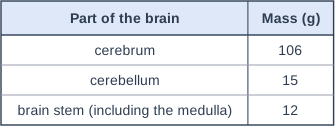
A student dissected a sheep's brain. The student separated the brain into three parts and found the mass of each part.

The table shows the student's results.

The student says: 'The cerebrum made up more than three-quarters of the total mass of this brain.'

Use calculations to decide whether the student is right.

Table with columns "Part of the brain", "Mass (g)". Part of the brain: cerebrum; Mass (g): 106 | Part of the brain: cerebellum; Mass (g): 15 | Part of the brain: brain stem (including the medulla); Mass (g): 12.

Model answer

Total mass = 106 + 15 + 12 = 133 g
Percentage of the mass that is cerebrum = 106 ÷ 133 × 100 = 79.7 %
Three-quarters is 75 %, and 79.7 % is more than 75 %, so the student is right.

Explanation

First add the three masses to find the total mass of the brain (133 g). Then work out the percentage that is cerebrum (106 ÷ 133 × 100 = 79.7 %) and compare it with three-quarters (75 %); comparing 106 g with three-quarters of 133 g (99.75 g) works just as well. A decision with no calculation scores no marks, because the question asks you to use calculations.

Mark scheme
  1. 1 mark

    total mass = 106 + 15 + 12 = 133 (g) / mass of the other two parts = 15 + 12 = 27 (g)

    A decision (right or wrong) with no calculation scores 0. ALLOW either first step.

  2. 1 mark

    a correct value to compare: 106 ÷ 133 × 100 = 79.7 (%) / 106 ÷ 133 = 0.797 / three-quarters of 133 = 0.75 × 133 = 99.75 (g) / one quarter of 133 = 33.25 (g) / 27 × 3 = 81 (g) / 106 ÷ 27 = 3.9

    ALLOW 79.7 % rounded to 79.70 %, 79.699 % or 80 %. ALLOW 0.797 rounded to 0.80 or 0.8. ALLOW 99.75 g rounded to 99.8 g or 100 g. ALLOW 3.9 written as 3.93. ALLOW ECF from a wrong total mass in point 1.

  3. 1 mark

    decision: the student is right, with a correct comparison: 79.7 % is more than 75 % / 0.797 is more than 0.75 / 106 g is more than 99.75 g / 27 g is less than 33.25 g / 106 g is more than 81 g / 3.9 is more than 3

    This mark depends on point 2 (awarded directly or by ECF from a wrong total mass). The comparison must be stated or clearly shown, not just the word 'right' or 'yes'. DO NOT ALLOW 'the student is wrong' from correct values.

Ready to try the rest? Every answer you write is marked against the mark scheme, so you can see exactly where the marks are.

Study Helper Hints first, answers after you try

Stuck on this one? Ask for a hint and I’ll point you in the right direction, without giving the answer away. Once you’ve checked your answer, I’ll show you how the marks are awarded.