Level:
Correct: 0
Incorrect: 0
Marks: 0/0
Exam Practice
Course:
Topics:
OCR GCSE Biology (Paper 1) Smart practice A mixed round aimed at your weak spots
Avg
score:
–
Topics
done:
0/29

Surface area to volume ratio and exchange

Practise 15 exam-style questions on Surface area to volume ratio and exchange for OCR GCSE Biology (Paper 1). Write your answer as you would in the exam and get it marked in seconds against the mark scheme, point by point, with the Study Helper on hand if you get stuck.

  • 15 questions
  • 1–6 marks each
  • Instant marking
  • No sign-up needed
15 questions, marked as you go

Sample questions with model answers

Here are 4 of the questions in this topic, each with a model answer, an explanation of why it earns the marks and the mark scheme an examiner would use.

Question 1

1 mark

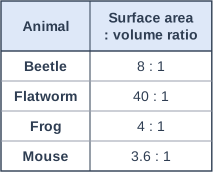
The table shows the surface area : volume ratios of four animals. All the ratios were worked out from measurements in centimetres.

Which animal is most likely to get all the oxygen it needs by diffusion through its body surface?

Choose your answer.

  • A beetle
  • B flatworm
  • C frog
  • D mouse
Table with columns "Animal", "Surface area : volume ratio". Animal: Beetle; Surface area : volume ratio: 8 : 1 | Animal: Flatworm; Surface area : volume ratio: 40 : 1 | Animal: Frog; Surface area : volume ratio: 4 : 1 | Animal: Mouse; Surface area : volume ratio: 3.6 : 1.

Model answer

B

Explanation

The larger an organism's surface area : volume ratio, the more surface it has for each unit of volume and the shorter the distance from the surface to its cells, so the more likely it is that diffusion through the body surface can supply all its cells. Animals with small ratios, such as the frog and the mouse, need specialised exchange surfaces (lungs) and a transport system.

Mark scheme
  1. 1 mark

    B / flatworm

    The only correct answer is B: the flatworm has by far the largest surface area : volume ratio (40 : 1), so it has a lot of surface for its volume and its cells are close to the surface, so diffusion through its body surface can supply enough oxygen. A is not correct because the beetle's ratio (8 : 1) is much smaller; insects take in air through small holes and a system of tubes. C is not correct because the frog's ratio (4 : 1) is small; it has lungs and a heart, although some oxygen enters through its skin. D is not correct because the mouse has the smallest ratio (3.6 : 1), so it needs lungs and a blood system. ALLOW the letter or the option. If more than one option is given, do not award the mark.

Question 2

2 marks

Some people keep goldfish in a tank with living water plants. The tank has a light above it.

The goldfish and the water plants take substances from the water and give substances out into the water.

Explain how the water plants help the goldfish when the light is on.

Model answer

When the light is on, the water plants photosynthesise. They give out oxygen into the water, which the goldfish take in through their gills for aerobic respiration. The plants also take in the carbon dioxide that the goldfish give out as a waste product of respiration, so it does not build up in the water.

Explanation

Organisms exchange substances with their surroundings to meet their needs. The goldfish need oxygen for respiration and must get rid of carbon dioxide; in the light, the plants need carbon dioxide for photosynthesis and give out oxygen. A full answer links what the plants give out to what the fish need, or what the fish give out to what the plants need.

Mark scheme
  1. 1 mark

    the plants photosynthesise (in the light) and give out oxygen, which the goldfish take in for (aerobic) respiration

    Max 2 from the three marking points. ALLOW the plants add oxygen to the water for the fish.

  2. 1 mark

    the plants take in carbon dioxide (for photosynthesis), which the goldfish give out (from respiration), so it does not build up in the water

    ALLOW the plants remove the carbon dioxide (waste) made by the fish.

  3. 1 mark

    the plants give out more oxygen than they use (in the light) / photosynthesis is faster than respiration (in the plants in the light)

    AW. IGNORE the plants give the fish food / shelter.

Question 3

2 marks

A student cuts agar cubes with sides of 0.5 cm, 1.0 cm and 2.0 cm, using a scalpel and a ruler marked in millimetres. The student times how long each cube takes to become colourless in acid, and repeats each size three times.

Compared with the size of their mean time, the repeat results for the 0.5 cm cubes are the most spread out.

Suggest why.

Model answer

A 0.5 cm cube is only 5 mm across, so cutting it just 1 mm too big or too small is a large fraction of its size. The small cubes are therefore not all the same size, and their surface area : volume ratios differ, so their times vary more between repeats.

Explanation

The same small mistake matters more when the measurement is small: 1 mm is 20% of a 5 mm side but only 5% of a 20 mm side. The short times for the smallest cubes also make the stopwatch reaction time a bigger share of each reading. Either idea, linked to why the results spread out, gains credit.

Mark scheme
  1. 1 mark

    a cutting error of 1 mm is a large fraction of a 0.5 cm (5 mm) side / small cubes are hard to cut to exactly the same size

    Max 2 from the three marking points. ALLOW 1 mm is 20% of the side of a 0.5 cm cube. IGNORE human error on its own.

  2. 1 mark

    so the size / surface area : volume ratio of the 0.5 cm cubes varies (more) between repeats

    ALLOW so the small cubes are not all the same size, so their times differ.

  3. 1 mark

    the 0.5 cm cubes become colourless in a short time, so the error in starting and stopping the stopwatch (reaction time) is a large fraction of the time

    ALLOW short times are harder to measure accurately (with a stopwatch). ALLOW it is hard to judge exactly when a small cube becomes colourless.

Question 4

4 marks

A student makes a model of a flat organism from a block of agar jelly. The block is 2 cm long, 1 cm wide and 5 mm thick.

Calculate the surface area : volume ratio of the block. Work in centimetres.

Model answer

5 mm = 0.5 cm
Surface area = (2 × 2 × 1) + (2 × 2 × 0.5) + (2 × 1 × 0.5) = 4 + 2 + 1 = 7 cm²
Volume = 2 × 1 × 0.5 = 1 cm³
Surface area : volume ratio = 7 ÷ 1 = 7 : 1

Explanation

First change 5 mm into 0.5 cm so that all three lengths are in the same unit. A cuboid has three pairs of identical faces, so work out the area of each pair and add them; the volume is length × width × thickness. A common slip is to use 5 instead of 0.5, which gives 3.4 : 1 and loses the conversion mark.

Mark scheme
  1. 1 mark

    unit conversion: 5 mm = 0.5 cm; or a correct final answer of 7 : 1 with no working

    An answer of 7 : 1 (or 7) with no working scores 4 marks. ALLOW 3.4 : 1 for 3 marks (5 mm not converted to 0.5 cm: surface area = 34, volume = 10). ALLOW 0.7 : 1 for 3 marks (worked in millimetres instead of centimetres: 700 mm² ÷ 1000 mm³).

  2. 1 mark

    surface area = (2 × 2 × 1) + (2 × 2 × 0.5) + (2 × 1 × 0.5) = 7 (cm²); or a correct final answer of 7 : 1 with no working

    ALLOW 4 + 2 + 1 = 7. ALLOW ECF from a wrong conversion of 5 mm.

  3. 1 mark

    volume = 2 × 1 × 0.5 = 1 (cm³); or a correct final answer of 7 : 1 with no working

    ALLOW ECF from a wrong conversion of 5 mm.

  4. 1 mark

    (ratio =) 7 : 1

    ALLOW 7 without : 1. ALLOW ECF: a wrong surface area divided by a wrong volume, correctly worked out. DO NOT ALLOW 1 : 7 or 0.14 : 1 (the ratio the wrong way round).

Ready to try the rest? Every answer you write is marked against the mark scheme, so you can see exactly where the marks are.

Study Helper Hints first, answers after you try

Stuck on this one? Ask for a hint and I’ll point you in the right direction, without giving the answer away. Once you’ve checked your answer, I’ll show you how the marks are awarded.