Level:
Correct: 0
Incorrect: 0
Marks: 0/0
Exam Practice
Course:
Topics:
OCR GCSE Biology (Paper 1) Smart practice A mixed round aimed at your weak spots
Avg
score:
–
Topics
done:
0/29

Enzymes

Practise 18 exam-style questions on Enzymes for OCR GCSE Biology (Paper 1). Write your answer as you would in the exam and get it marked in seconds against the mark scheme, point by point, with the Study Helper on hand if you get stuck.

  • 18 questions
  • 1–6 marks each
  • Instant marking
  • No sign-up needed
18 questions, marked as you go

Sample questions with model answers

Here are 4 of the questions in this topic, each with a model answer, an explanation of why it earns the marks and the mark scheme an examiner would use.

Question 1

1 mark

Plant tissues contain catalase. This enzyme speeds up the breakdown of hydrogen peroxide, releasing oxygen gas.

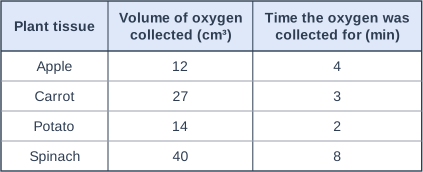
Four groups of students each tested the same mass of a different plant tissue in the same volume of hydrogen peroxide solution. Each group collected the oxygen for a different length of time.

The table shows their results.

Which tissue gave the fastest mean rate of oxygen production?

Choose your answer.

  • A Apple
  • B Carrot
  • C Potato
  • D Spinach
Table with columns "Plant tissue", "Volume of oxygen collected (cm³)", "Time the oxygen was collected for (min)". Plant tissue: Apple; Volume of oxygen collected (cm³): 12; Time the oxygen was collected for (min): 4 | Plant tissue: Carrot; Volume of oxygen collected (cm³): 27; Time the oxygen was collected for (min): 3 | Plant tissue: Potato; Volume of oxygen collected (cm³): 14; Time the oxygen was collected for (min): 2 | Plant tissue: Spinach; Volume of oxygen collected (cm³): 40; Time the oxygen was collected for (min): 8.

Model answer

B - Carrot (27 ÷ 3 = 9.0 cm³/min)

Explanation

To compare rates when the times are different, work out each mean rate as volume ÷ time: apple 3.0, carrot 9.0, potato 7.0 and spinach 5.0 cm³/min. The largest volume (spinach) or the shortest time (potato) does not on its own show the fastest rate.

Mark scheme
  1. 1 mark

    B / Carrot

    The only correct answer is B: mean rate = volume ÷ time, and carrot gives 27 ÷ 3 = 9.0 cm³/min. A is not correct because apple gives 12 ÷ 4 = 3.0 cm³/min; C is not correct because potato has the shortest time but gives only 14 ÷ 2 = 7.0 cm³/min; D is not correct because spinach gives the largest volume but over the longest time (40 ÷ 8 = 5.0 cm³/min). ALLOW the letter or the option. If more than one option is given, do not award the mark.
Question 2

1 mark

When a rice grain starts to grow, a small amount of the enzyme amylase in the grain breaks down a large store of starch.

Give the reason why only a small amount of amylase is needed.

Model answer

Amylase is not used up in the reaction, so each amylase molecule can break down starch again and again.

Explanation

Enzymes are catalysts: they are not used up or changed by the reactions they speed up. When the products leave the active site, the same enzyme molecule can bind another substrate molecule, so a little enzyme can break down a lot of substrate.

Mark scheme
  1. 1 mark

    (amylase / the enzyme) is not used up (in the reaction) / is not changed by the reaction / can be used again (and again)

    ALLOW the active site is free again (to take another substrate molecule) after the products leave. ALLOW it is a (biological) catalyst. IGNORE amylase works quickly / speeds up the reaction (on its own). DO NOT ALLOW amylase is a product of the reaction / amylase makes more amylase.

Question 3

2 marks

Dairies make lactose-free milk using the enzyme lactase. Lactase breaks down lactose, the sugar in milk, into glucose and galactose.

In a test, some lactase produced 18 mg of glucose in 40 seconds.

Calculate the mean rate of glucose production in mg/min.

Model answer

rate = 18 ÷ 40 = 0.45 mg per second
rate per minute = 0.45 × 60 = 27 mg/min

Explanation

Divide the mass of glucose by the time to get the rate, then change the unit: there are 60 seconds in a minute, so a rate per second is multiplied by 60 to give a rate per minute. You could also change 40 seconds into 0.67 minutes first and divide 18 by 0.67.

Mark scheme
  1. 1 mark

    18 ÷ 40 (= 0.45 mg per second) / 40 s = 0.67 minutes (40 ÷ 60); or a correct final answer of 27 mg/min (or any value from 26.8 to 27 mg/min) with no working

    An answer of 27 mg/min (or any value from 26.8 to 27 mg/min, such as 26.9 mg/min from 18 ÷ 0.67) with no working scores 2 marks. ALLOW 0.45 mg/s (seconds not converted to minutes: 18 ÷ 40) for 1 mark. ALLOW 18 × 60 ÷ 40 for this mark. 2.2 (40 ÷ 18, the wrong way round) scores 0.

  2. 1 mark

    evaluation: 27 (mg/min) / any value from 26.8 to 27 (mg/min)

    ALLOW 26.9 or 26.87 (from rounding 40 s to 0.67 minutes). IGNORE units.

Question 4

3 marks

Protein from tears can build up on contact lenses. Some cleaning tablets for contact lenses contain a protease enzyme, which breaks down the protein.

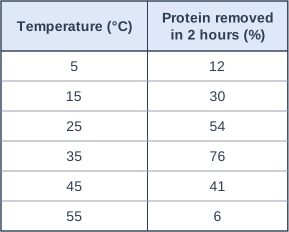
A scientist soaked lenses in cleaning solution at different temperatures. She measured the percentage of the protein that was removed in 2 hours.

The table shows the results.

Use the results to give the optimum temperature of the protease.

Explain why less protein was removed at 55 °C than at 35 °C.

Table with columns "Temperature (°C)", "Protein removed in 2 hours (%)". Temperature (°C): 5; Protein removed in 2 hours (%): 12 | Temperature (°C): 15; Protein removed in 2 hours (%): 30 | Temperature (°C): 25; Protein removed in 2 hours (%): 54 | Temperature (°C): 35; Protein removed in 2 hours (%): 76 | Temperature (°C): 45; Protein removed in 2 hours (%): 41 | Temperature (°C): 55; Protein removed in 2 hours (%): 6.

Model answer

The optimum temperature is 35 °C, because the most protein (76 %) was removed at this temperature. At 55 °C the protease is denatured: the high temperature changes the shape of its active site. The protein no longer fits into the active site, so very little protein (6 %) is broken down.

Explanation

The optimum temperature is the temperature at which the enzyme works fastest, so it is where the result is highest. Not every enzyme has an optimum of 37 °C: this one is 35 °C. Above the optimum the enzyme is denatured, which means its active site changes shape and the substrate cannot fit; enzymes are molecules, so they are not 'killed'.

Mark scheme
  1. 1 mark

    (optimum temperature) 35 (°C)

    ALLOW any value from 30 to 40 (°C).

  2. 1 mark

    at 55 °C the protease is denatured / the (high) temperature changes the shape of the active site

    ALLOW 55 °C is (well) above the optimum, so the active site changes shape. IGNORE too hot (on its own). DO NOT ALLOW the enzyme is killed.

  3. 1 mark

    so the protein (substrate) no longer fits (into) the active site / fewer enzyme-substrate complexes form (so less protein is broken down)

    This mark can be awarded without the second mark. ALLOW the protein is no longer complementary to the active site / cannot bind to it.

Ready to try the rest? Every answer you write is marked against the mark scheme, so you can see exactly where the marks are.

Study Helper Hints first, answers after you try

Stuck on this one? Ask for a hint and I’ll point you in the right direction, without giving the answer away. Once you’ve checked your answer, I’ll show you how the marks are awarded.