
Level:
Correct: 0
Incorrect: 0
Marks: 0/0
Exam Practice
Course:
Topics:
OCR GCSE Biology (Paper 1) Smart practice A mixed round aimed at your weak spots
Avg
score:
–
Topics
done:
0/29

Photosynthesis

Practise 14 exam-style questions on Photosynthesis for OCR GCSE Biology (Paper 1). Write your answer as you would in the exam and get it marked in seconds against the mark scheme, point by point, with the Study Helper on hand if you get stuck.

  • 14 questions
  • 1–6 marks each
  • Instant marking
  • No sign-up needed
14 questions, marked as you go

Sample questions with model answers

Here are 4 of the questions in this topic, each with a model answer, an explanation of why it earns the marks and the mark scheme an examiner would use.

Question 1

1 mark

Wheat plants in a field gain a lot of biomass during the summer.

Which process makes the new biomass in the wheat plants?

Choose your answer.

  • A diffusion
  • B digestion
  • C photosynthesis
  • D respiration

Model answer

C - photosynthesis

Explanation

Photosynthetic organisms are the main producers of biomass. In photosynthesis, plants use light energy to make glucose from carbon dioxide and water, and the glucose is turned into the substances that make up new cells. Respiration does the opposite: it breaks glucose down to release energy.

Mark scheme
  1. 1 mark

    C / photosynthesis

    The only correct answer is C: photosynthesis makes glucose from carbon dioxide and water, and the plant uses the glucose to build new substances (biomass), such as cellulose and starch. A is not correct because diffusion only moves substances, such as carbon dioxide into the leaf, and does not make new substances; B is not correct because digestion breaks down large food molecules in animals, and plants do not digest food to grow; D is not correct because respiration breaks down glucose to release energy, so it uses up biomass rather than making it. ALLOW the letter or the option. If more than one option is given, do not award the mark.
Question 2

2 marks

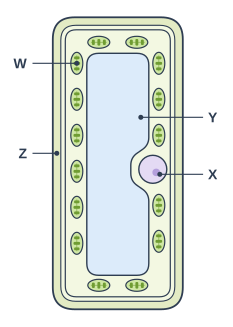
The diagram shows a palisade cell from a leaf. Four parts are labelled W, X, Y and Z.

Give the letter of the part where photosynthesis takes place, and name the green substance in this part that absorbs light.

Diagram: a tall column-shaped cell with a thick outer layer and a thin line just inside it. A long pale blue space fills the centre. 15 small green oval structures with darker stacks inside are packed round the edge, and a round structure with a darker spot sits on the right-hand side. Label W points to one of the many small green oval structures with darker stacks inside, packed round the edge of the cell; label X points to the round structure (with a darker spot inside it) on the right-hand side; label Y points to the long pale blue space filling the centre of the cell; label Z points to the thick outer layer around the whole cell.

Model answer

W (the chloroplasts). The green substance is chlorophyll.

Explanation

Photosynthesis takes place in the chloroplasts, and palisade cells are packed with them. Chloroplasts contain chlorophyll, a green substance that absorbs light energy for photosynthesis. Take care not to mix up the two words: the chloroplast is the structure and chlorophyll is the substance inside it.

Mark scheme
  1. 1 mark

    W (chloroplast)

    ALLOW chloroplast(s) instead of, or as well as, the letter W. DO NOT ALLOW W given with another letter (contradiction). Mark the two points independently.

  2. 1 mark

    chlorophyll

    ALLOW phonetic spellings such as chlorofil. DO NOT ALLOW chloroplast for this mark.

Question 3

2 marks

A cactus has sharp spines instead of normal leaves. The spines are not green. The thick stem of the cactus is green.

Suggest where photosynthesis takes place in a cactus, and explain your answer.

Model answer

Photosynthesis takes place in the cells of the green stem. The stem is green because its cells contain chloroplasts with chlorophyll, which absorbs the light needed for photosynthesis. The spines are not green, so they have no chlorophyll.

Explanation

Photosynthesis happens in chloroplasts, which contain the green substance chlorophyll. So any green part of a plant can photosynthesise, not just the leaves. In a cactus the spines have no chlorophyll, so the green stem does the job that leaves do in most plants.

Mark scheme
  1. 1 mark

    in the (cells of the) stem

    Mark the two points independently. ALLOW in the chloroplasts of the stem cells. DO NOT ALLOW in the spines.

  2. 1 mark

    the stem is green because its cells contain chloroplasts / chlorophyll, which absorb light (but the spines do not)

    ALLOW the green colour shows chlorophyll is present. IGNORE just 'the stem is green' with no reference to chlorophyll or chloroplasts.

Question 4

3 marks

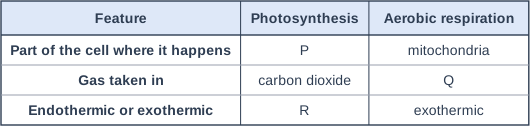
The table compares photosynthesis and aerobic respiration in a plant cell.

Give the words that should go in place of P, Q and R.

Table with columns "Feature", "Photosynthesis", "Aerobic respiration". Feature: Part of the cell where it happens; Photosynthesis: P; Aerobic respiration: mitochondria | Feature: Gas taken in; Photosynthesis: carbon dioxide; Aerobic respiration: Q | Feature: Endothermic or exothermic; Photosynthesis: R; Aerobic respiration: exothermic.

Model answer

P - chloroplasts
Q - oxygen
R - endothermic

Explanation

Photosynthesis takes place in chloroplasts, takes in carbon dioxide and takes in light energy, so it is endothermic. Aerobic respiration takes place in mitochondria, takes in oxygen and releases energy, so it is exothermic. Plant cells respire all the time but photosynthesise only in the light.

Mark scheme
  1. 1 mark

    P: chloroplast(s)

    Mark P, Q and R independently. DO NOT ALLOW chlorophyll for P.

  2. 1 mark

    Q: oxygen

    ALLOW O₂ / O2.

  3. 1 mark

    R: endothermic

    ALLOW phonetic spellings. DO NOT ALLOW exothermic.

Ready to try the rest? Every answer you write is marked against the mark scheme, so you can see exactly where the marks are.

Study Helper Hints first, answers after you try

Stuck on this one? Ask for a hint and I’ll point you in the right direction, without giving the answer away. Once you’ve checked your answer, I’ll show you how the marks are awarded.