
Level:
Correct: 0
Incorrect: 0
Marks: 0/0
Exam Practice
Course:
Topics:
OCR GCSE Biology (Paper 1) Smart practice A mixed round aimed at your weak spots
Avg
score:
–
Topics
done:
0/29

Factors affecting the rate of photosynthesis

Practise 13 exam-style questions on Factors affecting the rate of photosynthesis for OCR GCSE Biology (Paper 1). Write your answer as you would in the exam and get it marked in seconds against the mark scheme, point by point, with the Study Helper on hand if you get stuck.

  • 13 questions
  • 1–4 marks each
  • Instant marking
  • No sign-up needed
13 questions, marked as you go

Sample questions with model answers

Here are 4 of the questions in this topic, each with a model answer, an explanation of why it earns the marks and the mark scheme an examiner would use.

Question 1

1 mark

A student measured the rate of photosynthesis of some cress seedlings at 10 °C and at 25 °C. The light intensity and the carbon dioxide concentration were the same at both temperatures. The rate was faster at 25 °C.

Which statement explains why the rate was faster at 25 °C?

Choose your answer.

  • A more chlorophyll is made at 25 °C, so more light is absorbed
  • B more light energy is absorbed at 25 °C, so more glucose is made
  • C the enzymes are denatured at 10 °C, so they cannot work
  • D the molecules move faster at 25 °C, so they collide more often

Model answer

D - the molecules move faster at 25 °C, so they collide more often

Explanation

The reactions of photosynthesis are controlled by enzymes. Below the optimum temperature, raising the temperature gives the molecules more kinetic energy, so enzymes and substrates collide more often and the rate increases. Low temperatures slow enzymes down; only high temperatures denature them.

Mark scheme
  1. 1 mark

    D / the molecules move faster at 25 °C, so they collide more often

    The only correct answer is D: photosynthesis is controlled by enzymes, and at a higher temperature the enzyme and substrate molecules have more kinetic energy, so they collide more often and the reactions are faster. A is not correct because a change in temperature over a short time does not change the amount of chlorophyll; B is not correct because the light intensity was the same at both temperatures, so the same light energy was available; C is not correct because enzymes are denatured at high temperatures, not at low temperatures: at 10 °C they work slowly. ALLOW the letter or the option. If more than one option is given, do not award the mark.
Question 2

1 mark

A potted plant is sealed inside a clear glass box and kept in bright light at 20 °C. At first the plant photosynthesises quickly, but after a few hours its rate of photosynthesis has fallen.

Suggest why the rate of photosynthesis has fallen.

Model answer

The plant has used up most of the carbon dioxide in the sealed box for photosynthesis, and no more carbon dioxide can get in, so the carbon dioxide concentration is too low.

Explanation

Carbon dioxide is a reactant in photosynthesis. In a sealed box the plant keeps taking in carbon dioxide, so its concentration falls, and the lower the carbon dioxide concentration, the slower the rate of photosynthesis. The light and temperature stayed the same, so they cannot explain the fall.

Mark scheme
  1. 1 mark

    the plant has used up (most of) the carbon dioxide in the box / the carbon dioxide concentration in the box has fallen (and no more can get in)

    ALLOW there is not enough carbon dioxide left for photosynthesis. DO NOT ALLOW the temperature has changed (it was kept at 20 °C) / there is less light. IGNORE just 'oxygen builds up'.

Question 3

2 marks

Lettuce plants were grown in a growth room. The temperature and the carbon dioxide concentration in the room were kept constant, but the brightness of the lamps was changed.

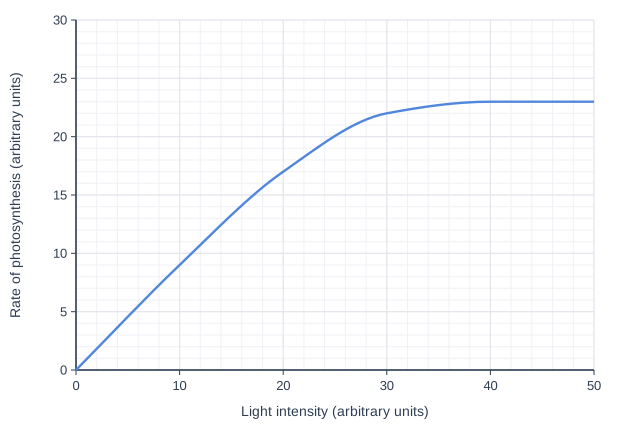
The graph shows the rate of photosynthesis of the lettuce plants at different light intensities.

A grower says: 'The brighter the lamps, the faster the lettuce plants will photosynthesise.'

Use data from the graph to explain why the grower is only partly right.

Line graph of rate of photosynthesis (arbitrary units) (y-axis, 0 to 30) against light intensity (arbitrary units) (x-axis, 0 to 50). The line is a smooth curve through (0, 0), (10, 9), (20, 17), (30, 22), (40, 23), (50, 23).

Model answer

The grower is right at lower light intensities: as the light intensity increases from 10 to 30 arbitrary units, the rate of photosynthesis increases from 9 to 22 arbitrary units. But the grower is wrong at higher light intensities: above about 40 units the rate stays the same at about 23 arbitrary units, so making the lamps brighter than this does not make the lettuces photosynthesise any faster.

Explanation

Check a claim like this against the whole graph. The rate rises as the light gets brighter, but only up to about 40 units; after that the line is flat, so extra brightness does not change the rate. Quote values from both parts of the graph, and remember that a flat line means the rate stays the same: photosynthesis does not stop.

Mark scheme
  1. 1 mark

    the grower is right at lower light intensities: as the light intensity increases from 0 to about 30 or 40 arbitrary units, the rate of photosynthesis increases

    Max 1 if no data from the graph are used. Mark the two points independently. ALLOW quoted data such as the rate rises from 9 to 22 arbitrary units as the light intensity increases from 10 to 30 units. ALLOW positive correlation at low light intensities.

  2. 1 mark

    the grower is wrong at higher light intensities: above about 40 arbitrary units the rate stays the same / levels off (at about 23 arbitrary units), so brighter lamps do not make it faster

    ALLOW levels off at a light intensity from 30 to 40 units. ALLOW a rate from 22 to 24 units. ALLOW the rate is the same (23 units) at 40 and at 50 units. DO NOT ALLOW the rate falls / photosynthesis stops. IGNORE explanations of why the rate levels off, including references to other factors.

Question 4

3 marks

Seaweeds live in rock pools on a beach in Cornwall. On a hot, sunny day at low tide, the water in one shallow rock pool warmed from 18 °C to 34 °C.

A scientist found that the rate of photosynthesis of the seaweed in the pool increased at first, but then fell when the water temperature rose above about 28 °C.

Explain why the rate of photosynthesis fell when the temperature rose above 28 °C.

Model answer

The reactions of photosynthesis are controlled by enzymes. Above about 28 °C the enzymes start to be denatured. The shape of their active sites changes, so the substrate no longer fits, fewer enzyme-substrate complexes form and photosynthesis slows down.

Explanation

Temperature affects photosynthesis because it is controlled by enzymes. Up to the optimum temperature, the rate rises because molecules move faster and collide more often. Above the optimum, the enzymes are denatured: their active sites change shape, so the substrates can no longer fit and the rate falls.

Mark scheme
  1. 1 mark

    photosynthesis is controlled by enzymes

    1 mark for each point, max 3. ALLOW the reactions of photosynthesis are catalysed by enzymes.

  2. 1 mark

    (above the optimum temperature) the enzymes are denatured

    The word 'denatured' (or denature) must be used. DO NOT ALLOW the enzymes are killed / die.

  3. 1 mark

    the shape of the active site changes

    ALLOW the enzyme changes shape.

  4. 1 mark

    so the substrate no longer fits the active site / fewer enzyme-substrate complexes form, so the reactions are slower

    ALLOW the substrate (such as carbon dioxide) cannot bind to the enzyme.

Ready to try the rest? Every answer you write is marked against the mark scheme, so you can see exactly where the marks are.

Study Helper Hints first, answers after you try

Stuck on this one? Ask for a hint and I’ll point you in the right direction, without giving the answer away. Once you’ve checked your answer, I’ll show you how the marks are awarded.