
Level:
Correct: 0
Incorrect: 0
Marks: 0/0
Exam Practice
Course:
Topics:
OCR GCSE Biology (Paper 1) Smart practice A mixed round aimed at your weak spots
Avg
score:
–
Topics
done:
0/29

Plant hormones and plant growth

Practise 13 exam-style questions on Plant hormones and plant growth for OCR GCSE Biology (Paper 1). Write your answer as you would in the exam and get it marked in seconds against the mark scheme, point by point, with the Study Helper on hand if you get stuck.

  • 13 questions
  • 1–4 marks each
  • Instant marking
  • No sign-up needed
13 questions, marked as you go

Sample questions with model answers

Here are 4 of the questions in this topic, each with a model answer, an explanation of why it earns the marks and the mark scheme an examiner would use.

Question 1

1 mark

A tropism is a growth response of a plant towards or away from a stimulus.

Which of these is an example of a tropism?

Choose your answer.

  • A A bean root growing downwards in the soil
  • B A geranium wilting on a hot afternoon
  • C A mimosa plant folding its leaves within seconds of being touched
  • D A pea seed swelling when it is soaked in water

Model answer

A (a bean root growing downwards in the soil)

Explanation

A tropism is a growth response whose direction depends on the direction of the stimulus. Roots grow downwards, towards gravity, so this is positive gravitropism. Wilting, leaves folding in a few seconds and seeds swelling as they take in water are not growth towards or away from a stimulus.

Mark scheme
  1. 1 mark

    A / a bean root growing downwards in the soil

    The only correct answer is A: the root grows towards the pull of gravity, so it is a growth response towards a stimulus (positive gravitropism). B is not correct because wilting happens when cells lose water, not because the plant grows towards or away from a stimulus; C is not correct because folding within seconds is a fast movement, not a growth response; D is not correct because the seed swells as it takes in water, which is not growth towards or away from a stimulus. ALLOW the letter or the option. If more than one option is given, do not award the mark.
Question 2

2 marks

Insulin is a human hormone. It is made in a gland, the pancreas, and carried in the blood to the cells it affects.

A student wrote: 'Auxin is a plant hormone, so it must also be made in a gland and carried in the blood.'

Give one reason why the student is wrong.

Explain why auxin is still called a hormone.

Model answer

The student is wrong because plants have no glands and no blood: auxin is made in the tips of shoots and moves from cell to cell through the plant.
Auxin is still a hormone because it is a chemical messenger: it is made in one part of the plant (the shoot tip) and causes a response in another part (it makes cells further down the shoot elongate).

Explanation

A hormone is a chemical messenger made in one part of an organism that causes a response in target cells in another part. In humans, hormones are made in endocrine glands and carried in the blood. Plants have no glands and no blood, but auxin is still a hormone: it is made in the tips of shoots and roots and moves from cell to cell to the cells it affects.

Mark scheme
  1. 1 mark

    plants have no (endocrine) glands: auxin is made in (the cells of) the tips of shoots (and roots)

    1 mark for any one of points 1 and 2 (why the student is wrong), max 1. If more than one answer is given, a wrong one cancels a right one. 1 mark for point 3 (why auxin is a hormone). ALLOW auxin is made in the shoot tip / in the growing tips. IGNORE auxin is made in the plant (unqualified).

  2. 1 mark

    plants have no blood: auxin moves (through the plant) from cell to cell

    ALLOW auxin diffuses through the plant / moves through the phloem / moves down the stem. IGNORE plants have no heart.

  3. 1 mark

    (auxin is a hormone because) it is a chemical (messenger) that is made in one part of the plant and causes a response in (target cells in) another part

    The answer must say that auxin is a chemical (messenger) or that it acts in a different part of the plant from where it is made. ALLOW auxin is made in the shoot tip and makes cells further down the shoot elongate. IGNORE auxin controls growth (unqualified: this does not say why it is a hormone).

Question 3

2 marks

A scientist grew two groups of pea seedlings in the same conditions, with light from directly above. She sprayed the shoots of one group with water. She sprayed the shoots of the other group with a chemical that stops plant cells making auxin.

After 4 days, the shoots sprayed with water had grown by a mean of 24 mm. The shoots sprayed with the chemical had grown by a mean of only 5 mm.

Explain why the shoots sprayed with the chemical grew less.

Model answer

Auxin makes the cells in a shoot elongate. The chemical stopped the cells making auxin, so there was less auxin in the shoots and their cells elongated less. So the shoots sprayed with the chemical grew only 5 mm, compared with 24 mm for the shoots sprayed with water.

Explanation

Auxin is made in the tips of shoots and moves down the shoot, where it makes the cells elongate: this is how auxin controls the growth of a shoot in length. With less auxin, the cells elongate less, so the shoot grows less. The shoots sprayed with the chemical still grew a little, so the chemical did not simply kill them.

Mark scheme
  1. 1 mark

    auxin makes (the) cells (in a shoot) elongate / get longer

    1 mark for each point. ALLOW auxin causes growth by cell elongation. ALLOW this point when the explanation for point 2 clearly says that less auxin means less cell elongation. DO NOT ALLOW auxin makes cells divide (faster). IGNORE auxin helps the plant to grow (unqualified).

  2. 1 mark

    (the shoots sprayed with the chemical had) less / no auxin, so their cells elongated less / grew less, so the shoots grew less (5 mm compared with 24 mm)

    Point 2 needs the link between less auxin and less elongation or growth of the shoots. IGNORE the chemical stopped auxin being made (unqualified: this repeats the question). IGNORE the chemical killed the shoots / is poisonous (the shoots still grew 5 mm). This mark can be awarded without the first mark.

Question 4

3 marks

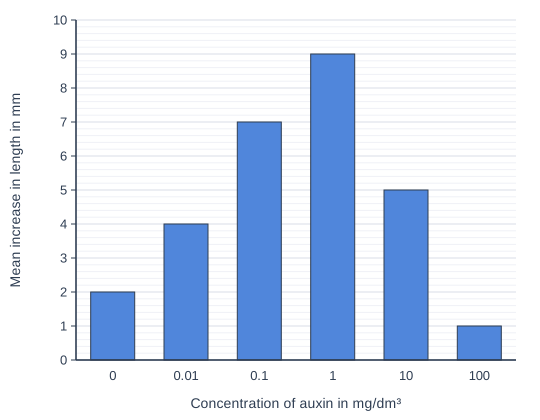
A student cut 10 mm sections from just below the tips of oat shoots. She put five sections into each of six dishes. Five dishes contained auxin solutions of different concentrations, and one dish contained water with no auxin. She kept the dishes in the dark for 24 hours, then measured the sections and calculated the mean increase in length for each dish.

The bar chart shows her results.

Describe the effect of the concentration of auxin on the growth of the shoot sections. Use data from the bar chart in your answer.

Bar chart of mean increase in length in mm for each concentration of auxin in mg/dm³: 0 2, 0.01 4, 0.1 7, 1 9, 10 5, 100 1.

Model answer

As the concentration of auxin increases from 0 to 1 mg/dm³, the growth of the sections increases, from 2 mm with no auxin to 9 mm. The most growth is at 1 mg/dm³. Above 1 mg/dm³ the growth decreases: 5 mm at 10 mg/dm³ and only 1 mm at 100 mg/dm³, which is less than with no auxin, so a very high concentration of auxin slows growth.

Explanation

Auxin makes the cells of shoots elongate, so up to a point more auxin gives more growth. The bar chart also shows that the effect depends on the concentration: at very high concentrations auxin slows growth. When describing data, give the pattern, the peak and values from the chart with their units.

Mark scheme
  1. 1 mark

    as the concentration of auxin increases up to 1 mg/dm³, the growth increases (from 2 mm with no auxin to 9 mm)

    Max 2 if no data from the bar chart are used. 1 mark for each point. Data means at least one concentration with its correct mean increase in length (for example 9 mm at 1 mg/dm³). ALLOW the higher the concentration, the more the sections grow, up to 1 mg/dm³.

  2. 1 mark

    the most growth is at 1 mg/dm³ (9 mm) / 1 mg/dm³ is the best (optimum) concentration

    ALLOW the peak is at 1 mg/dm³.

  3. 1 mark

    above 1 mg/dm³ the growth decreases (to 5 mm at 10 mg/dm³ and 1 mm at 100 mg/dm³) / at 100 mg/dm³ there is less growth than with no auxin (1 mm compared with 2 mm), so a very high concentration slows growth

    ALLOW high concentrations of auxin reduce growth. DO NOT ALLOW the sections stop growing at 10 mg/dm³ / the sections shrink.

Ready to try the rest? Every answer you write is marked against the mark scheme, so you can see exactly where the marks are.

Study Helper Hints first, answers after you try

Stuck on this one? Ask for a hint and I’ll point you in the right direction, without giving the answer away. Once you’ve checked your answer, I’ll show you how the marks are awarded.