Level:
Correct: 0
Incorrect: 0
Marks: 0/0
Exam Practice
Course:
Topics:
OCR GCSE Biology (Paper 1) Smart practice A mixed round aimed at your weak spots
Avg
score:
–
Topics
done:
0/29

DNA nucleotides

Practise 10 exam-style questions on DNA nucleotides for OCR GCSE Biology (Paper 1). Write your answer as you would in the exam and get it marked in seconds against the mark scheme, point by point, with the Study Helper on hand if you get stuck.

  • 10 questions
  • 1–3 marks each
  • Instant marking
  • No sign-up needed
10 questions, marked as you go

Sample questions with model answers

Here are 4 of the questions in this topic, each with a model answer, an explanation of why it earns the marks and the mark scheme an examiner would use.

Question 1

1 mark

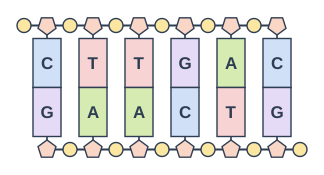
The diagram shows a short piece of DNA.

How many nucleotides are shown in the diagram?

Choose your answer.

  • A 6
  • B 12
  • C 18
  • D 36
A short section of DNA, drawn as two strands joined like a ladder. Each strand is a chain of alternating circles and pentagons; a rectangle containing a letter is attached to each pentagon, and the rectangles of the two strands meet in pairs across the middle. Top strand, from left to right: C, T, T, G, A, C. Bottom strand, from left to right: G, A, A, C, T, G.

Model answer

B (12)

Explanation

Each nucleotide is one sugar, one phosphate group and one base, so you can count nucleotides by counting bases. Each strand has 6 bases and there are two strands, so there are 12 nucleotides. Counting one strand only gives 6, which is the number of base pairs, not the number of nucleotides.

Mark scheme
  1. 1 mark

    B / 12

    The only correct answer is B: each strand has 6 bases, each base is part of one nucleotide (with one sugar and one phosphate group), and there are two strands, so there are 2 × 6 = 12 nucleotides. A is not correct because 6 is the number of nucleotides on one strand only (or the number of base pairs); C is not correct because 18 counts the sugars, phosphate groups and bases of one strand as separate nucleotides (6 × 3); D is not correct because 36 counts every sugar, phosphate group and base in the diagram as a separate nucleotide (12 × 3). ALLOW the letter or the option. If more than one option is given, do not award the mark.

Question 2

2 marks

A student wrote: 'A base and a base pair are the same thing.'

The student is wrong.

Explain the difference between a base and a base pair in DNA.

Model answer

A base is one part of a single nucleotide: it is A, T, C or G, attached to the sugar. A base pair is two bases joined together, one on each strand of the DNA, such as A with T or C with G.

Explanation

Each nucleotide has only one base. In the double helix, a base on one strand pairs with a base on the other strand: A with T and C with G. Two paired bases make one base pair, so a section of DNA with 100 base pairs has 200 bases.

Mark scheme
  1. 1 mark

    a base is one part of a single nucleotide / a base is one of A, T, C or G (attached to a sugar)

    ALLOW a base is one of adenine, thymine, cytosine or guanine. ALLOW a base is a single base on one strand. DO NOT ALLOW a base is a nucleotide / a base is a sugar or a phosphate group.

  2. 1 mark

    a base pair is two bases joined together, one on each strand / a base on one strand paired with a base on the other strand (A with T or C with G)

    ALLOW two bases that pair up across the two strands. ALLOW an example of a base pair (A and T, or C and G) as the description of the pair. DO NOT ALLOW a base pair is two strands / two nucleotides joined along one strand / A paired with C or G paired with T.

Question 3

2 marks

Plants take in phosphate ions from the soil through their roots. Farmers often add fertilisers that contain phosphate to the soil to help their crops grow.

Use your knowledge of the structure of DNA to suggest why a plant needs phosphate to grow.

Model answer

Every DNA nucleotide contains a phosphate group. When a plant grows it makes new cells by mitosis, and each new cell needs its own copy of the DNA. So the plant has to make lots of new nucleotides, and it needs phosphate to do this.

Explanation

Each nucleotide is a sugar, a phosphate group and a base, so making DNA uses phosphate. Before a cell divides by mitosis its DNA is copied, so a growing plant needs a steady supply of phosphate ions from the soil. Phosphate is also used to make some other molecules, but this question asks about DNA.

Mark scheme
  1. 1 mark

    each (DNA) nucleotide contains a phosphate group / phosphate is used to make (the nucleotides of) DNA

    ALLOW DNA contains phosphate (groups). IGNORE phosphate is needed for energy / for photosynthesis, unless it is linked to DNA.

  2. 1 mark

    a growing plant makes new cells (by cell division / mitosis) and each new cell needs (a copy of the) DNA / DNA must be copied before a cell divides, so the plant must make more nucleotides

    ALLOW growth needs more cells, which need more DNA. ALLOW more DNA must be made when cells divide. IGNORE the plant needs phosphate to make proteins.

Question 4

3 marks

A student builds a model of a short section of DNA, with both strands, from a kit. The kit contains:

• 20 sugar pieces
• 20 phosphate pieces
• 5 base pieces for each of the four bases (A, C, G and T)

The base sequence of one strand of the model will be:

A T A A G T C A T A

Use calculations to decide whether the kit has enough pieces to build both strands of the model.

Model answer

Each strand has 10 nucleotides, so both strands need 20 sugar pieces and 20 phosphate pieces. The kit has exactly enough of these.
The strand shown has 5 A and 3 T. The other strand has a T opposite each A and an A opposite each T, so it has 5 T and 3 A.
A pieces needed = 5 + 3 = 8
T pieces needed = 3 + 5 = 8
The kit has only 5 A pieces and 5 T pieces, so it does not have enough pieces to build the model.

Explanation

Every nucleotide needs one sugar and one phosphate group, so count the nucleotides on both strands. For the bases, remember that the second strand is complementary: each A is opposite a T and each T is opposite an A. Counting the bases on one strand only would wrongly suggest that 5 A pieces are enough.

Mark scheme
  1. 1 mark

    sugars and phosphates: 10 + 10 = 20 nucleotides, so 20 sugar pieces and 20 phosphate pieces are needed (the kit has enough of these)

    A decision (yes or no) with no calculation scores 0. ALLOW 2 × 10 = 20. DO NOT ALLOW 10 sugar pieces / 10 phosphate pieces (one strand only).

  2. 1 mark

    A pieces needed = 5 (on the strand shown) + 3 (opposite the 3 T bases) = 8 / T pieces needed = 3 + 5 = 8

    ALLOW either calculation, or a correct sequence written for the other strand (T A T T C A G T A T) with the A or T pieces counted as 8. Working out G or C pieces needed (1 + 1 = 2) does not score this mark on its own.

  3. 1 mark

    decision: no, the kit does not have enough pieces, because 8 A pieces and 8 T pieces are needed but the kit has only 5 of each

    This mark depends on point 2. ALLOW 'not enough A and T pieces' / '3 more A pieces and 3 more T pieces are needed'. DO NOT ALLOW 'the kit has enough pieces' / 'not enough sugar pieces'.

Ready to try the rest? Every answer you write is marked against the mark scheme, so you can see exactly where the marks are.

Study Helper Hints first, answers after you try

Stuck on this one? Ask for a hint and I’ll point you in the right direction, without giving the answer away. Once you’ve checked your answer, I’ll show you how the marks are awarded.