
Level:
Correct: 0
Incorrect: 0
Marks: 0/0
Exam Practice
Course:
Topics:
OCR GCSE Biology (Paper 1) Smart practice A mixed round aimed at your weak spots
Avg
score:
–
Topics
done:
0/29

Making and breaking down carbohydrates, proteins and lipids

Practise 15 exam-style questions on Making and breaking down carbohydrates, proteins and lipids for OCR GCSE Biology (Paper 1). Write your answer as you would in the exam and get it marked in seconds against the mark scheme, point by point, with the Study Helper on hand if you get stuck.

  • 15 questions
  • 1–6 marks each
  • Instant marking
  • No sign-up needed
15 questions, marked as you go

Sample questions with model answers

Here are 4 of the questions in this topic, each with a model answer, an explanation of why it earns the marks and the mark scheme an examiner would use.

Question 1

1 mark

A person eats beef. Their body uses the protein in the beef to make human proteins, such as the proteins in their own muscles.

Which statement explains how this is possible?

Choose your answer.

  • A Beef protein is the same as human protein.
  • B Human cells can absorb whole beef proteins.
  • C Muscle proteins are made from glucose monomers.
  • D The same types of amino acid are used by all organisms.

Model answer

D - The same types of amino acid are used by all organisms.

Explanation

Proteins are polymers of amino acids. Digestion breaks the beef protein down into its amino acid monomers, which are absorbed. Every organism builds its proteins from the same set of amino acids, so human cells can join them together in a new order to make human proteins.

Mark scheme
  1. 1 mark

    D / The same types of amino acid are used by all organisms.

    The only correct answer is D: the beef protein is broken down into amino acids, and because all organisms use the same types of amino acid, human cells can join these amino acids together to make human proteins. A is not correct because beef proteins and human proteins are different proteins; B is not correct because proteins are too large to be absorbed and must first be broken down into amino acids; C is not correct because proteins are made from amino acid monomers, not glucose. ALLOW the letter or the option. If more than one option is given, do not award the mark.
Question 2

1 mark

Waste paper is made mainly of cellulose, from the cell walls of trees. Cellulose is a polymer.

In one way of making biofuel, enzymes break down the cellulose in waste paper into its monomers.

Name the monomer that is produced.

Model answer

Glucose

Explanation

Cellulose, starch and glycogen are all carbohydrate polymers made of glucose monomers; the glucose units are joined in different ways in each one. Breaking down cellulose releases glucose, a sugar that microorganisms such as yeast can then use to make biofuel. Take care not to confuse glucose with glycogen (a polymer) or glycerol (part of a lipid).

Mark scheme
  1. 1 mark

    glucose

    IGNORE sugar on its own (the monomer must be named). DO NOT ALLOW glycerol / glycogen / starch / amino acids / fatty acids.

Question 3

2 marks

A teacher uses plastic building bricks to model biological molecules.
• To model a starch molecule, she joins 30 bricks of one colour into a chain.
• To model a protein molecule, she joins 30 bricks of 20 different colours into a chain.

Explain why the teacher used bricks of one colour for starch but bricks of 20 different colours for a protein.

Model answer

Each brick represents a monomer. Starch is made from only one type of monomer, glucose, so all the bricks are the same colour. Proteins are made from about 20 different types of amino acid, so the teacher used 20 different colours.

Explanation

Starch and proteins are both polymers, but their monomers differ: starch is made of glucose only, while proteins are made of many different amino acids. In the model each brick is a monomer, and joining or separating the bricks represents synthesis or breakdown of the polymer.

Mark scheme
  1. 1 mark

    starch is made from only one type of monomer / from glucose monomers only

    ALLOW all the monomers in starch are the same (glucose). IGNORE starch is a polymer (on its own).

  2. 1 mark

    proteins are made from many (about 20) different (types of) amino acids / monomers

    ALLOW each colour represents a different amino acid. IGNORE proteins are bigger than starch.

Question 4

4 marks

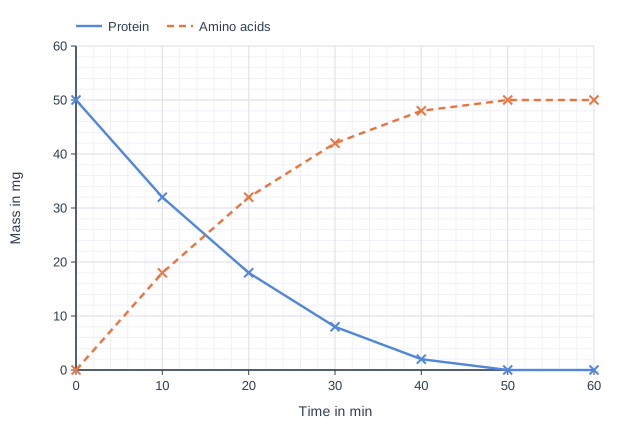
A scientist added a protease enzyme to a solution of pea protein. She measured the mass of protein and the mass of amino acids in the mixture every 10 minutes.

The graph shows her results.

Describe and explain the changes in the mass of protein and the mass of amino acids.

Use the terms monomer and polymer in your answer.

Line graph of mass in mg (y-axis, 0 to 60) against time in min (x-axis, 0 to 60). "Protein" joins the points (0, 50), (10, 32), (20, 18), (30, 8), (40, 2), (50, 0), (60, 0). "Amino acids" (dashed) joins the points (0, 0), (10, 18), (20, 32), (30, 42), (40, 48), (50, 50), (60, 50).

Model answer

The mass of protein falls from 50 mg to 0 mg, and at the same time the mass of amino acids rises from 0 mg to 50 mg. After 50 minutes both stay the same. This is because the protease breaks down the protein, which is a polymer, into amino acids, which are its monomers. The changes stop after 50 minutes because all the protein has been broken down, so there is no substrate left.

Explanation

As the polymer is broken down, its monomers appear, so one line falls as the other rises. The reaction stops when the substrate (protein) runs out; the protease is not used up. Describe the pattern with values from the graph, then explain it in terms of polymers, monomers and the enzyme.

Mark scheme
  1. 1 mark

    describe: the mass of protein decreases (from 50 mg to 0 mg) while the mass of amino acids increases (from 0 mg to 50 mg)

    1 mark for each of the four points. ALLOW the protein goes down as the amino acids go up. Data are not needed for this mark.

  2. 1 mark

    describe: both stop changing / level off after 50 minutes (protein at 0 mg, amino acids at 50 mg)

    ALLOW after about 50 minutes. ALLOW both change quickly at first and then more slowly.

  3. 1 mark

    explain: the protease breaks down the protein (a polymer) into amino acids (monomers)

    The terms polymer and monomer must be used correctly for this mark. ALLOW the protease digests the protein into amino acid monomers.

  4. 1 mark

    explain: the changes stop because all the protein has been broken down / there is no protein (substrate) left

    DO NOT ALLOW the protease / enzyme has been used up / has stopped working (enzymes are not used up).

Ready to try the rest? Every answer you write is marked against the mark scheme, so you can see exactly where the marks are.

Study Helper Hints first, answers after you try

Stuck on this one? Ask for a hint and I’ll point you in the right direction, without giving the answer away. Once you’ve checked your answer, I’ll show you how the marks are awarded.