
Level:
Correct: 0
Incorrect: 0
Marks: 0/0
Exam Practice
Course:
Topics:
OCR GCSE Biology (Paper 1) Smart practice A mixed round aimed at your weak spots
Avg
score:
–
Topics
done:
0/29

Osmotic balance and the kidneys

Practise 15 exam-style questions on Osmotic balance and the kidneys for OCR GCSE Biology (Paper 1). Write your answer as you would in the exam and get it marked in seconds against the mark scheme, point by point, with the Study Helper on hand if you get stuck.

  • 15 questions
  • 1–6 marks each
  • Instant marking
  • No sign-up needed
15 questions, marked as you go

Sample questions with model answers

Here are 4 of the questions in this topic, each with a model answer, an explanation of why it earns the marks and the mark scheme an examiner would use.

Question 1

1 mark

A scientist added a drop of blood to some distilled water. When she looked at it with a microscope a few minutes later, the red blood cells had burst open.

What name is given to the bursting of animal cells in this way?

Model answer

Lysis.

Explanation

Distilled water has a higher water potential than the cytoplasm of red blood cells, so water moves into the cells by osmosis. Animal cells have no cell wall, so the cells swell until the cell membrane breaks open: this bursting is called lysis. Osmosis is the movement of water that causes lysis; it is not the name of the bursting.

Mark scheme
  1. 1 mark

    lysis

    ALLOW haemolysis / cytolysis. ALLOW phonetic spellings such as 'lysys'. DO NOT ALLOW osmosis / diffusion / plasmolysis / crenation / turgor on their own (osmosis causes the bursting but is not its name). IGNORE 'the cells burst' (given in the question).
Question 2

2 marks

A student put some red blood cells into a salt solution. The salt solution had the same water potential as the cytoplasm of the cells. After 30 minutes the cells were still the same size as at the start.

The student wrote: 'No water molecules moved into or out of the red blood cells.'

Explain why the student's statement is wrong.

Model answer

Water molecules still move into and out of the red blood cells across the cell membrane, because they move randomly. As the water potentials are equal, water moves in and out at the same rate, so there is no net movement of water and the cells stay the same size.

Explanation

Equal water potentials do not stop water molecules moving: they keep moving randomly across the partially permeable membrane in both directions. The numbers moving in and out are equal, so the net movement of water is zero and the cells neither swell nor shrink. The word 'net' is the key idea.

Mark scheme
  1. 1 mark

    water molecules (still) move into and out of the cells / across the cell membrane (in both directions)

    ALLOW water molecules keep moving randomly, so some cross the membrane. ALLOW water still moves by osmosis in both directions. IGNORE the cells stay the same size (given in the question).

  2. 1 mark

    (water molecules move) in and out at the same rate / the same number move in as move out, so there is no net movement (of water)

    The idea of equal movement in both directions, or of no NET movement, is needed. ALLOW 'the overall movement of water is zero'. DO NOT ALLOW 'no movement of water' / 'osmosis stops'. DO NOT ALLOW salt moves in and out at the same rate.

Question 3

2 marks

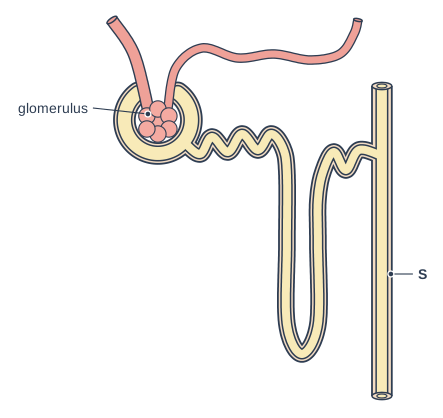
The diagram shows a kidney tubule.

A student looked at the diagram and said: 'S is the ureter, because urine flows along it.'

Explain why the student is wrong.

Diagram of a simplified kidney tubule. At the top left, a small knot of tiny blood vessels sits inside a cup-shaped structure; one small vessel brings blood into the knot and a narrower one carries it out. From the cup a narrow tube winds to the right, runs down into a long U-shaped loop and back up, winds again and joins a wider vertical tube on the right. The vessel leaving the knot continues as a blood vessel running along the top of the winding tube. The label "glomerulus" points to the knot of tiny blood vessels inside the cup at the top left; label S points to the wider vertical tube on the right that the winding tube joins.

Model answer

S is the collecting duct, not the ureter. The collecting duct is part of the kidney tubule, inside the kidney, and it carries urine towards the ureter. The ureter is a single tube that carries urine out of the kidney to the bladder.

Explanation

Urine does flow along the collecting duct, but the collecting duct is the last part of a kidney tubule, inside the kidney. Many collecting ducts empty into a space in the centre of the kidney, which leads into the ureter. The ureter then carries the urine from the kidney to the bladder.

Mark scheme
  1. 1 mark

    S is the collecting duct

    ALLOW collecting tubule. DO NOT ALLOW loop of Henlé / proximal convoluted tubule / Bowman's capsule.

  2. 1 mark

    the collecting duct is part of the (kidney) tubule, inside the kidney / the ureter is (a single tube) outside the kidney that carries urine from the kidney to the bladder

    This mark can be awarded without marking point 1. ALLOW S is inside the kidney but the ureter leaves the kidney. ALLOW each kidney has many collecting ducts but only one ureter. ALLOW S carries urine towards the ureter / to the renal pelvis. DO NOT ALLOW S carries blood / S carries urine to the bladder.

Question 4

4 marks

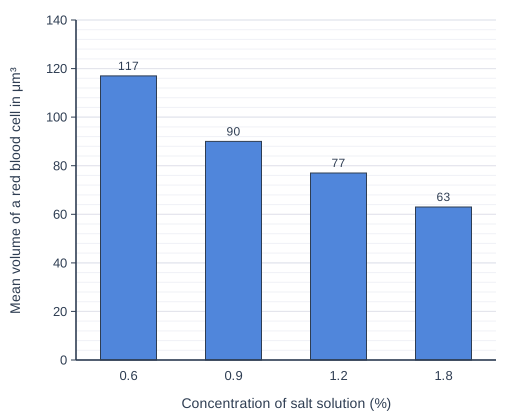
A scientist put samples of red blood cells into four salt solutions of different concentrations. At the start, the mean volume of a red blood cell was 90 μm³.

After 20 minutes she measured the mean volume of the red blood cells in each solution. The bar chart shows her results.

Calculate the percentage decrease in the mean volume of the red blood cells in the 1.8% salt solution.

Explain why the volume of the red blood cells decreased in the 1.8% salt solution.

Bar chart of mean volume of a red blood cell in μm³ for each concentration of salt solution (%): 0.6 117, 0.9 90, 1.2 77, 1.8 63.

Model answer

Decrease in volume = 90 − 63 = 27 μm³
Percentage decrease = 27 ÷ 90 × 100 = 30%

The 1.8% salt solution has a lower water potential than the cytoplasm of the red blood cells, so water moved out of the cells by osmosis and the cells shrank.

Explanation

To find a percentage decrease, divide the decrease by the starting value and multiply by 100. Dividing by the final volume (27 ÷ 63 × 100 = 43%) gives the wrong answer. The volume did not change in the 0.9% solution, so that solution has the same water potential as the cytoplasm; the 1.8% solution is more concentrated, so it has a lower water potential and the cells lose water by osmosis.

Mark scheme
  1. 1 mark

    decrease in volume = 90 − 63 = 27 (μm³) / 27 ÷ 90 (× 100) / 63 ÷ 90 × 100 = 70 (%) (then 100 − 70); or a correct final answer of 30% with no working

    An answer of 30% with no working scores marking points 1 and 2 only. ALLOW the other route: 63 ÷ 90 × 100 = 70%, then 100 − 70 = 30%. An answer of 43% or 42.9% (27 ÷ 63 × 100, dividing by the final volume instead of the starting volume) scores marking point 1 only. An answer of 70% (the final volume as a percentage of the starting volume) scores marking point 1 only. An answer of 27 with no working scores marking point 1 only.

  2. 1 mark

    30 (%)

    ALLOW −30 (%). IGNORE units. DO NOT ALLOW 27 (the decrease in volume, not a percentage).

  3. 1 mark

    the (concentrated) salt solution has a lower water potential than the cytoplasm of the red blood cells

    ORA (allow the reverse argument): the cytoplasm of the cells has a higher water potential than the solution. ALLOW the solution is more concentrated than the cytoplasm / has a higher salt concentration than the inside of the cells. DO NOT ALLOW the solution has a higher water potential than the cells.

  4. 1 mark

    (so) water moves out of the red blood cells (by osmosis)

    ALLOW the cells lose water (by osmosis) / water diffuses out of the cells. DO NOT ALLOW salt moves into the cells (by osmosis) / water moves out by active transport. IGNORE the cells shrink (given in the question).

Ready to try the rest? Every answer you write is marked against the mark scheme, so you can see exactly where the marks are.

Study Helper Hints first, answers after you try

Stuck on this one? Ask for a hint and I’ll point you in the right direction, without giving the answer away. Once you’ve checked your answer, I’ll show you how the marks are awarded.