
Level:
Correct: 0
Incorrect: 0
Marks: 0/0
Exam Practice
Course:
Topics:
OCR GCSE Biology (Paper 1) Smart practice A mixed round aimed at your weak spots
Avg
score:
–
Topics
done:
0/29

The skin and body temperature control

Practise 10 exam-style questions on The skin and body temperature control for OCR GCSE Biology (Paper 1). Write your answer as you would in the exam and get it marked in seconds against the mark scheme, point by point, with the Study Helper on hand if you get stuck.

  • 10 questions
  • 1–4 marks each
  • Instant marking
  • No sign-up needed
10 questions, marked as you go

Sample questions with model answers

Here are 4 of the questions in this topic, each with a model answer, an explanation of why it earns the marks and the mark scheme an examiner would use.

Question 1

1 mark

When a person is cold, they may start to shiver.

Which structures contract to cause shivering?

Choose your answer.

  • A blood vessels in the skin
  • B hair erector muscles in the skin
  • C muscles attached to the skeleton
  • D sweat glands in the skin

Model answer

C

Explanation

Shivering is the rapid contraction and relaxation of the skeletal muscles, the muscles attached to the skeleton. Contracting muscles respire faster, and respiration releases heat, which warms the blood. The hair erector muscles in the skin are much smaller: they raise the hairs (goose bumps) but they do not cause shivering.

Mark scheme
  1. 1 mark

    C / muscles attached to the skeleton

    The only correct answer is C: shivering is the rapid contraction and relaxation of skeletal muscles (the muscles attached to the skeleton); the extra respiration in the muscle cells releases heat. A is not correct because blood vessels supplying the skin narrow or widen to change the blood flow, which does not cause shivering; B is not correct because hair erector muscles make the hairs stand up (goose bumps), which is not shivering; D is not correct because sweat glands release sweat and do not cause shivering. ALLOW the letter or the option. If more than one option is given, do not award the mark.
Question 2

1 mark

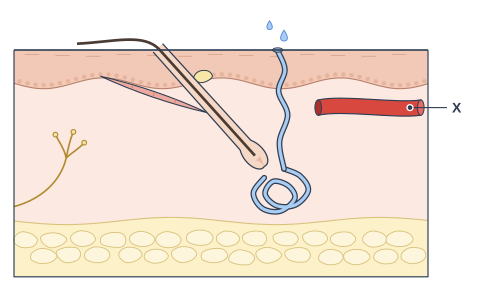
The diagram shows a section through the skin of a person who is too hot.

Name the process that has happened to the blood vessel labelled X.

Diagram of a section through human skin. The skin has three layers: a thin top layer, a thicker middle layer and a bottom layer of rounded cells. A strand grows from a tube-shaped pocket in the middle layer out through the surface; a small band runs from the pocket up to the underside of the top layer, and a small lobed sac sits beside the pocket. A coiled tube deep in the middle layer leads up through a narrow tube to a tiny opening on the surface, and a red tube runs through the middle layer just below the top layer on the right. On the left, fine branching nerve endings lie in the middle layer. The red tube near the surface is drawn wide, the strand lies flat against the skin and drops of liquid are coming out of the tiny opening on the surface. Label X points to the red tube just below the top layer, on the right.

Model answer

Vasodilation.

Explanation

When the body is too hot, the blood vessels that supply the skin widen. This is vasodilation. More warm blood then flows near the surface of the skin, so more heat is lost to the surroundings. The opposite process, when the vessels narrow in the cold, is vasoconstriction.

Mark scheme
  1. 1 mark

    vasodilation

    ALLOW vasodilatation / (blood vessel) dilation. ALLOW phonetic spellings that clearly mean vasodilation. DO NOT ALLOW vasoconstriction. IGNORE the blood vessel has got wider / bigger (this describes the change but does not name the process). If more than one process is given, do not award the mark.

Question 3

2 marks

A student wrote this about how the skin helps to cool the body:

'When the body is too hot, the blood vessels in the skin move upwards, closer to the surface of the skin, so that more heat can escape.'

The student's description of the blood vessels is wrong.

Explain what is wrong, and describe what really happens to the blood vessels supplying the skin.

Model answer

Blood vessels cannot move up or down in the skin, so the student is wrong to say they move closer to the surface. What really happens is vasodilation: the blood vessels supplying the skin widen, so more warm blood flows through the skin near its surface and more heat is lost to the surroundings.

Explanation

Blood vessels do not move up or down in the skin: they stay where they are, and it is their width that changes. When the body is too hot they widen (vasodilation), so more blood flows near the surface of the skin and more heat is lost; when it is too cold they narrow (vasoconstriction), so less blood flows near the surface and less heat is lost.

Mark scheme
  1. 1 mark

    blood vessels do not move (up or down) in the skin / the blood vessels stay in the same place

    1 mark for each point. ALLOW the blood vessels cannot move closer to the surface. IGNORE more heat is lost / heat escapes (given in the question).

  2. 1 mark

    the blood vessels supplying the skin widen / dilate / vasodilation happens (so more blood flows through the skin near its surface)

    The idea of the blood vessels getting wider is needed. ALLOW vasodilation on its own. ALLOW the blood vessels get bigger in diameter. This mark can be awarded without the first mark. DO NOT ALLOW the blood vessels narrow / vasoconstriction. DO NOT ALLOW the blood vessels widen and move towards the surface.

Question 4

3 marks

Many people with diabetes check their blood glucose level by pricking the side of a fingertip to get a small drop of blood.

On a cold day, it can be hard to get enough blood from the fingertip. People are often advised to wash their hands in warm water before the test.

Explain why it is harder to get blood from the fingertip on a cold day, and why washing the hands in warm water helps.

Model answer

On a cold day, the blood vessels supplying the skin of the fingers narrow (vasoconstriction). So less blood flows through the skin of the fingertip, and only a little blood comes out when it is pricked. Warm water warms the hands, so the blood vessels supplying the skin of the fingers widen (vasodilation) and more blood flows through the fingertip, which makes it easier to get a drop of blood.

Explanation

When temperature receptors in the skin detect the cold, the blood vessels supplying the skin narrow (vasoconstriction), especially in the hands and feet: this reduces the heat lost from the blood, but it also means less blood reaches the fingertips. Warming the hands makes these blood vessels widen again (vasodilation), so more blood flows through the skin of the fingers. Remember that blood vessels change their width: they do not move up or down in the skin.

Mark scheme
  1. 1 mark

    (on a cold day) vasoconstriction / the blood vessels supplying the skin (of the fingers) narrow

    ALLOW the blood vessels in the skin of the fingers constrict / become narrower. IGNORE temperature receptors in the skin detect the cold, on its own. IGNORE the blood vessels move away from the surface of the skin (blood vessels do not move). DO NOT ALLOW vasodilation on the cold day.

  2. 1 mark

    so less blood flows through the skin of the fingertip (so only a little blood comes out when it is pricked)

    ALLOW less blood flows near the surface of the skin of the fingers / less blood reaches the fingers. This mark can be awarded without point 1. IGNORE the blood is colder / thicker. DO NOT ALLOW the blood freezes.

  3. 1 mark

    (warm water) vasodilation / the blood vessels supplying the skin (of the fingers) widen (so more blood flows through the fingertip)

    ALLOW the warm water stops the vasoconstriction / the blood vessels are no longer narrowed, so more blood reaches the fingertip. IGNORE warm water warms the blood / makes the blood flow faster, unqualified. IGNORE warm water cleans the fingers. IGNORE the blood vessels move closer to the surface (blood vessels do not move).

Ready to try the rest? Every answer you write is marked against the mark scheme, so you can see exactly where the marks are.

Study Helper Hints first, answers after you try

Stuck on this one? Ask for a hint and I’ll point you in the right direction, without giving the answer away. Once you’ve checked your answer, I’ll show you how the marks are awarded.