
Level:
Correct: 0
Incorrect: 0
Marks: 0/0
Exam Practice
Course:
Topics:
Avg
score:
–
Topics
done:
0/26

The particle model

Practise 15 exam-style questions on The particle model for OCR GCSE Chemistry (Paper 3). Write your answer as you would in the exam and get it marked in seconds against the mark scheme, point by point, with the Study Helper on hand if you get stuck.

  • 15 questions
  • 1–6 marks each
  • Instant marking
  • No sign-up needed
15 questions, marked as you go

Sample questions with model answers

Here are 4 of the questions in this topic, each with a model answer, an explanation of why it earns the marks and the mark scheme an examiner would use.

Question 1

1 mark

Hydrogen peroxide, H₂O₂, slowly breaks down to form water and oxygen.

2H₂O₂ → 2H₂O + O₂

Which statement explains why this is a chemical change?

Choose your answer.

  • A The atoms are rearranged to form different molecules.
  • B The forces between the molecules are overcome.
  • C The molecules move faster.
  • D The molecules spread further apart.

Model answer

A

Explanation

In a chemical change, bonds between the atoms inside the particles break and the atoms join up in a different way, so new substances form. Here the H₂O₂ molecules become H₂O and O₂ molecules. Faster movement, spreading out and overcoming the forces between molecules all happen in physical changes, such as boiling, where the molecules themselves do not change.

Mark scheme
  1. 1 mark

    A / the atoms are rearranged to form different molecules

    The only correct answer is A: bonds inside the H₂O₂ molecules break and the atoms join together in a different way to make new substances (H₂O and O₂ molecules). B is not correct because overcoming the forces between molecules happens in physical changes such as boiling, where the molecules stay the same; C is not correct because molecules move faster when a substance is heated, even if no new substance forms; D is not correct because molecules spread apart when a liquid evaporates, which is a physical change. ALLOW the letter or the statement. If more than one option is given, do not award the mark.
Question 2

2 marks

In a fume cupboard, a teacher puts a few drops of liquid bromine into a gas jar. The bromine evaporates to form a brown gas. The teacher then places a second gas jar, full of air, upside down on top of the first one.

After about 30 minutes, the brown colour has spread evenly through both gas jars.

Use the particle model to explain why the brown colour spreads through both gas jars.

Model answer

The particles in a gas move quickly and randomly in all directions. The bromine particles and the air particles keep colliding and moving into the spaces between each other, so they mix. The bromine particles spread out until they are evenly spread through both gas jars, so the brown colour is the same everywhere.

Explanation

Gas particles are far apart and move randomly in all directions, so two gases mix by themselves (diffusion). The spreading takes several minutes because each bromine particle keeps colliding with air particles and changing direction. A common error is to say the bromine particles move upwards on purpose: their movement is random.

Mark scheme
  1. 1 mark

    the (bromine and air) particles in a gas move quickly / randomly / in all directions

    ALLOW the particles are constantly moving in random directions. IGNORE the bromine particles rise / move upwards (the movement is random, not only upwards). DO NOT ALLOW the particles vibrate about fixed positions.

  2. 1 mark

    the particles collide and mix / the bromine particles spread out among the air particles (until they are evenly spread)

    ALLOW the bromine particles move from where there are many of them to where there are few (diffusion). ALLOW the gas particles are far apart, so the bromine particles can move into the spaces between the air particles. IGNORE the bromine reacts with the air.

Question 3

2 marks

A student builds a model of the particles in a solid. She glues 125 identical polystyrene balls together to make a cube. There is the same number of balls along each edge of the cube.

She then draws a flat diagram of the front face of the cube.

Calculate the number of balls shown in her diagram.

Give one feature of the arrangement of the particles in a real solid that the cube shows but the flat diagram does not show.

Model answer

5 × 5 × 5 = 125, so there are 5 balls along each edge.
Number of balls on the front face = 5 × 5 = 25
The cube shows that the particles are arranged in three dimensions, in layers one behind another, which the flat diagram cannot show.

Explanation

To find the number of balls along each edge, find the number that multiplied by itself three times gives 125 (the cube root, 5). The front face is a square of 5 × 5 balls. A two-dimensional diagram of a three-dimensional structure shows only one face or layer, so all the particles behind it are hidden.

Mark scheme
  1. 1 mark

    25 (balls)

    An answer of 25 with no working scores marking point 1. Working: 5 × 5 × 5 = 125, so there are 5 balls along each edge and 5 × 5 on the front face. ALLOW 125 ÷ 5 = 25 (five layers of balls). DO NOT ALLOW 125 ÷ 6 or 125 ÷ 4.

  2. 1 mark

    the particles are arranged in three dimensions / in layers behind each other / the particles go back in depth (as well as across and up)

    ALLOW the diagram shows only one layer and hides the particles behind it. ALLOW each particle inside a solid touches particles above, below, in front and behind (more neighbours than the diagram shows). IGNORE colour or size of the balls.

Question 4

4 marks

A student heats two solids, zinc oxide and copper carbonate, in separate test tubes. She lets each one cool down again.

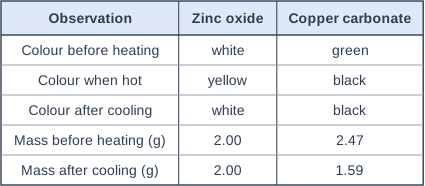
The table shows her results.

The student says:

'Both solids have had a chemical change because their colour changed.'

Evaluate the student's statement. Use the data in the table and the particle model.

Table with columns "Observation", "Zinc oxide", "Copper carbonate". Observation: Colour before heating; Zinc oxide: white; Copper carbonate: green | Observation: Colour when hot; Zinc oxide: yellow; Copper carbonate: black | Observation: Colour after cooling; Zinc oxide: white; Copper carbonate: black | Observation: Mass before heating (g); Zinc oxide: 2.00; Copper carbonate: 2.47 | Observation: Mass after cooling (g); Zinc oxide: 2.00; Copper carbonate: 1.59.

Model answer

The student is only partly correct. Zinc oxide turns yellow when hot but goes back to white when it cools, and its mass stays at 2.00 g. No new substance has formed: the particles are the same and only their energy changed, so this is a physical change. Copper carbonate turns black and stays black after cooling, and its mass falls from 2.47 g to 1.59 g, a loss of 0.88 g. A gas (carbon dioxide) has been given off and a new black solid formed, so the atoms have been rearranged into new substances: this is a chemical change. So a colour change on its own does not show that a chemical change has happened.

Explanation

To decide whether a change is chemical, look for evidence that a new substance has formed: the change is not reversed on cooling, or the mass changes because a gas is given off. Zinc oxide gives neither, so its colour change is physical, while copper carbonate gives both. An evaluation needs a judgement on each part of the statement, backed by data from the table.

Mark scheme
  1. 1 mark

    zinc oxide has had a physical change / no chemical change, because it goes back to white when it cools / the colour change is reversed

    Max 3 if no data from the table are used. ALLOW the student is wrong about zinc oxide because it returns to its original colour.

  2. 1 mark

    the mass of zinc oxide does not change (2.00 g before and after), so no new substance has formed / the zinc oxide particles are unchanged

    ALLOW nothing is given off or lost from the zinc oxide. ALLOW the particles stay the same, only their energy changes.

  3. 1 mark

    copper carbonate has had a chemical change, because it stays black after cooling / a new (black) substance has formed

    ALLOW the student is correct about copper carbonate. ALLOW the change is not reversed when it cools. ALLOW copper oxide is formed.

  4. 1 mark

    the mass of copper carbonate decreases (by 0.88 g) because a gas is given off / the atoms are rearranged to form new substances (copper oxide and carbon dioxide)

    ALLOW mass decreases from 2.47 g to 1.59 g because carbon dioxide escapes. ALLOW ECF for a wrongly calculated mass loss if the idea of a gas or new substance is given.

Ready to try the rest? Every answer you write is marked against the mark scheme, so you can see exactly where the marks are.

Study Helper Hints first, answers after you try

Stuck on this one? Ask for a hint and I’ll point you in the right direction, without giving the answer away. Once you’ve checked your answer, I’ll show you how the marks are awarded.