Question 1
1 markLiquid nitrogen boils at −196 °C. A scientist cools small samples of three substances in sealed tubes by standing the tubes in liquid nitrogen until each sample reaches −196 °C.
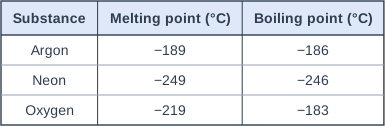
The table shows the melting points and boiling points of the three substances.
Which row shows the states of argon, neon and oxygen at −196 °C?
Choose your answer.
- A argon gas; neon gas; oxygen liquid
- B argon liquid; neon gas; oxygen liquid
- C argon solid; neon gas; oxygen gas
- D argon solid; neon gas; oxygen liquid
Model answer
D
Explanation
Compare −196 °C with each pair of values. A substance is solid below its melting point, liquid between its melting point and boiling point, and a gas above its boiling point. With negative temperatures, a bigger number after the minus sign is colder: −196 °C is colder than −189 °C (so argon is solid) but warmer than −219 °C (so oxygen has melted).
Mark scheme
-
1 mark
D / argon solid; neon gas; oxygen liquid
The only correct answer is D: −196 °C is below the melting point of argon (−189 °C), above the boiling point of neon (−246 °C), and between the melting point (−219 °C) and boiling point (−183 °C) of oxygen. A is not correct because argon boils at −186 °C and melts at −189 °C, so at −196 °C it is not a gas; it is a solid. B is not correct because −196 °C is below the melting point of argon, so argon is solid, not liquid. C is not correct because oxygen does not boil until −183 °C, so it is a liquid at −196 °C. ALLOW the letter or the option. If more than one option is given, do not award the mark.