
Level:
Correct: 0
Incorrect: 0
Marks: 0/0
Exam Practice
Course:
Topics:
Avg
score:
–
Topics
done:
0/26

Conservation of mass, stoichiometry and reacting masses

Practise 19 exam-style questions on Conservation of mass, stoichiometry and reacting masses for OCR GCSE Chemistry (Paper 3). Write your answer as you would in the exam and get it marked in seconds against the mark scheme, point by point, with the Study Helper on hand if you get stuck.

  • 19 questions
  • 1–6 marks each
  • Instant marking
  • No sign-up needed
19 questions, marked as you go

Sample questions with model answers

Here are 4 of the questions in this topic, each with a model answer, an explanation of why it earns the marks and the mark scheme an examiner would use.

Question 1

1 mark

Iron(III) oxide reacts with hydrogen when it is heated.

Fe₂O₃ + 3H₂ → 2Fe + 3H₂O

What mass of hydrogen is needed to make 11.16 g of iron?

Relative atomic mass (Ar): H = 1.0 Fe = 55.8

Choose your answer.

  • A 0.27 g
  • B 0.30 g
  • C 0.40 g
  • D 0.60 g

Model answer

D

Explanation

Amount of iron = 11.16 ÷ 55.8 = 0.200 mol. The equation shows that 3 mol of H₂ makes 2 mol of Fe, so 0.300 mol of H₂ is needed, with a mass of 0.300 × 2.0 = 0.60 g. Write the ratio with the substances labelled (H₂ : Fe = 3 : 2) so that you multiply by the right fraction.

Mark scheme
  1. 1 mark

    D / 0.60 g

    The only correct answer is D: 11.16 ÷ 55.8 = 0.200 mol of iron; the equation shows 3 mol of H₂ for every 2 mol of Fe, so 0.200 × 3 ÷ 2 = 0.300 mol of H₂ is needed, which is 0.300 × 2.0 = 0.60 g. A is not correct because it uses the ratio the wrong way round (0.200 × 2 ÷ 3); B is not correct because it uses the Ar of hydrogen (1.0) instead of the Mr of H₂ (2.0); C is not correct because it takes the ratio Fe : H₂ as 1 : 1. ALLOW the letter or the option. If more than one option is given, do not award the mark.
Question 2

2 marks

Ammonium carbonate decomposes when it is heated.

(NH₄)₂CO₃(s) → 2NH₃(g) + H₂O(g) + CO₂(g)

A student heats 2.40 g of ammonium carbonate in an open boiling tube until the reaction stops.

Predict the mass of solid left in the boiling tube.

Explain your answer using the particle model.

Model answer

There will be no solid left (0 g), because all three products are gases. The ammonia, water and carbon dioxide molecules move quickly and spread out, escaping from the open boiling tube into the air. The atoms have not been destroyed: the gases made have a total mass of 2.40 g, but they are no longer in the tube.

Explanation

When every product of a reaction is a gas, a solid can disappear completely from an open container. The law of conservation of mass still applies: the atoms are rearranged into gas molecules that escape. A common error is to think the solid has simply melted or that its mass has been destroyed.

Mark scheme
  1. 1 mark

    0 g / no solid is left, because all of the products are gases

    The prediction must be linked to the products being gases. DO NOT ALLOW 'the ammonium carbonate melts and evaporates'.

  2. 1 mark

    the gas particles / molecules move away / escape (from the open tube) into the air, so their mass is not in the tube (the atoms are not destroyed)

    ALLOW the total mass of ammonia, water vapour and carbon dioxide made is 2.40 g, but it escapes. DO NOT ALLOW 'the atoms are destroyed' or 'the mass disappears'.

Question 3

3 marks

Lithium chloride absorbs water vapour, so it is used to dry the air in some air-conditioning systems. It can be made by reacting lithium carbonate with hydrochloric acid.

Li₂CO₃ + 2HCl → 2LiCl + H₂O + CO₂

Calculate the mass of lithium carbonate needed to make 8.48 tonnes of lithium chloride.

Give your answer in tonnes.

Relative atomic mass (Ar): Li = 6.9 C = 12.0 O = 16.0 Cl = 35.5

Model answer

Mr of LiCl = 6.9 + 35.5 = 42.4
8.48 tonnes = 8 480 000 g
Amount of LiCl = 8 480 000 ÷ 42.4 = 200 000 mol
From the equation, 1 mol Li₂CO₃ makes 2 mol LiCl, so amount of Li₂CO₃ = 200 000 ÷ 2 = 100 000 mol
Mr of Li₂CO₃ = (2 × 6.9) + 12.0 + (3 × 16.0) = 73.8
Mass of Li₂CO₃ = 100 000 × 73.8 = 7 380 000 g = 7.38 tonnes

Explanation

This is a reacting-mass calculation worked backwards, from the product to the reactant needed. 1 tonne = 1 000 000 g, but you can also work in tonnes throughout because the ratio of masses is the same in any unit: 73.8 tonnes of Li₂CO₃ make 84.8 tonnes of LiCl. Missing the 2 in front of LiCl doubles the answer.

Mark scheme
  1. 1 mark

    amount of LiCl = 8 480 000 ÷ 42.4 = 2.00 × 10⁵ (mol); or a correct final answer of 7.38 tonnes with no working

    An answer of 7.38 tonnes with no working scores 3 marks. ALLOW 200 000 mol. ALLOW working in tonnes throughout: 8.48 ÷ 42.4 = 0.200 (Mmol).

  2. 1 mark

    amount of Li₂CO₃ = 2.00 × 10⁵ ÷ 2 = 1.00 × 10⁵ (mol); or a correct final answer of 7.38 tonnes with no working

    ALLOW 100 000 mol. ALLOW the mass-ratio route: 73.8 g of Li₂CO₃ makes 84.8 g of LiCl, so 8.48 × (73.8 ÷ 84.8).

  3. 1 mark

    evaluation: 1.00 × 10⁵ × 73.8 = 7.38 × 10⁶ g = 7.38 (tonnes)

    ALLOW 7.4 tonnes. ALLOW 2 marks for 7 380 000 g or 7380 kg given as the final answer (not converted to tonnes). ALLOW ECF for this mark from a wrong amount shown in the working: for example 14.8 tonnes (ratio 1 : 1 used) scores marking points 1 and 3.

Question 4

4 marks

A student mixes different volumes of calcium chloride solution, CaCl₂(aq), and sodium phosphate solution, Na₃PO₄(aq). Both solutions have a concentration of 0.500 mol/dm³. The total volume of the two solutions is always 10.0 cm³.

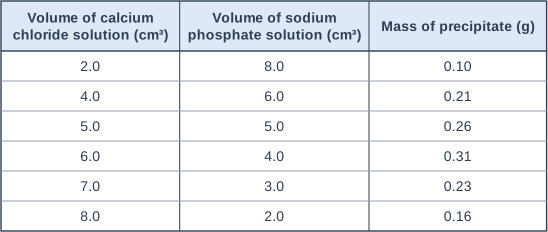
A white precipitate of calcium phosphate, Ca₃(PO₄)₂, forms. The other product is sodium chloride, NaCl, which stays dissolved. The student filters off the precipitate, dries it and weighs it. The table shows the results.

Use the results to deduce the mole ratio in which calcium chloride and sodium phosphate react, and write the balanced equation for the reaction.

Explain why less precipitate forms when 8.0 cm³ of calcium chloride solution is used.

Table with columns "Volume of calcium chloride solution (cm³)", "Volume of sodium phosphate solution (cm³)", "Mass of precipitate (g)". Volume of calcium chloride solution (cm³): 2.0; Volume of sodium phosphate solution (cm³): 8.0; Mass of precipitate (g): 0.10 | Volume of calcium chloride solution (cm³): 4.0; Volume of sodium phosphate solution (cm³): 6.0; Mass of precipitate (g): 0.21 | Volume of calcium chloride solution (cm³): 5.0; Volume of sodium phosphate solution (cm³): 5.0; Mass of precipitate (g): 0.26 | Volume of calcium chloride solution (cm³): 6.0; Volume of sodium phosphate solution (cm³): 4.0; Mass of precipitate (g): 0.31 | Volume of calcium chloride solution (cm³): 7.0; Volume of sodium phosphate solution (cm³): 3.0; Mass of precipitate (g): 0.23 | Volume of calcium chloride solution (cm³): 8.0; Volume of sodium phosphate solution (cm³): 2.0; Mass of precipitate (g): 0.16.

Model answer

The largest mass of precipitate, 0.31 g, forms when 6.0 cm³ of calcium chloride solution is mixed with 4.0 cm³ of sodium phosphate solution, so at this point neither reactant is left over. The two solutions have the same concentration, so their volumes are in the same ratio as the amounts in moles: CaCl₂ : Na₃PO₄ = 6.0 : 4.0 = 3 : 2.
Balanced equation: 3CaCl₂ + 2Na₃PO₄ → Ca₃(PO₄)₂ + 6NaCl
With 8.0 cm³ of calcium chloride solution there is only 2.0 cm³ of sodium phosphate solution (0.00100 mol). To react with all 0.00400 mol of calcium chloride, 0.00267 mol of sodium phosphate would be needed, so sodium phosphate is the limiting reactant: it is used up, some calcium chloride is left over, and less precipitate forms.

Explanation

When the total volume is kept the same, the most product forms when the reactants are mixed in exactly the ratio in the equation, so the peak in the results gives the mole ratio. On either side of the peak, one reactant is limiting and the other is in excess. Check the equation by counting atoms: 3 Ca, 6 Na, 6 Cl, 2 P and 8 O on each side.

Mark scheme
  1. 1 mark

    the greatest mass of precipitate forms with 6.0 cm³ of calcium chloride solution and 4.0 cm³ of sodium phosphate solution

    ALLOW the peak is at 6.0 cm³ of calcium chloride solution. A balanced equation with no use of the data scores marking point 3 only.

  2. 1 mark

    the solutions have the same concentration, so the mole ratio CaCl₂ : Na₃PO₄ = 6.0 : 4.0 = 3 : 2

    ALLOW the amounts in moles: 0.00300 mol of CaCl₂ and 0.00200 mol of Na₃PO₄ (ratio 3 : 2). ALLOW ECF from a wrong peak in marking point 1.

  3. 1 mark

    3CaCl₂ + 2Na₃PO₄ → Ca₃(PO₄)₂ + 6NaCl

    ALLOW correct multiples. IGNORE state symbols. Typed forms: ALLOW plain numbers for subscripts and -> or = for →.

  4. 1 mark

    with 8.0 cm³ of calcium chloride solution there is only 2.0 cm³ of sodium phosphate solution, less than is needed to react with all the calcium chloride, so sodium phosphate is the limiting reactant (and calcium chloride is in excess)

    ALLOW 0.00400 mol of CaCl₂ would need 0.00267 mol of Na₃PO₄, but only 0.00100 mol is present. ALLOW sodium phosphate is used up first / runs out. The idea of a limiting reactant (or of the other reactant being in excess) is needed for this mark.

Ready to try the rest? Every answer you write is marked against the mark scheme, so you can see exactly where the marks are.

Study Helper Hints first, answers after you try

Stuck on this one? Ask for a hint and I’ll point you in the right direction, without giving the answer away. Once you’ve checked your answer, I’ll show you how the marks are awarded.