
Level:
Correct: 0
Incorrect: 0
Marks: 0/0
Exam Practice
Course:
Topics:
Avg
score:
–
Topics
done:
0/26

Choosing purification and chromatographic methods

Practise 14 exam-style questions on Choosing purification and chromatographic methods for OCR GCSE Chemistry (Paper 3). Write your answer as you would in the exam and get it marked in seconds against the mark scheme, point by point, with the Study Helper on hand if you get stuck.

  • 14 questions
  • 1–6 marks each
  • Instant marking
  • No sign-up needed
14 questions, marked as you go

Sample questions with model answers

Here are 4 of the questions in this topic, each with a model answer, an explanation of why it earns the marks and the mark scheme an examiner would use.

Question 1

1 mark

A factory makes tartrazine, a yellow food dye. Tartrazine is a solid that dissolves in water. It decomposes when heated strongly, before it can boil.

Which method is most suitable to show whether a batch of tartrazine is pure?

Choose your answer.

  • A dissolve the batch in water and filter the solution
  • B paper chromatography of the batch, using water as the solvent
  • C gas chromatography of the batch, comparing it with pure tartrazine
  • D measure the boiling point of the batch

Model answer

B

Explanation

Choose the method from the properties given. Gas chromatography needs a sample that can be vaporised, and a boiling point needs a substance that boils without decomposing. A coloured, water-soluble solid suits paper chromatography with an aqueous solvent: a pure substance gives a single spot, at the same height as the pure reference.

Mark scheme
  1. 1 mark

    B / paper chromatography of the batch, using water as the solvent

    The only correct answer is B: tartrazine dissolves in water and is coloured, so paper chromatography with water shows a single spot if the batch is pure (level with a spot of pure tartrazine, if one is run alongside), and extra spots if it is not. A is not correct because filtering only removes insoluble solids, and any soluble impurities would pass through with the tartrazine; C is not correct because the sample must be turned into a gas for gas chromatography, and tartrazine decomposes before it can boil, so comparing it with pure tartrazine does not help; D is not correct because tartrazine decomposes before it boils, so it has no boiling point to measure. ALLOW the letter or the method. If more than one option is given, do not award the mark.
Question 2

2 marks

A student heats a black ink in simple distillation apparatus. Colourless water collects in the beaker and a black residue is left in the flask.

Explain why simple distillation does not separate the dyes in the ink from each other.

Name a technique that would separate the dyes.

Model answer

In simple distillation only the water boils and is condensed. The dyes do not boil at this temperature, so they all stay behind in the flask together as the residue and are not separated from each other. Paper chromatography would separate the dyes.

Explanation

Distillation separates a liquid from substances that boil at a much higher temperature, so it recovers the solvent but leaves all the dissolved solids together. Chromatography separates substances by how they are distributed between a mobile and a stationary phase, so it can separate dyes that are all dissolved in the same ink.

Mark scheme
  1. 1 mark

    the dyes do not boil / evaporate (at the temperature of the flask), so only the water boils off and all the dyes are left behind together (in the flask)

    ALLOW distillation only separates the liquid / solvent from the dissolved solids. ALLOW the dyes have much higher boiling points than water, so they stay in the flask together. IGNORE the dyes are mixed.

  2. 1 mark

    (paper / thin layer) chromatography

    ALLOW TLC. DO NOT ALLOW fractional distillation / crystallisation / filtration. If more than one technique is given, do not award this mark.

Question 3

3 marks

Sucralose is a colourless sweetener. It is a solid that dissolves in ethanol. It decomposes when heated strongly, before it can boil.

A scientist wants to check the purity of a sample of sucralose. She can use paper chromatography, thin layer chromatography (TLC) or gas chromatography (GC).

Suggest which method she should use. Justify your choice and explain how the result would show whether the sample is pure.

Model answer

She should use TLC with ethanol as the solvent, because sucralose dissolves in ethanol. Gas chromatography is not suitable because sucralose decomposes before it boils, so it cannot be turned into a gas. Sucralose is colourless, so after running the plate she must use a locating agent or UV light to see the spots. If the sample is pure it gives one spot, at the same Rf value as pure sucralose run on the same plate; any extra spot shows an impurity.

Explanation

Match the method to the properties: GC needs a volatile sample, while paper and TLC need a solvent that dissolves the substance. Colourless substances need a locating agent or UV light. Many answers choose a method but do not justify it, or forget that colourless spots are invisible without help.

Mark scheme
  1. 1 mark

    TLC / paper chromatography, using a solvent that dissolves sucralose, such as ethanol

    Max 3. Both the method (TLC or paper chromatography) and a suitable solvent, or the idea that the solvent must dissolve sucralose, are needed for this mark. ALLOW water as the solvent (sucralose also dissolves in water). DO NOT ALLOW gas chromatography (no marks for the choice, but marking points 3 and 4 can still be awarded).

  2. 1 mark

    not GC because sucralose decomposes before it boils / cannot be turned into a gas

    ALLOW GC needs a sample that can be vaporised.

  3. 1 mark

    sucralose is colourless, so a locating agent / UV light is needed to see the spots

    ALLOW spray with a locating agent / use a fluorescent plate under UV light.

  4. 1 mark

    a pure sample gives one spot (at the same Rf as pure sucralose); more than one spot means it is impure

    ALLOW ORA (allow the reverse argument). ALLOW the sample's spot should match a spot of pure sucralose run on the same plate.

Question 4

4 marks

A sample of fertiliser is a mixture of 90 g of potassium nitrate and 10 g of sodium chloride.

A chemist dissolves the mixture in 100 g of water at 80 °C. She then cools the solution to 20 °C. Crystals form, and she filters them off.

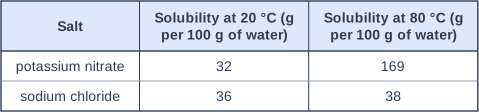
The table shows the solubility of the two salts.

Calculate the mass of potassium nitrate crystals that form.

Explain why the crystals contain no sodium chloride.

Table with columns "Salt", "Solubility at 20 °C (g per 100 g of water)", "Solubility at 80 °C (g per 100 g of water)". Salt: potassium nitrate; Solubility at 20 °C (g per 100 g of water): 32; Solubility at 80 °C (g per 100 g of water): 169 | Salt: sodium chloride; Solubility at 20 °C (g per 100 g of water): 36; Solubility at 80 °C (g per 100 g of water): 38.

Model answer

At 80 °C both salts dissolve completely, because 90 g is less than 169 g and 10 g is less than 38 g.

At 20 °C only 32 g of potassium nitrate can stay dissolved in 100 g of water.
Mass of potassium nitrate crystals = 90 − 32 = 58 g

The solubility of sodium chloride hardly changes: at 20 °C, 36 g can dissolve, which is more than the 10 g present. So all of the sodium chloride stays in solution and passes through the filter paper, and the crystals contain no sodium chloride.

Explanation

When a solution is cooled, a solute crystallises only if there is more of it than its solubility at the lower temperature. Potassium nitrate's solubility falls steeply, so 90 − 32 = 58 g crystallises; sodium chloride's solubility hardly changes and 10 g is well below 36 g, so it all stays dissolved. A common error is to subtract the two solubilities of potassium nitrate (169 − 32), forgetting that only 90 g was present.

Mark scheme
  1. 1 mark

    mass of crystals = 90 − 32; or a correct final answer of 58 g with no working

    An answer of 58 g with no working scores marking points 1 and 2. Max 4.

  2. 1 mark

    evaluation: 58 (g)

    DO NOT ALLOW 137 g (169 − 32: the mixture contains only 90 g) or 79 g (169 − 90).

  3. 1 mark

    potassium nitrate is much less soluble at the lower temperature / its solubility falls a lot on cooling, so (the amount above its solubility) crystallises out of the solution

    ALLOW the water can hold only 32 g of potassium nitrate when cold, so the rest forms crystals.

  4. 1 mark

    the mass of sodium chloride is less than its solubility at the lower temperature (and its solubility hardly changes), so all of it stays dissolved

    ALLOW 10 g is less than 36 g, so the sodium chloride does not crystallise. ALLOW sodium chloride stays in solution and passes through the filter paper.

  5. 1 mark

    both salts dissolve completely in the hot water / the masses are below the solubilities of both salts at the higher temperature (so there is no solid sodium chloride at the start)

    ALLOW 90 g is less than 169 g and 10 g is less than 38 g.

Ready to try the rest? Every answer you write is marked against the mark scheme, so you can see exactly where the marks are.

Study Helper Hints first, answers after you try

Stuck on this one? Ask for a hint and I’ll point you in the right direction, without giving the answer away. Once you’ve checked your answer, I’ll show you how the marks are awarded.