
Level:
Correct: 0
Incorrect: 0
Marks: 0/0
Exam Practice
Course:
Topics:
Avg
score:
–
Topics
done:
0/26

Practical skills (chemistry PAGs C1-C8)

Practise 22 exam-style questions on Practical skills (chemistry PAGs C1-C8) for OCR GCSE Chemistry (Paper 3). Write your answer as you would in the exam and get it marked in seconds against the mark scheme, point by point, with the Study Helper on hand if you get stuck.

  • 22 questions
  • 1–6 marks each
  • Instant marking
  • No sign-up needed
20 questions, marked as you go

Sample questions with model answers

Here are 4 of the questions in this topic, each with a model answer, an explanation of why it earns the marks and the mark scheme an examiner would use.

Question 1

1 mark

A student electrolyses copper(II) sulfate solution five times under the same conditions and weighs the copper deposited on the cathode each time. Her results, in g, are:

0.242   0.238   0.240   0.256   0.238

What is the median of her results?

Choose your answer.

  • A 0.238 g
  • B 0.240 g
  • C 0.243 g
  • D 0.247 g

Model answer

B (0.240 g)

In order: 0.238, 0.238, 0.240, 0.242, 0.256. The middle (third) value is 0.240 g.

Explanation

The median is the middle value when the results are put in order. It is less affected by an unusually high or low value (here 0.256 g) than the mean is. Do not confuse it with the mode, the most common value, or the mean, the total divided by the number of results.

Mark scheme
  1. 1 mark

    B / 0.240 g

    The only correct answer is B: in order the results are 0.238, 0.238, 0.240, 0.242, 0.256, and the middle value is 0.240 g. A is not correct because 0.238 g is the mode (the most common value); C is not correct because 0.243 g is the mean (1.214 ÷ 5 = 0.2428); D is not correct because 0.247 g is halfway between the lowest and highest values. ALLOW the letter or the option. If more than one option is given, do not award the mark.
Question 2

2 marks

A student wants to check the purity of some crystals by measuring their melting point. The pure compound melts at 128 °C.

She plans to heat a sample of the crystals in a capillary tube held in a beaker of water (a water bath), heated by a Bunsen burner.

Explain why this method cannot be used, and suggest a suitable piece of apparatus or method for heating the sample.

Model answer

Water boils at 100 °C, so a water bath cannot get hotter than 100 °C. The crystals should melt at about 128 °C, so they would not melt in the water bath and no melting point could be measured. She should use an oil bath or an electrically heated melting point apparatus, which can heat the sample slowly and evenly to above 128 °C, with a thermometer that reads to above 128 °C.

Explanation

When choosing apparatus, check that it covers the range of values needed. A water bath gives gentle, even heating, but only up to 100 °C. Heating the sample directly in a flame would be too fast and uneven to give an accurate melting point.

Mark scheme
  1. 1 mark

    water boils at 100 °C, so the water bath cannot be heated above 100 °C / cannot reach 128 °C, so the crystals would not melt

    ALLOW the water would boil (away) before 128 °C is reached.

  2. 1 mark

    use an oil bath / an electrically heated melting point apparatus / a heating block, which can heat the sample gently and evenly to above 128 °C

    ALLOW any heating method that can heat the sample slowly and evenly above 128 °C, with a thermometer that reads above 128 °C. DO NOT ALLOW heating the capillary tube directly in a Bunsen flame (too fast and uneven to measure the melting point).

Question 3

3 marks

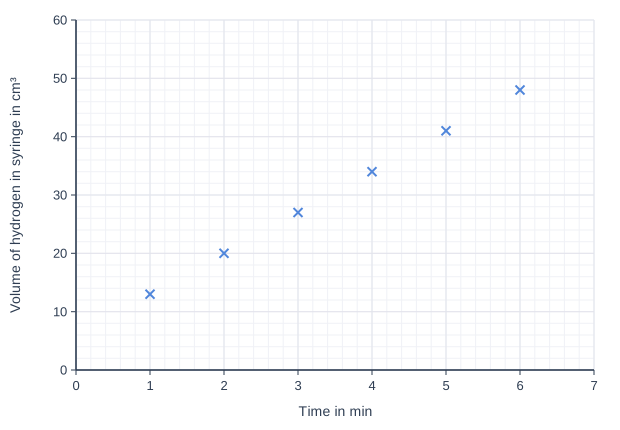
A student electrolyses dilute sulfuric acid with a constant current. The hydrogen from the cathode passes into a gas syringe. She reads the syringe every minute from 1 to 6 minutes.

The graph shows her results. The points lie on a straight line.

The equation of this straight line is V = mt + c, where V is the syringe reading in cm³ and t is the time in minutes.

Determine the values of m and c. Explain what the value of c shows about her readings, and suggest a cause.

Line graph of volume of hydrogen in syringe in cm³ (y-axis, 0 to 60) against time in min (x-axis, 0 to 7). The line is shown as plotted points only (no line), at (1, 13), (2, 20), (3, 27), (4, 34), (5, 41), (6, 48).

Model answer

The gradient is m = (48 − 13) ÷ (6 − 1) = 35 ÷ 5 = 7 cm³ per minute.
At t = 1 min, V = 13 cm³, so c = 13 − 7 = 6 cm³.
So V = 7t + 6.

No hydrogen had been made at 0 minutes, so the line should pass through the origin. The value c = 6 cm³ shows a systematic (zero) error: every reading is about 6 cm³ too high. A likely cause is that about 6 cm³ of air was pushed into the syringe when the bung was pushed into the cell, or the syringe was not at zero at the start.

Explanation

For a straight line V = mt + c, the gradient m is the change in V divided by the change in t, and c is the value of V where the line meets the volume axis. With a constant current, hydrogen is made at a steady rate, so a straight line is expected; it should go through (0, 0) because no gas has formed at the start. A non-zero intercept points to a systematic error that adds the same amount to every reading; subtracting it corrects the results.

Mark scheme
  1. 1 mark

    m = 7 (cm³ per minute); or a correct final answer of m = 7 and c = 6 (or any answers from 6.8 to 7.2 for m and from 5.5 to 6.5 for c) with no working

    An answer of m = 7 and c = 6 (or any answers from 6.8 to 7.2 for m and from 5.5 to 6.5 for c) with no working scores marking points 1 and 2. ALLOW 6.8 to 7.2. ALLOW working such as (48 − 13) ÷ (6 − 1) = 7.

  2. 1 mark

    c = 6 (cm³)

    ALLOW 5.5 to 6.5. ALLOW ECF from the student's value of m (for example c = 13 − m).

  3. 1 mark

    c shows a systematic / zero error: every reading is too high by the same amount (the value of c), because air was pushed into the syringe when the apparatus was sealed / the syringe did not read zero at the start

    Both the idea of a constant extra volume and a sensible cause are needed for this mark. ALLOW 'the plunger was not pushed fully in at the start'. ALLOW 'the stopwatch was started after the current was switched on, so some hydrogen had already been collected'. IGNORE 'random error'.

Question 4

4 marks

Limewater is a saturated solution of calcium hydroxide. It is made by shaking solid calcium hydroxide with water and leaving the excess solid to settle.

A student uses a titration to find out how much calcium hydroxide is dissolved in limewater.
• She filters some limewater, then uses a pipette to put 25.0 cm³ of the filtrate into a conical flask.
• She adds a few drops of indicator. She runs 0.0400 mol/dm³ hydrochloric acid into the flask from a burette, stopping as soon as the indicator changes colour.
• The mean of her concordant titres is 28.45 cm³.

When the indicator changes colour, the acid added has reacted exactly with all of the calcium hydroxide in the 25.0 cm³ of limewater.

Ca(OH)₂(aq) + 2HCl(aq) → CaCl₂(aq) + 2H₂O(l)

Calculate the concentration of calcium hydroxide in the limewater, in mol/dm³.
• First calculate the amount, in moles, of hydrochloric acid in 28.45 cm³ of the acid.
• Then use the equation to find the amount, in moles, of calcium hydroxide in 25.0 cm³ of limewater.
• Then calculate the concentration of calcium hydroxide.

Explain why the student filters the limewater before she uses the pipette.

Model answer

Amount of HCl = 0.0400 × 28.45 ÷ 1000 = 0.001138 mol
The equation shows 1 mol of Ca(OH)₂ reacts with 2 mol of HCl, so amount of Ca(OH)₂ = 0.001138 ÷ 2 = 0.000569 mol
Volume of limewater = 25.0 ÷ 1000 = 0.0250 dm³
Concentration = 0.000569 ÷ 0.0250 = 0.0228 mol/dm³

The student filters the limewater to remove any undissolved solid calcium hydroxide. Solid particles taken up by the pipette would also react with the acid, so the titre would be too large and the calculated concentration would be higher than the concentration of the calcium hydroxide that is dissolved.

Explanation

Work in moles: find the amount of acid from its concentration and the titre in dm³, use the 1 : 2 ratio from the equation, then divide by the volume of limewater in dm³. The most common errors are ignoring the ratio in the equation (which gives 0.0455 mol/dm³) and forgetting to change cm³ into dm³. A saturated solution is in contact with undissolved solid, so only the clear solution must be measured.

Mark scheme
  1. 1 mark

    amount of HCl = 0.0400 × 28.45 ÷ 1000 = 0.001138 / 1.138 × 10⁻³ (mol); or a correct final answer of 0.0228 mol/dm³ with no working

    An answer of 0.0228 mol/dm³ (ALLOW 0.023 or 0.02276) with no working scores marking points 1, 2 and 3. ALLOW 2 marks for 0.0455 mol/dm³ (the 1 : 2 ratio not used) or for 0.0910 mol/dm³ (the amount of HCl multiplied by 2). ALLOW 2 marks for 2.28 × 10⁻⁵ (the volume of limewater not converted to dm³). ALLOW the volume-ratio method, concentration = 0.0400 × 28.45 ÷ (2 × 25.0), for marking points 1 and 2.

  2. 1 mark

    amount of Ca(OH)₂ = 0.001138 ÷ 2 = 0.000569 / 5.69 × 10⁻⁴ (mol); or a correct final answer of 0.0228 mol/dm³ with no working

    ALLOW ECF from marking point 1.

  3. 1 mark

    concentration = 0.000569 ÷ 0.0250 = 0.0228 (mol/dm³)

    ALLOW 0.023 or 0.02276 mol/dm³. ALLOW 2.28 × 10⁻² mol/dm³. ALLOW ECF from marking point 2.

  4. 1 mark

    to remove undissolved / solid calcium hydroxide: any solid in the pipette would also react with the acid, so the titre (and the calculated concentration) would be too high

    Both the idea of undissolved solid and one effect of it (it would also react with the acid / the titre or the calculated concentration would be too high) are needed for this mark. ALLOW 'so that only the dissolved calcium hydroxide reacts with the acid, otherwise the concentration found would be too high'. IGNORE 'to remove impurities' unless undissolved calcium hydroxide is meant. DO NOT ALLOW 'the solid would block the pipette' on its own.

Ready to try the rest? Every answer you write is marked against the mark scheme, so you can see exactly where the marks are.

Study Helper Hints first, answers after you try

Stuck on this one? Ask for a hint and I’ll point you in the right direction, without giving the answer away. Once you’ve checked your answer, I’ll show you how the marks are awarded.