
Level:
Correct: 0
Incorrect: 0
Marks: 0/0
Exam Practice
Course:
Topics:
Avg
score:
–
Topics
done:
0/26

Energetics

Practise 18 exam-style questions on Energetics for OCR GCSE Chemistry (Paper 3). Write your answer as you would in the exam and get it marked in seconds against the mark scheme, point by point, with the Study Helper on hand if you get stuck.

  • 18 questions
  • 1–6 marks each
  • Instant marking
  • No sign-up needed
18 questions, marked as you go

Sample questions with model answers

Here are 4 of the questions in this topic, each with a model answer, an explanation of why it earns the marks and the mark scheme an examiner would use.

Question 1

1 mark

The bond energy of the H–Cl bond is 432 kJ/mol.

Which statement about this bond energy is correct?

Choose your answer.

  • A 432 kJ of energy is released when 1 mole of H–Cl bonds is broken.
  • B 432 kJ of energy is needed to break 1 mole of H–Cl bonds.
  • C 432 kJ of energy is needed to break one H–Cl bond.
  • D 432 kJ of energy is needed to make 1 mole of H–Cl bonds.

Model answer

B

Explanation

Bond energies are given per mole of bonds, in kJ/mol. Breaking a bond always takes in energy, and making the same bond releases the same amount of energy. This is why the energy change of a reaction is the energy needed to break bonds minus the energy released when bonds are made.

Mark scheme
  1. 1 mark

    B / 432 kJ of energy is needed to break 1 mole of H–Cl bonds

    The only correct answer is B: a bond energy is the energy needed (taken in) to break one mole of that bond, and the same amount of energy is released when one mole of the bond is made. A is not correct because breaking bonds takes in energy (it is endothermic) rather than releasing it; C is not correct because 432 kJ is the energy for one mole (6.02 × 10²³) of bonds, not for a single bond; D is not correct because making bonds releases energy rather than needing it. ALLOW the letter or the statement. If more than one option is given, do not award the mark.
Question 2

2 marks

A disposable hand warmer contains iron powder. When the packet is opened, the iron reacts slowly with oxygen from the air and the hand warmer gets hot.

A student says: 'The products of this reaction have less energy than the reactants because the energy has been used up.'

Explain why the student is wrong.

Model answer

Energy is not used up in a chemical reaction: it is conserved. The energy difference between the reactants and the products is transferred to the surroundings as heat, which is why the hand warmer and the hands holding it get warmer.

Explanation

Energy is never used up or lost, only transferred. In an exothermic reaction the chemicals end up with less energy and the surroundings gain that energy, so their temperature rises. 'Used up' is a common misconception to avoid.

Mark scheme
  1. 1 mark

    energy is not used up / energy is conserved / energy cannot be created or destroyed

    IGNORE 'energy is lost' unless the energy is said to go to the surroundings (then credit point 2).

  2. 1 mark

    the energy is transferred to the surroundings / to the hands / to the air (as heat), so the temperature of the surroundings increases

    ALLOW the energy (difference) heats the surroundings / is released to the surroundings. DO NOT ALLOW energy is released by breaking bonds.

Question 3

3 marks

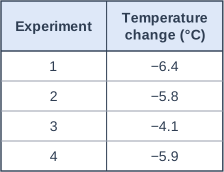
A student adds 3.0 g of potassium hydrogencarbonate to 30 cm³ of dilute hydrochloric acid in a polystyrene cup and measures the temperature change. The reaction is endothermic. The student does the experiment four times.

The table shows the results.

Calculate the mean temperature change, leaving out the anomalous result.

Estimate the uncertainty in the mean as half of the range of the results you used.

Table with columns "Experiment", "Temperature change (°C)". Experiment: 1; Temperature change (°C): −6.4 | Experiment: 2; Temperature change (°C): −5.8 | Experiment: 3; Temperature change (°C): −4.1 | Experiment: 4; Temperature change (°C): −5.9.

Model answer

Experiment 3 (−4.1 °C) is anomalous, so it is left out.
mean = (−6.4 + (−5.8) + (−5.9)) ÷ 3 = −18.1 ÷ 3 = −6.03 = −6.0 °C
range of the results used = 6.4 − 5.8 = 0.6 °C, so uncertainty = ± 0.3 °C
mean temperature change = −6.0 ± 0.3 °C

Explanation

An anomalous result does not fit the pattern of the others, so it is left out before the mean is calculated. Half the range of the results used gives an estimate of the uncertainty in the mean. Keep the negative sign: it shows the temperature fell, as expected for an endothermic reaction.

Mark scheme
  1. 1 mark

    the anomalous result (−4.1 °C) is left out: (−6.4 + −5.8 + −5.9) ÷ 3; or a correct final answer of −6.0 °C ± 0.3 °C with no working

    An answer of −6.0 °C ± 0.3 °C with no working scores 3 marks. A mean of all four results (−5.55 °C) scores 0 for points 1 and 2.

  2. 1 mark

    mean = −6.0 (°C) / −6.03 (°C); or a correct final answer of −6.0 °C ± 0.3 °C with no working

    ALLOW −6 or −6.033. ALLOW 6.0, 6.03 or 6 (°C) given as a fall in temperature.

  3. 1 mark

    uncertainty = ± 0.3 (°C) (half of the range 6.4 − 5.8 = 0.6)

    ALLOW 0.3 without the ± sign. ALLOW −6.0 ± 0.3 °C. ALLOW ECF from the results the student used (for example ± 1.15 or ± 1.2 from all four results).

Question 4

4 marks

Ethanol and methoxymethane both have the formula C₂H₆O, but their atoms are joined in different ways.
• In ethanol, CH₃–CH₂–O–H, there are one C–C bond, five C–H bonds, one C–O bond and one O–H bond.
• In methoxymethane, CH₃–O–CH₃, there are six C–H bonds and two C–O bonds.

Both compounds burn completely in oxygen:

C₂H₆O + 3O₂ → 2CO₂ + 3H₂O

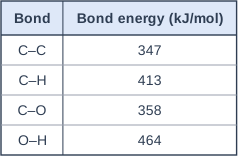
Use the bond energies in the table to calculate the energy needed to break all the bonds in one mole of each compound.

Use your answers to explain which compound gives out more energy when one mole of it burns completely.

Table with columns "Bond", "Bond energy (kJ/mol)". Bond: C–C; Bond energy (kJ/mol): 347 | Bond: C–H; Bond energy (kJ/mol): 413 | Bond: C–O; Bond energy (kJ/mol): 358 | Bond: O–H; Bond energy (kJ/mol): 464.

Model answer

Ethanol: 347 + (5 × 413) + 358 + 464 = 347 + 2065 + 358 + 464 = 3234 kJ/mol
Methoxymethane: (6 × 413) + (2 × 358) = 2478 + 716 = 3194 kJ/mol
When either compound burns, the same bonds are broken in 3O₂ and the same bonds are made in 2CO₂ and 3H₂O, so the only difference between the two energy changes comes from the bonds in the compounds. Less energy (40 kJ/mol less) is needed to break the bonds in methoxymethane, so more energy is given out overall when one mole of methoxymethane burns.

Explanation

Energy change = energy needed to break bonds − energy released making bonds. When two reactions make the same products from the same amount of oxygen, the one whose reactant bonds need less energy to break gives out more energy. List the bonds in each molecule carefully: ethanol has a C–C bond and an O–H bond that methoxymethane does not have.

Mark scheme
  1. 1 mark

    ethanol: 347 + (5 × 413) + 358 + 464 = 3234 (kJ/mol); or a correct final answer of 3234 kJ/mol for ethanol with no working

    An answer of 3234 kJ/mol for ethanol and 3194 kJ/mol for methoxymethane with no working scores marking points 1 and 2. ALLOW 347 + 2065 + 358 + 464. ALLOW ECF for marking point 4 from wrong totals (the compound with the smaller total gives out more energy).

  2. 1 mark

    methoxymethane: (6 × 413) + (2 × 358) = 3194 (kJ/mol)

    ALLOW 2478 + 716. IGNORE units.

  3. 1 mark

    the bonds broken in the oxygen molecules and the bonds made in carbon dioxide and water are the same for both compounds

    ALLOW 'the products and the oxygen are the same in both reactions, so only the bonds in the compounds differ'.

  4. 1 mark

    so methoxymethane gives out more energy when it burns, because less energy is needed to break its bonds

    ALLOW methoxymethane gives out 40 kJ/mol more energy. DO NOT ALLOW ethanol. DO NOT ALLOW a conclusion with no reason.

Ready to try the rest? Every answer you write is marked against the mark scheme, so you can see exactly where the marks are.

Study Helper Hints first, answers after you try

Stuck on this one? Ask for a hint and I’ll point you in the right direction, without giving the answer away. Once you’ve checked your answer, I’ll show you how the marks are awarded.