
Level:
Correct: 0
Incorrect: 0
Marks: 0/0
Exam Practice
Course:
Topics:
Avg
score:
–
Topics
done:
0/26

Nanoparticles: size, surface area, uses and risks

Practise 16 exam-style questions on Nanoparticles: size, surface area, uses and risks for OCR GCSE Chemistry (Paper 3). Write your answer as you would in the exam and get it marked in seconds against the mark scheme, point by point, with the Study Helper on hand if you get stuck.

  • 16 questions
  • 1–6 marks each
  • Instant marking
  • No sign-up needed
16 questions, marked as you go

Sample questions with model answers

Here are 4 of the questions in this topic, each with a model answer, an explanation of why it earns the marks and the mark scheme an examiner would use.

Question 1

1 mark

Nickel is used as a catalyst. A chemist has two samples of nickel with the same mass.

• In sample P, each particle is a cube with sides of 2.4 µm.
• In sample Q, each particle is a cube with sides of 6.0 nm.

1 µm = 1000 nm

How many times larger is the total surface area of sample Q than the total surface area of sample P?

Choose your answer.

  • A 0.0025
  • B 400
  • C 160 000
  • D 64 000 000

Model answer

B

Explanation

Equal masses have equal total volumes, so the total surface area depends on the surface area to volume ratio, which is 6 ÷ L for a cube. Making the side 400 times smaller makes the total surface area 400 times larger: there are 400³ times as many particles, but each has 400² times less surface. This is why a catalyst made of nanoparticles needs far less metal.

Mark scheme
  1. 1 mark

    B / 400

    The only correct answer is B: the two samples have the same mass, so the same total volume; for a cube of side L the surface area to volume ratio is 6L² ÷ L³ = 6 ÷ L, so the total surface area (ratio × total volume) is inversely proportional to the side length; 2.4 µm = 2400 nm and 2400 ÷ 6.0 = 400. A is not correct because 0.0025 is 6.0 ÷ 2400, the comparison the wrong way round; C is not correct because 160 000 (400²) compares the surface areas of single particles (and a single particle of P has the larger surface area); D is not correct because 64 000 000 (400³) is the number of particles of Q for each particle of P, which ignores that each particle of Q has a much smaller surface area. ALLOW the letter or the option. If more than one option is given, do not award the mark.
Question 2

2 marks

A teacher uses a demonstration to model how the size of particles affects the properties of a substance.

She stirs equal masses of three types of sugar into separate beakers, each containing 100 cm³ of water at 20 °C. She times how long it takes until no sugar can be seen.

• sugar cube: 150 s
• granulated sugar: 35 s
• icing sugar (a very fine powder): 8 s

Explain these results using ideas about surface area to volume ratio.

Give one limitation of the demonstration as a model of the properties of nanoparticles.

Model answer

The smaller the grains, the larger their surface area to volume ratio, so for the same mass of sugar a much larger surface is in contact with the water and the sugar dissolves faster. Icing sugar has the largest surface area to volume ratio, so it dissolves fastest.
One limitation is that even the grains of icing sugar are far larger than nanoparticles, so the model does not show how large the surface area to volume ratio of nanoparticles is.

Explanation

Breaking a solid into smaller pieces does not change its total volume but creates new surface, so the surface area to volume ratio increases. Dissolving happens at the surface of the solid, so the finest powder dissolves fastest. The model is useful, but it works at a much larger scale than nanoparticles and shows only one property.

Mark scheme
  1. 1 mark

    the smaller the grains, the larger the surface area to volume ratio (the larger the total surface area of the same mass of sugar), so more of the sugar is in contact with the water at the same time

    Marking points 2 to 4 are limitations of the model: 1 mark for any one, max 1. ORA (allow the reverse argument). IGNORE 'the icing sugar grains are smaller' with no reference to surface area. IGNORE references to particles colliding. For the limitation, IGNORE limitations of the method rather than of the model, such as 'each test was done only once'.

  2. 1 mark

    limitation: even the grains of icing sugar are much larger than nanoparticles (so their surface area to volume ratio is far smaller)

    ALLOW 'the sugar grains are not on the nanoscale'.

  3. 1 mark

    limitation: it shows only one property (how fast the sugar dissolves), but nanoparticles can have other different properties (such as colour, melting point or acting as a catalyst)

    ALLOW 'it does not show the new properties that nanoparticles can have'.

  4. 1 mark

    limitation: a sugar cube is made of grains stuck together, so it is not one large particle

    ALLOW 'the sugar cube is already made of small grains'.

Question 3

3 marks

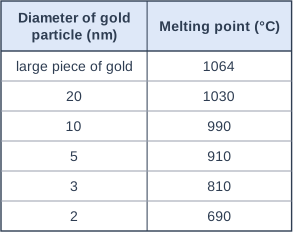
A scientist measured the melting points of gold particles of different diameters. The table shows the scientist's results.

An atom at the surface of a particle has fewer neighbouring atoms than an atom inside the particle, so it is held in place less strongly.

Describe the pattern in the results. Use data from the table in your answer.

Explain the pattern using ideas about surface area to volume ratio.

Table with columns "Diameter of gold particle (nm)", "Melting point (°C)". Diameter of gold particle (nm): large piece of gold; Melting point (°C): 1064 | Diameter of gold particle (nm): 20; Melting point (°C): 1030 | Diameter of gold particle (nm): 10; Melting point (°C): 990 | Diameter of gold particle (nm): 5; Melting point (°C): 910 | Diameter of gold particle (nm): 3; Melting point (°C): 810 | Diameter of gold particle (nm): 2; Melting point (°C): 690.

Model answer

As the diameter of the particles decreases, the melting point decreases. The fall is small for larger particles (from 1064 °C for a large piece to 1030 °C at 20 nm) but much larger for the smallest particles (from 810 °C at 3 nm to 690 °C at 2 nm).
The smaller the particle, the larger its surface area to volume ratio, so a larger proportion of its atoms are at the surface. These surface atoms have fewer neighbours and are held less strongly, so less energy is needed to overcome the forces holding the atoms in place, and the particle melts at a lower temperature.

Explanation

When a particle gets smaller, its volume falls faster than its surface area, so the fraction of atoms at the surface rises - slowly for large particles and very steeply below about 10 nm. Surface atoms are held less strongly, so less energy is needed to melt the particle. This is an example of nanoparticles having different properties from the bulk material, even though they are made of the same atoms.

Mark scheme
  1. 1 mark

    the melting point decreases as the diameter of the particles decreases

    Max 2 if no data from the table are used. ORA (allow the reverse argument). ALLOW data such as: a large piece melts at 1064 °C but 2 nm particles melt at 690 °C (374 °C lower); the melting point falls by only 34 °C from a large piece to 20 nm, but by 120 °C from 3 nm to 2 nm. ALLOW 'the melting point falls more steeply as the particles get smaller'.

  2. 1 mark

    smaller particles have a larger surface area to volume ratio, so a larger proportion (fraction) of their atoms are at the surface

    ALLOW 'more of the atoms are at the surface'. IGNORE 'smaller particles have more surface area' (a single smaller particle has less surface area).

  3. 1 mark

    (surface atoms are held less strongly, so) less energy is needed to overcome the forces (metallic bonding) holding the atoms in place, so the melting point is lower

    DO NOT ALLOW 'the atoms are smaller' or 'the atoms melt'. DO NOT ALLOW 'intermolecular forces' (gold is a metal).

Question 4

5 marks

Palladium is a very expensive metal. It is used as a catalyst in the catalytic converters of cars. The palladium speeds up reactions of the exhaust gases.

In a simple model, a palladium nanoparticle is a cube of atoms arranged in rows, columns and layers, with 12 atoms along each edge.

Calculate the percentage of the atoms in this nanoparticle that are at its surface.

In a palladium powder with particles about 1 µm across, only about 0.2% of the atoms are at the surface.

Use your answer to explain why using palladium nanoparticles instead of the powder reduces the cost of a catalytic converter.

Model answer

total atoms = 12 × 12 × 12 = 1728
The atoms not at the surface form a cube with 10 atoms along each edge: 10³ = 1000
atoms at the surface = 1728 − 1000 = 728
percentage at the surface = 728 ÷ 1728 × 100 = 42%
The reactions happen only on the surface, so only the palladium atoms at the surface can act as a catalyst. In the nanoparticles about 42% of the atoms are at the surface, compared with only about 0.2% in the powder - about 200 times as many. So a much smaller mass of palladium nanoparticles gives the same number of surface atoms, and less of the expensive metal is needed in each catalytic converter.

Explanation

The atoms inside form a smaller cube with one atom taken off each end of every row, so it has 12 − 2 = 10 atoms along each edge. A common error is 6 × 12² = 864, which counts the atoms on the edges and corners more than once. The smaller the particle, the larger the fraction of its atoms at the surface, which is why nanoparticle catalysts need far less metal.

Mark scheme
  1. 1 mark

    total number of atoms = 12³ = 1728; or a correct final answer of 42% with no working

    An answer of 42% (or 42.1%) with no working scores marking points 1, 2 and 3. With working shown, an answer of 50% (from 6 × 12² = 864 surface atoms, which counts the atoms on the edges and corners more than once) scores marking points 1 and 3 (ECF). With working shown, an answer of 23% (from taking 11³ = 1331 atoms as the atoms inside) scores marking points 1 and 3 (ECF).

  2. 1 mark

    atoms not at the surface = 10³ = 1000, so atoms at the surface = 1728 − 1000 = 728 / atoms at the surface = 2 × 144 + 2 × 120 + 2 × 100 = 728; or a correct final answer of 42% with no working

    ALLOW any correct method of counting the 728 surface atoms.

  3. 1 mark

    percentage at the surface = 728 ÷ 1728 × 100 = 42 (%)

    ALLOW 42.1% or 42.13%. ALLOW ECF from a wrong number of surface atoms or a wrong total.

  4. 1 mark

    only the atoms at the surface can be in contact with the exhaust gases (reactant molecules), so only surface atoms can catalyse the reactions

    ALLOW 'the reactions only happen where the gases touch the palladium' or 'catalysed reactions take place on the surface of the catalyst'. IGNORE 'nanoparticles are smaller' alone.

  5. 1 mark

    the nanoparticles have a much larger proportion of their atoms at the surface than the powder, so a much smaller mass of palladium is needed to give the same surface for the reactions (so less of the expensive metal is used)

    ALLOW use of the figures, for example 'about 42% compared with 0.2%, so about 200 times as many surface atoms for the same mass'. ALLOW ECF from the calculated percentage. IGNORE 'nanoparticles are cheaper to make'.

Ready to try the rest? Every answer you write is marked against the mark scheme, so you can see exactly where the marks are.

Study Helper Hints first, answers after you try

Stuck on this one? Ask for a hint and I’ll point you in the right direction, without giving the answer away. Once you’ve checked your answer, I’ll show you how the marks are awarded.