
Level:
Correct: 0
Incorrect: 0
Marks: 0/0
Exam Practice
Course:
Topics:
Avg
score:
–
Topics
done:
0/26

Purity and melting points

Practise 13 exam-style questions on Purity and melting points for OCR GCSE Chemistry (Paper 3). Write your answer as you would in the exam and get it marked in seconds against the mark scheme, point by point, with the Study Helper on hand if you get stuck.

  • 13 questions
  • 1–6 marks each
  • Instant marking
  • No sign-up needed
13 questions, marked as you go

Sample questions with model answers

Here are 4 of the questions in this topic, each with a model answer, an explanation of why it earns the marks and the mark scheme an examiner would use.

Question 1

1 mark

A small amount of an impurity is mixed with a pure solid compound.

How does the impure solid melt, compared with the pure compound?

Choose your answer.

  • A it starts to melt at a higher temperature and melts sharply
  • B it starts to melt at a higher temperature and melts gradually over several degrees
  • C it starts to melt at a lower temperature and melts sharply
  • D it starts to melt at a lower temperature and melts gradually over several degrees

Model answer

D

Explanation

A pure substance melts sharply at a fixed temperature. Even a small amount of impurity lowers the melting point and spreads the melting over a range of temperatures. So a low, wide melting range is evidence that a sample is impure.

Mark scheme
  1. 1 mark

    D / it starts to melt at a lower temperature and melts gradually over several degrees

    The only correct answer is D: an impurity lowers the temperature at which a solid starts to melt and makes it melt over a range of temperatures. A is not correct because impurities lower the melting point, not raise it, and a sharp melting point is a sign of a pure substance; B is not correct because the melting point is lowered, not raised; C is not correct because an impure solid does not melt sharply at one temperature. ALLOW the letter or the option. If more than one option is given, do not award the mark.
Question 2

2 marks

A student dissolves some glucose in distilled water. The solution is clear and colourless. When the student pours it through a filter paper, nothing is left on the paper.

The student says: 'The solution is pure, because nothing can be seen in it and nothing is trapped by the filter paper.'

Explain why the student is wrong.

Model answer

The solution is a mixture of two substances, glucose and water, so it is not pure: a pure substance contains only one substance. When glucose dissolves, its molecules spread out between the water molecules. They are far too small to be seen or to be trapped by the filter paper, so the glucose is still present even though nothing can be seen.

Explanation

In science, 'pure' means a single element or compound with nothing else mixed in. A solution always contains at least two substances, the solute and the solvent, so it is a mixture. Thinking that a clear solution is pure because the dissolved substance cannot be seen is a common misconception.

Mark scheme
  1. 1 mark

    the solution contains two substances, glucose and water / is a mixture, but a pure substance contains only one substance

    ALLOW 'it is impure because it contains glucose as well as water'. ALLOW 'a pure substance is a single element or compound' / 'contains only one type of molecule / particle' (the solution has two types of molecule). IGNORE 'it contains impurities' if what they are is not stated. DO NOT ALLOW 'the glucose reacts with the water to make a new substance'.

  2. 1 mark

    the glucose is still there: its particles are spread out between the water molecules / are too small to be seen or to be trapped by the filter paper

    ALLOW 'dissolved substances pass through filter paper'. ALLOW 'dissolving does not remove the glucose'. IGNORE 'the glucose disappears'. DO NOT ALLOW 'the glucose turns into water'.

Question 3

3 marks

A tub of table salt is labelled 'pure dried vacuum salt'. The label also says that the salt contains at least 99.8% sodium chloride by mass.

The tub contains 750 g of salt.

Calculate the maximum mass of substances other than sodium chloride in the tub.

Explain whether a chemist would describe this salt as pure.

Model answer

Percentage that is not sodium chloride = 100 − 99.8 = 0.2 %
Mass = 0.2 ÷ 100 × 750 = 1.5 g
A chemist would not describe the salt as pure. Up to 1.5 g of it is other substances, so it is a mixture of sodium chloride with small amounts of other substances, even though it is very nearly pure.

Explanation

First find the percentage that is not sodium chloride (0.2 %), then find that percentage of 750 g. A common error is to give the mass of sodium chloride (748.5 g) instead. On a food label 'pure' means that nothing unwanted has been added, but in science a pure substance contains only one substance, so any other substance, however little, makes it impure.

Mark scheme
  1. 1 mark

    (100 − 99.8 = 0.2 %, so) 0.2 ÷ 100 × 750 / 750 − (99.8 ÷ 100 × 750); or a correct final answer of 1.5 g with no working

    An answer of 1.5 g with no working scores marking points 1 and 2. ALLOW 750 × 0.002. ALLOW 1 mark for 748.5 g (the mass of sodium chloride) seen in the working.

  2. 1 mark

    1.5 (g)

    ALLOW 1.50 g. IGNORE units.

  3. 1 mark

    not pure (in the scientific sense), because it contains other substances as well as sodium chloride / it is a mixture

    ALLOW 'it contains up to 1.5 g (0.2 %) of other substances'. ALLOW 'very nearly pure, but still a mixture'. ALLOW 'a pure substance contains only one element or compound / one type of particle, and this salt contains other substances as well'. The answer must say that other substances are present. DO NOT ALLOW 'pure because it is 99.8 % sodium chloride' or 'pure because nothing has been added'. ALLOW ECF from a wrong mass in marking point 2.

Question 4

4 marks

A company makes a medicine, compound Y. Pure Y melts at 138.0 °C.

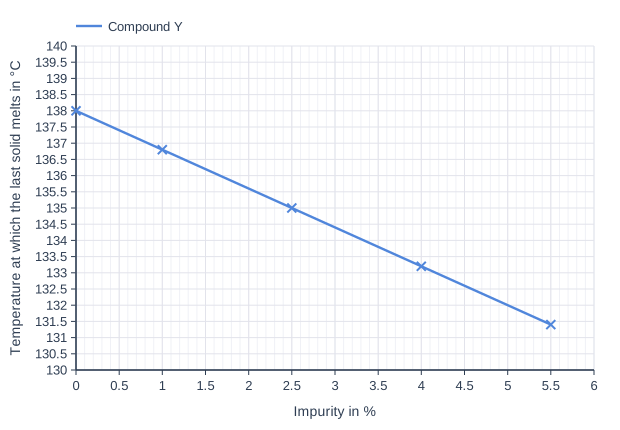
A scientist mixes pure Y with different small percentages by mass of an impurity. For each sample, she records the temperature at which the last of the solid melts. The graph shows her results.

A new batch of Y finishes melting at 134.4 °C. The company sells only batches that contain less than 2% impurity.

Use the graph to estimate the percentage of impurity in the new batch.

Describe the relationship shown by the graph, and explain whether the company can sell the new batch.

Line graph of temperature at which the last solid melts in °C (y-axis, 130 to 140) against impurity in % (x-axis, 0 to 6). "Compound Y" joins the points (0, 138), (1, 136.8), (2.5, 135), (4, 133.2), (5.5, 131.4).

Model answer

Reading across from 134.4 °C to the line and down to the impurity axis, the new batch contains about 3.0% impurity.
As the percentage of impurity increases, the temperature at which Y finishes melting decreases. The line is straight: the melting temperature falls by about 1.2 °C for each 1% of impurity.
The batch contains about 3.0% impurity, which is more than 2%, so the company cannot sell it.

Explanation

Read across from 134.4 °C on the temperature axis to the line, then down to the impurity axis. Impurities lower the melting point of a substance, so a lower final melting temperature means more impurity. 'Directly proportional' is wrong here, because the line does not pass through the origin; a common error is to say the batch can be sold because 134.4 °C is close to 138.0 °C.

Mark scheme
  1. 1 mark

    (about) 3.0 (%)

    A reading of 3.0 % (or any reading from 2.8 to 3.2 %) with no working scores marking point 1. ALLOW 2.8 to 3.2 %.

  2. 1 mark

    as the percentage of impurity increases, the (final) melting temperature decreases

    ORA (allow the reverse argument). ALLOW 'more impurity lowers the melting point'.

  3. 1 mark

    the line is straight / the melting temperature falls by the same amount for each equal increase in impurity

    ALLOW 'the melting temperature is lowered by about 1.2 °C for each 1 % of impurity' (ALLOW 1.1 to 1.3 °C). ALLOW 'linear' or 'it decreases at a constant rate'. DO NOT ALLOW 'directly proportional' or 'inversely proportional'.

  4. 1 mark

    the batch cannot be sold, because its (estimated) impurity is more than the company's limit

    ALLOW 'it cannot be sold because 134.4 °C is below the melting temperature for 2 % impurity (about 135.6 °C)'. ALLOW ECF from the value given for marking point 1 (for example, a reading below 2 % with the conclusion that it can be sold). The decision must be supported by a comparison with the limit.

Ready to try the rest? Every answer you write is marked against the mark scheme, so you can see exactly where the marks are.

Study Helper Hints first, answers after you try

Stuck on this one? Ask for a hint and I’ll point you in the right direction, without giving the answer away. Once you’ve checked your answer, I’ll show you how the marks are awarded.