
Level:
Correct: 0
Incorrect: 0
Marks: 0/0
Exam Practice
Course:
Topics:
Avg
score:
–
Topics
done:
0/26

Strong and weak acids and pH

Practise 17 exam-style questions on Strong and weak acids and pH for OCR GCSE Chemistry (Paper 3). Write your answer as you would in the exam and get it marked in seconds against the mark scheme, point by point, with the Study Helper on hand if you get stuck.

  • 17 questions
  • 1–6 marks each
  • Instant marking
  • No sign-up needed
17 questions, marked as you go

Sample questions with model answers

Here are 4 of the questions in this topic, each with a model answer, an explanation of why it earns the marks and the mark scheme an examiner would use.

Question 1

1 mark

Pure water is neutral and has a pH of 7.

Which statement about a neutral solution is correct?

Choose your answer.

  • A It contains no hydrogen ions and no hydroxide ions.
  • B It contains hydrogen ions but no hydroxide ions.
  • C It contains hydrogen ions at a concentration of 7 mol/dm³.
  • D It contains hydrogen ions at a concentration of 1 × 10⁻⁷ mol/dm³.

Model answer

D - It contains hydrogen ions at a concentration of 1 × 10⁻⁷ mol/dm³.

Explanation

Every aqueous solution contains some hydrogen ions. For a whole-number pH value n, the H⁺ concentration is 1 × 10⁻ⁿ mol/dm³, so pH 7 means 1 × 10⁻⁷ mol/dm³. A neutral solution has equal concentrations of H⁺ and OH⁻ ions; acidic solutions have more H⁺ and lower pH values, and alkaline solutions have fewer H⁺ and higher pH values.

Mark scheme
  1. 1 mark

    D / it contains hydrogen ions at a concentration of 1 × 10⁻⁷ mol/dm³

    The only correct answer is D: pH 7 corresponds to a hydrogen ion concentration of 1 × 10⁻⁷ mol/dm³ (pH 1 is 1 × 10⁻¹ mol/dm³, and each increase of 1 in pH is a tenfold decrease in concentration). A is not correct because neutral water contains a very small concentration of both H⁺ and OH⁻ ions. B is not correct because in a neutral solution the concentrations of H⁺ and OH⁻ ions are equal, so OH⁻ ions are present too. C is not correct because the pH number is not the concentration: a higher pH means a lower H⁺ concentration. ALLOW the letter or the option. If more than one option is given, do not award the mark.
Question 2

2 marks

Before using a pH meter, a technician puts its probe into a buffer solution. The buffer solution has a pH of exactly 7.00. The meter reads 7.35.

Explain what this shows about the readings the meter would give, and state what the technician should do before using the meter.

Model answer

The meter reads 0.35 pH units higher than the true value, so all its readings would be about 0.35 too high: this is a systematic error and the readings would not be accurate. The technician should calibrate the meter by adjusting it until it reads 7.00 in the pH 7.00 buffer solution, and then check it with a second buffer solution of a different pH, such as pH 4.00.

Explanation

A buffer solution has a known pH, so it is used to check and calibrate a pH meter before it is used. An error that shifts every reading by the same amount is a systematic error: repeating the readings and taking a mean does not remove it. Calibrating the meter (or correcting each reading) does.

Mark scheme
  1. 1 mark

    the meter reads 0.35 too high / every reading would be (about) 0.35 too high / the readings would be inaccurate (a systematic or zero error)

    ALLOW the meter is not calibrated / is not accurate. IGNORE the meter is broken.

  2. 1 mark

    calibrate / adjust the meter until it reads 7.00 in the buffer solution (then check it with a buffer of a different pH)

    ALLOW subtract 0.35 from every reading. ALLOW use another pH meter that reads 7.00 in the buffer. IGNORE repeat the readings / take a mean.

Question 3

2 marks

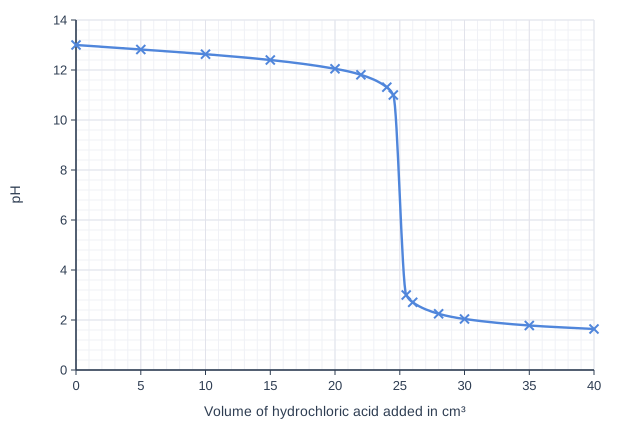
A student adds dilute hydrochloric acid to 25.0 cm³ of sodium hydroxide solution and measures the pH after each addition. The acid has a pH of 1.0.

The graph shows the results.

After 40 cm³ of acid has been added, the pH of the mixture is still higher than the pH of the acid that was added.

Explain why.

Line graph of pH (y-axis, 0 to 14) against volume of hydrochloric acid added in cm³ (x-axis, 0 to 40). The line is a smooth curve through (0, 13), (5, 12.82), (10, 12.63), (15, 12.4), (20, 12.05), (22, 11.81), (24, 11.31), (24.5, 11), (25.5, 3), (26, 2.71), (28, 2.25), (30, 2.04), (35, 1.78), (40, 1.64).

Model answer

Some of the hydrogen ions from the acid have reacted with the hydroxide ions in the sodium hydroxide (H⁺ + OH⁻ → H₂O): about the first 25 cm³ of acid was used up in neutralising the alkali. The hydrogen ions that are left over are spread through the whole 65 cm³ of mixture, so the acid has been diluted. The concentration of hydrogen ions in the mixture is therefore lower than in the acid itself, so its pH stays higher than 1.0.

Explanation

pH depends on the concentration of H⁺ ions. After the end point, only the acid added beyond about 25 cm³ is in excess, and those H⁺ ions are diluted by the solution already in the flask. The pH keeps falling slowly towards 1.0 as more acid is added, but it can never quite reach it.

Mark scheme
  1. 1 mark

    some of the H⁺ ions (from the acid) have reacted with / been neutralised by the OH⁻ ions (in the sodium hydroxide)

    ALLOW about 25 cm³ of the acid was used up neutralising the alkali / only the acid added after neutralisation is in excess. ALLOW H⁺ + OH⁻ → H₂O.

  2. 1 mark

    the remaining H⁺ ions are spread through a larger (total) volume / the acid is diluted by the solution in the flask, so the concentration of H⁺ ions is lower than in the acid (so the pH is higher)

    ALLOW the mixture is more dilute than the acid. ALLOW 65 cm³ of mixture contains the excess H⁺ ions from only 15 cm³ of acid.

Question 4

4 marks

A student adds sodium hydroxide solution to 25.0 cm³ of dilute hydrochloric acid and measures the pH with a pH meter. Both solutions have a concentration of 0.10 mol/dm³.
• At the start the pH is 1.0.
• Adding the first 5.0 cm³ of sodium hydroxide solution raises the pH to only 1.2.
• Near the end of the reaction the pH is 4.0. Adding just 0.10 cm³ more sodium hydroxide solution makes the pH jump to 10.0.

Explain why a very small volume of sodium hydroxide solution has a large effect on the pH near the end of the reaction, but a much larger volume has only a small effect at the start.

Model answer

At the start the acid contains a large number of H⁺ ions. Adding 5.0 cm³ of sodium hydroxide solution neutralises only about one fifth of them, so the H⁺ concentration falls by much less than a factor of ten and the pH rises by less than 1 (from 1.0 to 1.2).

At pH 4.0 the H⁺ concentration is 1 × 10⁻⁴ mol/dm³, 1000 times lower than at the start, so almost all the H⁺ ions have already reacted. The 0.10 cm³ of alkali contains more OH⁻ ions than the H⁺ ions that are left, so all the remaining H⁺ ions react (H⁺ + OH⁻ → H₂O) and there are OH⁻ ions left over, making the solution alkaline. Because each change of 1 in pH is a tenfold change in H⁺ concentration, the change from pH 4 to pH 10 means the H⁺ concentration has fallen by a factor of a million, even though only a tiny amount of acid was neutralised.

Explanation

pH measures the H⁺ concentration on a scale of factors of ten. When there is a lot of acid, neutralising some of it changes the H⁺ concentration by a small factor, so the pH barely moves. Near the end point almost no H⁺ is left, so a tiny amount of alkali removes all of it and then adds excess OH⁻, and the H⁺ concentration changes by many factors of ten. This is why titration curves for a strong acid and a strong alkali have a steep vertical section.

Mark scheme
  1. 1 mark

    at pH 4 the hydrogen ion concentration is 1000 times lower than at the start (pH 1) / almost all of the H⁺ ions have already reacted / only a tiny fraction (about 0.2 %) of the H⁺ ions are left

    Max 4. ALLOW [H⁺] = 1 × 10⁻⁴ mol/dm³ compared with 1 × 10⁻¹ mol/dm³ at the start.

  2. 1 mark

    0.10 cm³ of the alkali contains more OH⁻ ions than the H⁺ ions that are left / enough OH⁻ ions to react with all the remaining H⁺ ions

    ALLOW the small amount of alkali is enough to neutralise all the acid that is left.

  3. 1 mark

    all the remaining H⁺ ions react (H⁺ + OH⁻ → H₂O) and OH⁻ ions are left in excess, so the solution becomes alkaline

    ALLOW the solution goes past neutral / past pH 7.

  4. 1 mark

    each change of 1 in pH is a tenfold change in H⁺ concentration, so going from pH 4 to pH 10 is a decrease in H⁺ concentration by a factor of a million (10⁶)

    ALLOW a small change in the amount of H⁺ near neutral is a very large factor change in its concentration.

  5. 1 mark

    at the start, 5.0 cm³ of alkali removes only a small fraction (about one fifth) of the H⁺ ions, so the H⁺ concentration falls by much less than ten times and the pH rises by less than 1

    ALLOW at the start there is a large excess of H⁺ ions, so removing some of them hardly changes the H⁺ concentration on the pH scale.

Ready to try the rest? Every answer you write is marked against the mark scheme, so you can see exactly where the marks are.

Study Helper Hints first, answers after you try

Stuck on this one? Ask for a hint and I’ll point you in the right direction, without giving the answer away. Once you’ve checked your answer, I’ll show you how the marks are awarded.