
Level:
Correct: 0
Incorrect: 0
Marks: 0/0
Exam Practice
Course:
Topics:
Avg
score:
–
Topics
done:
0/26

Protons, neutrons, electrons and isotopes

Practise 15 exam-style questions on Protons, neutrons, electrons and isotopes for OCR GCSE Chemistry (Paper 3). Write your answer as you would in the exam and get it marked in seconds against the mark scheme, point by point, with the Study Helper on hand if you get stuck.

  • 15 questions
  • 1–6 marks each
  • Instant marking
  • No sign-up needed
15 questions, marked as you go

Sample questions with model answers

Here are 4 of the questions in this topic, each with a model answer, an explanation of why it earns the marks and the mark scheme an examiner would use.

Question 1

1 mark

A particle contains 24 protons, 28 neutrons and 21 electrons.

Which symbol represents this particle?

Choose your answer.

  • A ⁵²₂₄Cr³⁺
  • B ⁵²₂₄Cr³⁻
  • C ⁵²₂₈Cr³⁺
  • D ⁷³₂₄Cr³⁺

Model answer

A

Explanation

In standard notation the mass number (protons + neutrons) is written at the top left and the atomic number (protons) at the bottom left, with the charge at the top right. This particle has lost 3 electrons, so it is a 3+ ion. Electrons are never counted in the mass number because their mass is negligible.

Mark scheme
  1. 1 mark

    A / ⁵²₂₄Cr³⁺

    The only correct answer is A: the atomic number (bottom) is the number of protons, 24; the mass number (top) is protons + neutrons = 24 + 28 = 52; and 24 protons with 21 electrons give a charge of 3+. B is not correct because the particle has fewer electrons than protons, so the charge is positive, not negative; C is not correct because the bottom number must be the number of protons (24), not the number of neutrons; D is not correct because the mass number does not include the electrons (24 + 28 + 21 = 73). ALLOW the letter or the symbol written on one line (52 24 Cr 3+). If more than one option is given, do not award the mark.
Question 2

2 marks

Lithium ions, Li⁺, each contain 3 protons and 2 electrons.

A student says: 'Every lithium ion has the same mass, because every lithium ion has 3 protons and 2 electrons.'

Explain why the student is wrong.

Model answer

The student is wrong because lithium has isotopes. All lithium ions have 3 protons and 2 electrons, but they can have different numbers of neutrons: an ion of lithium-6 has 3 neutrons and an ion of lithium-7 has 4 neutrons. Each neutron has a relative mass of 1, while an electron has a relative mass of only about 0.0005, so the ions with more neutrons have a greater mass.

Explanation

The numbers of protons and electrons fix which element a particle is and its charge, but not its mass. The mass of an atom or ion is almost all in its nucleus, so it depends on the number of neutrons as well as the number of protons. Isotopes of an element have the same number of protons but different numbers of neutrons.

Mark scheme
  1. 1 mark

    lithium has isotopes: lithium atoms / ions can have different numbers of neutrons (for example 3 or 4)

    ALLOW the ions can have different mass numbers (6 or 7). ALLOW isotopes have the same number of protons but different numbers of neutrons. DO NOT ALLOW different numbers of protons or electrons.

  2. 1 mark

    a neutron has a relative mass of 1 (and an electron almost 0), so an ion with more neutrons has a greater mass / the mass depends on the numbers of protons and neutrons in the nucleus

    ALLOW the mass of an ion is almost all in its nucleus, which includes the neutrons. IGNORE 'electrons have a negative charge'.

Question 3

2 marks

In 1932, James Chadwick studied a new type of particle that was knocked out of beryllium atoms by alpha particles. He found that:
• the particles were not attracted or repelled by electrically charged objects
• each particle had about the same mass as a proton.

Use the relative charges and relative masses of protons, neutrons and electrons to explain how this evidence shows that the particles were neutrons.

Model answer

A proton has a relative charge of +1 and an electron has a relative charge of −1, but a neutron has no charge. The particles were not attracted or repelled by charged objects, so they had no charge, which fits a neutron.
A proton and a neutron both have a relative mass of 1, but an electron has a relative mass of only about 1/2000. The particles had about the same mass as a proton, so they had a relative mass of 1. Particles with a relative mass of 1 and no charge are neutrons.

Explanation

Use both pieces of evidence: the lack of charge rules out protons and electrons, and the mass rules out electrons. Only the neutron has a relative mass of 1 and a relative charge of 0. Remember that an electron's mass is tiny compared with a proton or a neutron.

Mark scheme
  1. 1 mark

    the particles had no charge / a relative charge of 0, so they could not be protons (+1) or electrons (−1)

    ALLOW the particles were neutral. The idea of no charge must be linked to the particles not being attracted or repelled.

  2. 1 mark

    their relative mass was 1 / the same as a proton (much more than an electron, about 1/2000), and a neutron has a relative mass of 1 and no charge

    ALLOW the mass rules out electrons, which have a very small relative mass (about 0.0005). The relative mass must be linked to the neutron for this mark.

Question 4

4 marks

Many minerals contain oxide ions, O²⁻, formed from atoms of oxygen-16, ¹⁶₈O.

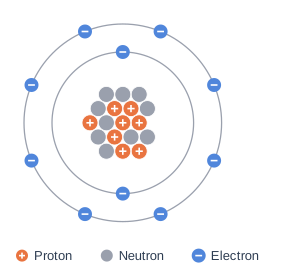
A student draws the diagram as a model of an oxide ion.

Evaluate the student's model. In your answer, write the correct symbol for an oxide ion in standard notation.

You may type the symbol on one line, for example 23 11 Na+ for ²³₁₁Na⁺.

Diagram of the nuclear model of a particle: a nucleus of 8 protons (+) and 10 neutrons, with 10 electrons (−) on 2 energy levels (2, 8 from the inside out) (2 more electrons than protons). A key shows: orange circle with + = proton, grey circle = neutron, blue circle with − = electron.

Model answer

The model has 8 protons, which is correct because every oxygen particle has atomic number 8. It has 10 electrons arranged 2,8, two more than the number of protons, which is correct for an ion with a 2− charge. However, it has 10 neutrons, so it shows a mass number of 18. An ion made from oxygen-16 has only 16 − 8 = 8 neutrons, so the model has two neutrons too many. The correct symbol is ¹⁶₈O²⁻ (typed: 16 8 O 2-).

Explanation

To evaluate a model, check each type of particle: protons from the atomic number, neutrons from mass number minus atomic number, and electrons from the charge. Only the neutrons are wrong here: the drawing shows an ion of the isotope oxygen-18. A common error is to think a negative ion has gained protons or neutrons; ions form only by gaining or losing electrons.

Mark scheme
  1. 1 mark

    the model has 8 protons, which is correct because every oxygen particle has 8 protons / atomic number 8

    ALLOW the number of protons is correct (8).

  2. 1 mark

    the model has 10 electrons (2,8), two more than the number of protons, which is correct for a charge of 2− / for O²⁻

    ALLOW the electrons are correct because the ion has gained two electrons. ALLOW the electron arrangement 2,8 is correct.

  3. 1 mark

    the model has 10 neutrons, but an ion made from oxygen-16 has 16 − 8 = 8 neutrons (the model shows mass number 18)

    ALLOW the model has two neutrons too many. ALLOW the model shows an ion of oxygen-18, not oxygen-16. DO NOT ALLOW the model needs more protons.

  4. 1 mark

    ¹⁶₈O²⁻ / 16 8 O 2-

    Mass number 16 at the top, atomic number 8 at the bottom and a 2− charge are all needed. ALLOW 16 8 O2-. DO NOT ALLOW ¹⁸₈O²⁻ or ¹⁶₈O²⁺.

Ready to try the rest? Every answer you write is marked against the mark scheme, so you can see exactly where the marks are.

Study Helper Hints first, answers after you try

Stuck on this one? Ask for a hint and I’ll point you in the right direction, without giving the answer away. Once you’ve checked your answer, I’ll show you how the marks are awarded.