
Level:
Correct: 0
Incorrect: 0
Marks: 0/0
Exam Practice
Course:
Topics:
Avg
score:
–
Topics
done:
0/23

The development of the atmosphere

Practise 14 exam-style questions on The development of the atmosphere for OCR GCSE Combined Science (Chemistry Paper 4). Write your answer as you would in the exam and get it marked in seconds against the mark scheme, point by point, with the Study Helper on hand if you get stuck.

  • 14 questions
  • 1–6 marks each
  • Instant marking
  • No sign-up needed
14 questions, marked as you go

Sample questions with model answers

Here are 4 of the questions in this topic, each with a model answer, an explanation of why it earns the marks and the mark scheme an examiner would use.

Question 1

1 mark

As the early Earth cooled down, water vapour in the atmosphere condensed to form the oceans.

What happened to the water particles as the water vapour condensed?

Choose your answer.

  • A They broke apart into hydrogen and oxygen atoms.
  • B They gained energy and moved further apart.
  • C They lost energy and moved closer together.
  • D They stopped moving and formed a regular pattern.

Model answer

C - They lost energy and moved closer together.

Explanation

In a gas the particles are far apart and move quickly. As the early atmosphere cooled, the water particles lost energy, slowed down and came close together, forming liquid water that collected as the oceans. Condensing is a change of state, so the water molecules themselves do not change, and in a liquid the particles still move around each other.

Mark scheme
  1. 1 mark

    C / They lost energy and moved closer together.

    The only correct answer is C: when a gas condenses, its particles lose (kinetic) energy, move more slowly and come close together, so they are touching but can still move around each other in the liquid. A is not correct because condensing is a physical change: the water molecules stay as H₂O and are not broken into atoms; B is not correct because this describes evaporating or boiling (liquid to gas), the reverse change; D is not correct because particles in a liquid still move around each other, and a regular pattern describes a solid (and even the particles in a solid vibrate). ALLOW the letter or the option. If more than one option is given, do not award the mark.
Question 2

2 marks

One model suggests that about 4 billion years ago, carbon dioxide made up about 80% of the Earth's atmosphere. In 2024, carbon dioxide made up about 0.042% of dry air. (Data for 2024: NOAA Global Monitoring Laboratory.)

Calculate how many times greater the percentage of carbon dioxide was 4 billion years ago than in 2024.

Use your answer to give the difference as an order of magnitude.

Model answer

80 ÷ 0.042 = 1905, so about 1900 times greater.
This is about 1000 times, which is 3 orders of magnitude (10³).

Explanation

Divide the larger percentage by the smaller one: 80 ÷ 0.042 = about 1900. The nearest power of ten is 1000 (10³), so the early atmosphere had about three orders of magnitude more carbon dioxide than air in 2024. Comparing orders of magnitude shows how huge the change was: almost all of the carbon dioxide has been removed from the atmosphere.

Mark scheme
  1. 1 mark

    80 ÷ 0.042 = 1905 (times) / about 1900 times / about 2000 times; or a correct final answer of 1905 (or 1900, or 2000) with no working

    An answer of 1905 (or 1900, or about 2000) with no working scores marking point 1 only. ALLOW 1904.8 or any correct rounding to 2 or more significant figures. 0.000525 (0.042 ÷ 80, the division the wrong way round) scores 0 for point 1.

  2. 1 mark

    about 1000 times / 3 orders of magnitude (greater) / 10³

    ALLOW 'three orders of magnitude' / 'about a thousand times'. ALLOW ECF from a wrong value in point 1 converted to the nearest power of ten. DO NOT ALLOW 'about 10 000 times' / 4 orders of magnitude (1905 is closer to 1000 than to 10 000).

Question 3

2 marks

Animals take in oxygen for respiration. The percentage of oxygen in the atmosphere carried on rising after the first animals evolved.

In recent decades, the percentage of oxygen in the atmosphere has stayed about the same, at about 21%, from year to year.

Use ideas about photosynthesis and respiration to explain these two observations.

Model answer

The oxygen increased because photosynthesis by plants and algae produced oxygen faster than respiration used it up, so there was a gain each year.
Now the percentage stays about the same because oxygen is made by photosynthesis at about the same rate as it is used up by respiration, burning and decay.

Explanation

Photosynthesis adds oxygen to the atmosphere and respiration removes it. The percentage rises only when oxygen is made faster than it is used, and it stays the same when the two rates are about equal. Animals using oxygen did not stop the rise, because plants and algae were making even more.

Mark scheme
  1. 1 mark

    (oxygen increased because) photosynthesis (by plants and algae) produced oxygen faster than respiration (and other processes) used it up

    The idea of a faster rate (or more oxygen made than used) is needed. ALLOW 'there was more photosynthesis than respiration'. IGNORE 'plants make oxygen' on its own.

  2. 1 mark

    (it has stayed about the same in recent decades because) oxygen is produced by photosynthesis at about the same rate as it is used up by respiration (and burning and decay)

    ALLOW 'photosynthesis and respiration are balanced' / 'the oxygen made equals the oxygen used'.

Question 4

3 marks

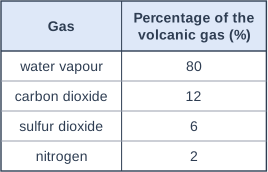
A scientist analyses gas from a vent on a volcano. The table shows her results.

Scientists think that gases like these, released by volcanoes, formed the Earth's early atmosphere. As the Earth cooled, most of the water vapour turned into liquid water, which collected as the oceans.

Calculate the percentage of carbon dioxide in the gas from the table if all of the water vapour were removed from it.

Use your answer to explain why scientists think that carbon dioxide became the main gas in the early atmosphere.

Table with columns "Gas", "Percentage of the volcanic gas (%)". Gas: water vapour; Percentage of the volcanic gas (%): 80 | Gas: carbon dioxide; Percentage of the volcanic gas (%): 12 | Gas: sulfur dioxide; Percentage of the volcanic gas (%): 6 | Gas: nitrogen; Percentage of the volcanic gas (%): 2.

Model answer

Other gases = 100 − 80 = 20%
Percentage of carbon dioxide = 12 ÷ 20 × 100 = 60%

Volcanoes released mostly water vapour, but as the Earth cooled the water vapour condensed to form the oceans. The gases left behind were mostly carbon dioxide (60% of them in this sample), so carbon dioxide became the main gas in the early atmosphere.

Explanation

Removing the water vapour leaves 20% of the original gas, and 12 of those 20 parts are carbon dioxide: 12 ÷ 20 × 100 = 60%. This shows why an atmosphere made from volcanic gases could be mostly carbon dioxide even though volcanic gas is mostly water vapour: most of the water vapour condensed into the oceans. A common slip is to divide 12 by 80, the water vapour, instead of by the 20% that is left.

Mark scheme
  1. 1 mark

    gases left when water vapour is removed = 100 − 80 = 20 (%) / 12 + 6 + 2 = 20; or a correct final answer of 60% with no working

    An answer of 60% with no working scores marking points 1 and 2 only. 12% (the value in the table) and 15% (12 ÷ 80 × 100) score 0 for points 1 and 2.

  2. 1 mark

    12 ÷ 20 × 100 = 60 (%); or a correct final answer of 60% with no working

    ALLOW ECF from a wrong total of the other gases. IGNORE units unless the question asks for them.

  3. 1 mark

    once the water vapour had condensed (to form the oceans), carbon dioxide made up the largest share of the gases that were left

    The idea that removing the water vapour leaves carbon dioxide as the largest part is needed. ALLOW 'without the water vapour, carbon dioxide is more than half of the gas'. ALLOW ECF from their percentage if it is the largest share.

Ready to try the rest? Every answer you write is marked against the mark scheme, so you can see exactly where the marks are.

Study Helper Hints first, answers after you try

Stuck on this one? Ask for a hint and I’ll point you in the right direction, without giving the answer away. Once you’ve checked your answer, I’ll show you how the marks are awarded.