
Level:
Correct: 0
Incorrect: 0
Marks: 0/0
Exam Practice
Course:
Topics:
Avg
score:
–
Topics
done:
0/23

Factors affecting the rate of reaction

Practise 15 exam-style questions on Factors affecting the rate of reaction for OCR GCSE Combined Science (Chemistry Paper 4). Write your answer as you would in the exam and get it marked in seconds against the mark scheme, point by point, with the Study Helper on hand if you get stuck.

  • 15 questions
  • 1–6 marks each
  • Instant marking
  • No sign-up needed
15 questions, marked as you go

Sample questions with model answers

Here are 4 of the questions in this topic, each with a model answer, an explanation of why it earns the marks and the mark scheme an examiner would use.

Question 1

1 mark

Zinc reacts with an acid to give off hydrogen. At a fixed temperature, doubling the concentration of the acid doubles the rate, and tripling it triples the rate.

Acid of concentration 0.40 mol/dm³ gives off hydrogen at 0.30 cm³/s.

A student needs hydrogen to be given off at 1.2 cm³/s.

Which concentration of acid should she use?

Choose your answer.

  • A 0.10 mol/dm³
  • B 1.2 mol/dm³
  • C 1.3 mol/dm³
  • D 1.6 mol/dm³

Model answer

D - 1.6 mol/dm³

Explanation

Directly proportional means that when one quantity is multiplied by a number, the other is multiplied by the same number. The rate has to go from 0.30 to 1.2 cm³/s, which is × 4, so the concentration must also go × 4: 0.40 × 4 = 1.6 mol/dm³.

Mark scheme
  1. 1 mark

    D / 1.6 mol/dm³

    The only correct answer is D: the rate needed is 1.2 ÷ 0.30 = 4 times as large, and the rate is directly proportional to the concentration, so the concentration must also be 4 times as large: 0.40 × 4 = 1.6 mol/dm³. A is not correct because 0.10 mol/dm³ is 0.40 ÷ 4, which would make the reaction slower. B is not correct because 1.2 is the rate wanted, not a concentration. C is not correct because 1.3 mol/dm³ comes from adding the increase in rate (0.90) to the concentration, which is not how proportion works. ALLOW the letter or the option. If more than one option is given, do not award the mark.
Question 2

2 marks

When sodium hydrogencarbonate powder is added to dilute hydrochloric acid, the mixture fizzes as carbon dioxide is given off.

A student measures the temperature of the mixture. It falls from 21 °C to 15 °C during the reaction.

State whether this reaction is exothermic or endothermic, and give a reason.

Describe how the change in temperature affects the rate of the reaction as it goes on.

Model answer

The reaction is endothermic, because the temperature of the mixture falls: the reaction takes in energy from its surroundings.
As the mixture gets colder, the reaction gets slower, so the rate falls more quickly than it would if the temperature stayed at 21 °C.

Explanation

A reaction that makes its surroundings colder is endothermic. Temperature is one of the factors that controls the rate, so a reaction that cools itself also slows itself down. To study the effect of another factor fairly, the flask could be kept in a water bath at a constant temperature.

Mark scheme
  1. 1 mark

    endothermic, because the temperature (of the mixture / surroundings) falls / because energy is taken in (from the surroundings)

    The reason is needed for this mark. DO NOT ALLOW 'endothermic because it gives out heat'. DO NOT ALLOW 'exothermic'.

  2. 1 mark

    the mixture gets colder, so the reaction gets slower / the rate decreases (more than it would if the temperature stayed the same)

    The answer must link the lower temperature to a slower rate. ALLOW a lower temperature makes the reaction slower. DO NOT ALLOW 'the reaction gets faster as it cools'.

Question 3

2 marks

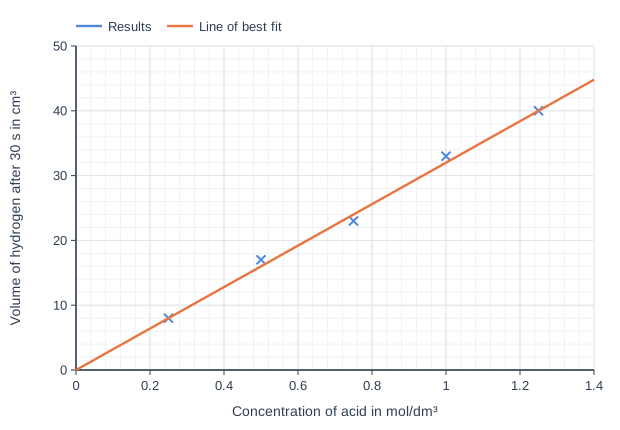
A student adds the same mass of zinc powder to dilute sulfuric acid of different concentrations. She measures the volume of hydrogen given off in the first 30 seconds.

The graph shows her results and her line of best fit.

Describe what the graph shows about the effect of the concentration of the acid on the rate of reaction.

Line graph of volume of hydrogen after 30 s in cm³ (y-axis, 0 to 50) against concentration of acid in mol/dm³ (x-axis, 0 to 1.4). "Results" is shown as plotted points only (no line), at (0.25, 8), (0.5, 17), (0.75, 23), (1, 33), (1.25, 40). "Line of best fit" joins the points (0, 0), (1.4, 44.8).

Model answer

As the concentration of the acid increases, the volume of hydrogen given off in the first 30 seconds increases, so the rate of reaction increases. The line of best fit is straight and passes through the origin, so the rate is directly proportional to the concentration: doubling the concentration from 0.50 to 1.00 mol/dm³ doubles the volume from about 16 cm³ to about 32 cm³.

Explanation

The volume of gas made in a fixed time is a measure of the rate. A straight line through the origin shows direct proportion: if one quantity doubles, the other doubles too. Proportion is read from the line of best fit, not from single points, which scatter a little either side of it.

Mark scheme
  1. 1 mark

    as the concentration (of the acid) increases, the volume of hydrogen in the first 30 s / the rate of reaction increases

    ALLOW the higher the concentration, the faster the reaction. ALLOW positive correlation.

  2. 1 mark

    the line is straight and goes through the origin, so the rate is (directly) proportional to the concentration / doubling the concentration doubles the rate

    ALLOW a correct use of data to show proportion, for example at 0.50 mol/dm³ about 16 cm³ and at 1.00 mol/dm³ about 32 cm³ (twice as much). DO NOT ALLOW 'straight line' on its own without the origin or proportion idea.

Question 4

3 marks

The test for oxygen uses a glowing splint. In air, a glowing splint only glows. In pure oxygen, the splint relights and bursts into flame.

Air is about 21% oxygen. Pure oxygen is 100% oxygen.

Calculate how many times greater the concentration of oxygen is in pure oxygen than in air.

Use your answer to explain why the splint relights in pure oxygen.

Model answer

100 ÷ 21 = 4.8, so the concentration of oxygen in pure oxygen is 4.8 times (nearly 5 times) greater than in air.
With a higher concentration of oxygen, the hot wood reacts with oxygen much faster, so it gives out energy fast enough to burst into flame.

Explanation

The splint test works because concentration affects the rate of reaction. In air, the glowing wood reacts only slowly with the 21% oxygen; in pure oxygen the concentration is nearly five times higher, so the wood burns fast enough to relight. A difference (100 − 21) does not tell you how many times greater one value is than another.

Mark scheme
  1. 1 mark

    100 ÷ 21; or a correct final answer of 4.8 (or 4.76) with no working

    An answer of 4.8 or 4.76 (or 4.762) with no working scores marking points 1 and 2 only. DO NOT ALLOW 79 (100 − 21) or 0.21 (21 ÷ 100) for either mark.

  2. 1 mark

    4.8 / 4.76 (times)

    ALLOW 4.762. ALLOW ECF for a wrong division correctly evaluated. A final answer of 5 on its own (rounded to 1 significant figure) does not score this mark.

  3. 1 mark

    the higher concentration of oxygen makes the wood (carbon) react / burn much faster, so the glowing splint bursts into flame

    The answer must link the higher concentration of oxygen to a faster reaction or faster burning. ALLOW about five times as much oxygen in the same volume, so the reaction is much faster. IGNORE 'oxygen is needed for burning' on its own.

Ready to try the rest? Every answer you write is marked against the mark scheme, so you can see exactly where the marks are.

Study Helper Hints first, answers after you try

Stuck on this one? Ask for a hint and I’ll point you in the right direction, without giving the answer away. Once you’ve checked your answer, I’ll show you how the marks are awarded.