
Level:
Correct: 0
Incorrect: 0
Marks: 0/0
Exam Practice
Course:
Topics:
Avg
score:
–
Topics
done:
0/23

Crude oil and fractional distillation

Practise 16 exam-style questions on Crude oil and fractional distillation for OCR GCSE Combined Science (Chemistry Paper 4). Write your answer as you would in the exam and get it marked in seconds against the mark scheme, point by point, with the Study Helper on hand if you get stuck.

  • 16 questions
  • 1–6 marks each
  • Instant marking
  • No sign-up needed
16 questions, marked as you go

Sample questions with model answers

Here are 4 of the questions in this topic, each with a model answer, an explanation of why it earns the marks and the mark scheme an examiner would use.

Question 1

1 mark

Hexane, C₆H₁₄, boils at 69 °C. Dodecane, C₁₂H₂₆, boils at 216 °C.

Which statement explains why dodecane has the higher boiling point?

Choose your answer.

  • A Dodecane has more covalent bonds, and all of these must be broken when it boils.
  • B Dodecane is made of ions, which attract each other very strongly.
  • C Dodecane molecules are larger, so their intermolecular forces are stronger.
  • D Hexane molecules are heavier, so they move around more slowly.

Model answer

C - Dodecane molecules are larger, so their intermolecular forces are stronger.

Explanation

When an alkane boils, its molecules separate from each other, but the molecules themselves do not break up. The larger the molecules, the stronger the intermolecular forces between them, so more energy is needed to overcome them and the boiling point is higher. A common mistake is to think that covalent bonds break when a simple molecular substance boils.

Mark scheme
  1. 1 mark

    C / Dodecane molecules are larger, so their intermolecular forces are stronger.

    The only correct answer is C: larger alkane molecules have stronger intermolecular forces between them, so more energy is needed to overcome these forces and the boiling point is higher. A is not correct because covalent bonds inside the molecules are not broken when an alkane boils; only the forces between molecules are overcome. B is not correct because dodecane is made of molecules with covalent bonds, not ions. D is not correct because hexane molecules are lighter (smaller) than dodecane molecules, not heavier. ALLOW the letter or the option. If more than one option is given, do not award the mark.
Question 2

2 marks

Petrol left in the fuel tank of a lawnmower over the winter slowly loses some of its alkanes by evaporation. The petrol left in the tank contains a greater proportion of alkanes with larger molecules than fresh petrol does.

Explain why the alkanes with smaller molecules evaporate first. Use ideas about intermolecular forces.

Model answer

Alkanes with smaller molecules have weaker intermolecular forces between their molecules. Less energy is needed to overcome these weaker forces, so the smaller molecules escape from the liquid more easily and evaporate first. The larger molecules, with stronger intermolecular forces, are left behind in the tank.

Explanation

Evaporation happens when molecules gain enough energy to overcome the forces holding them in the liquid. Petrol is a mixture of alkanes, and the ones with the smallest molecules have the weakest intermolecular forces, so they escape first. The same idea explains why smaller molecules have lower boiling points and are collected higher up a fractionating column.

Mark scheme
  1. 1 mark

    smaller (alkane) molecules have weaker intermolecular forces (between them)

    ALLOW ORA (allow the reverse argument): larger molecules have stronger intermolecular forces. DO NOT ALLOW weaker covalent bonds / bonds within the molecules break.

  2. 1 mark

    so less energy is needed to overcome the forces, so the smaller molecules escape from the liquid more easily

    ALLOW smaller alkanes have lower boiling points, so they turn into a gas more easily. ALLOW ORA (allow the reverse argument). Point 2 can be awarded without point 1.

Question 3

2 marks

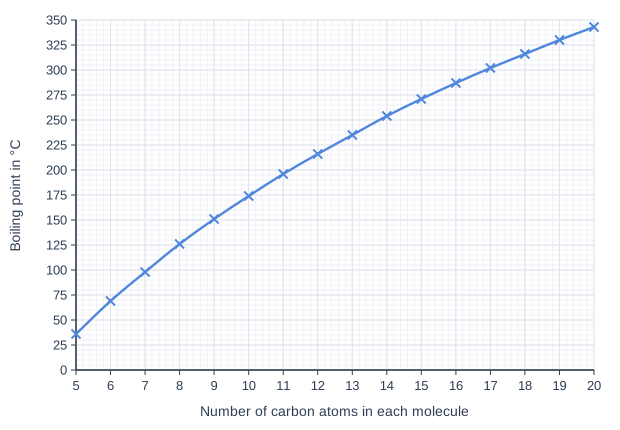
The graph shows the boiling points of the straight-chain alkanes with 5 to 20 carbon atoms in each molecule (data-book values).

At one refinery, the kerosene fraction is collected between 185 °C and 245 °C.

Use the graph to find the smallest and the largest number of carbon atoms in the molecules of the straight-chain alkanes in this kerosene fraction.

Line graph of boiling point in °C (y-axis, 0 to 350) against number of carbon atoms in each molecule (x-axis, 5 to 20). The line is a smooth curve through (5, 36), (6, 69), (7, 98), (8, 126), (9, 151), (10, 174), (11, 196), (12, 216), (13, 235), (14, 254), (15, 271), (16, 287), (17, 302), (18, 316), (19, 330), (20, 343).

Model answer

Smallest: 11 carbon atoms (boiling point 196 °C; the alkane with 10 carbon atoms boils at 174 °C, which is below 185 °C).
Largest: 13 carbon atoms (boiling point 235 °C; the alkane with 14 carbon atoms boils at 254 °C, which is above 245 °C).

Explanation

Read across from 185 °C and from 245 °C to the curve, then down to the number of carbon atoms. Only whole numbers of carbon atoms are possible, so count the alkanes whose boiling points lie inside the range. This shows that a fraction is a mixture of several alkanes with similar boiling points.

Mark scheme
  1. 1 mark

    smallest: 11 (carbon atoms)

    11 is the smallest alkane with a boiling point above 185 °C (196 °C); the alkane with 10 carbon atoms boils at 174 °C, below the range. DO NOT ALLOW 10.

  2. 1 mark

    largest: 13 (carbon atoms)

    13 is the largest alkane with a boiling point below 245 °C (235 °C); the alkane with 14 carbon atoms boils at 254 °C, above the range. DO NOT ALLOW 14. ALLOW the answer written as a range '11 to 13' for both marks.

Question 4

4 marks

A student tries to separate a crude oil substitute by simple distillation. The liquid in a flask is heated, and the vapour goes straight into a condenser. The student collects all the liquid from the condenser in one test tube.

Explain why the liquid in the test tube is still a mixture of many hydrocarbons.

Explain how a fractionating column at a refinery separates crude oil into fractions.

Model answer

The crude oil substitute contains many hydrocarbons with boiling points close together, so several of them evaporate at the same time. In simple distillation all of these vapours go straight into the condenser and condense together, so the liquid in the test tube is still a mixture.
In a fractionating column, the column is hot at the bottom and cooler towards the top. As the vapours rise, each hydrocarbon condenses at the height where the temperature falls below its boiling point, so the fractions are collected separately at different heights.

Explanation

Simple distillation (Paper 3) separates a liquid from a solution, but it cannot separate many liquids whose boiling points are close together. A fractionating column has a temperature gradient, so hydrocarbons condense at different heights. The fractions are still mixtures, but each contains hydrocarbons with similar boiling points.

Mark scheme
  1. 1 mark

    crude oil (substitute) contains many hydrocarbons with boiling points close together, so several of them boil (evaporate) at the same time

    1 mark for each of points 1 to 4. ALLOW the hydrocarbons have similar boiling points.

  2. 1 mark

    in simple distillation all the vapours go into the condenser and condense together, so they are collected together / nothing separates them

    ALLOW simple distillation only separates a liquid from a dissolved solid / liquids with very different boiling points.

  3. 1 mark

    a fractionating column is hot at the bottom and cooler towards the top / has a temperature gradient

    DO NOT ALLOW the column is hottest at the top.

  4. 1 mark

    each hydrocarbon condenses at the height where the temperature falls below its boiling point, so the fractions are collected at different heights

    ALLOW hydrocarbons with lower boiling points rise higher before they condense / smaller molecules are collected higher up.

Ready to try the rest? Every answer you write is marked against the mark scheme, so you can see exactly where the marks are.

Study Helper Hints first, answers after you try

Stuck on this one? Ask for a hint and I’ll point you in the right direction, without giving the answer away. Once you’ve checked your answer, I’ll show you how the marks are awarded.