
Level:
Correct: 0
Incorrect: 0
Marks: 0/0
Exam Practice
Course:
Topics:
Avg
score:
–
Topics
done:
0/23

Practical skills: analysing and evaluating results

Practise 15 exam-style questions on Practical skills: analysing and evaluating results for OCR GCSE Combined Science (Chemistry Paper 4). Write your answer as you would in the exam and get it marked in seconds against the mark scheme, point by point, with the Study Helper on hand if you get stuck.

  • 15 questions
  • 1–6 marks each
  • Instant marking
  • No sign-up needed
15 questions, marked as you go

Sample questions with model answers

Here are 4 of the questions in this topic, each with a model answer, an explanation of why it earns the marks and the mark scheme an examiner would use.

Question 1

1 mark

A student records her measurements in these units.

Which one is an SI base unit?

Choose your answer.

  • A centimetre
  • B gram
  • C minute
  • D second

Model answer

D

Explanation

The SI base units include the metre (length), the kilogram (mass), the second (time), the kelvin (temperature) and the ampere (current). Units such as the centimetre, the gram and the minute are useful in the laboratory, but they are not SI base units. Notice that the base unit of mass is the kilogram, not the gram.

Mark scheme
  1. 1 mark

    D / second

    The only correct answer is D: the second is the SI base unit of time. A is not correct because the SI base unit of length is the metre (a centimetre is one hundredth of a metre); B is not correct because the SI base unit of mass is the kilogram, not the gram; C is not correct because the minute is not an SI unit (1 minute = 60 seconds). ALLOW the letter or the option. If more than one option is given, do not award the mark.
Question 2

2 marks

A teacher times how long a small piece of lithium takes to disappear completely in water. The stopclock shows 2 minutes 45 seconds.

A student records the time in a table as 2.45 minutes.

Explain why 2.45 minutes is not correct.

Give the time in seconds.

Model answer

There are 60 seconds in a minute, not 100, so 45 seconds is 45 ÷ 60 = 0.75 of a minute. The time is 2.75 minutes, not 2.45 minutes.
Time in seconds = (2 × 60) + 45 = 165 s

Explanation

Minutes and seconds are not a decimal system: 1 minute = 60 seconds, so '2 minutes 45 seconds' cannot be written as 2.45 minutes. Converting to seconds, 2 × 60 + 45 = 165 s, avoids the problem. Multiplying 2.45 by 60 (147 s) carries the first mistake forward.

Mark scheme
  1. 1 mark

    there are 60 seconds in a minute (not 100), so 45 seconds is 0.75 of a minute and the time is 2.75 minutes (not 2.45 minutes)

    ALLOW 45 seconds is three-quarters of a minute. ALLOW a minute is not divided into 100 parts.

  2. 1 mark

    (2 × 60) + 45 = 165 (s)

    An answer of 165 s with no working scores point 2 only. DO NOT ALLOW 147 s (2.45 × 60) or 245 s.

Question 3

2 marks

Chlorine water is a solution of chlorine in water. It bleaches damp blue litmus paper.

A student puts some fresh chlorine water into two clear glass bottles. She keeps bottle 1 on a sunny windowsill and bottle 2 in a dark cupboard. Each day she times how long one drop of chlorine water from each bottle takes to bleach a strip of damp blue litmus paper.

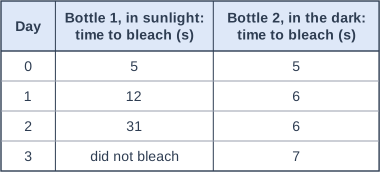
The table shows her results.

Describe the effect of sunlight on chlorine water. Use data from the table.

Explain why the student also kept a bottle in a dark cupboard.

Table with columns "Day", "Bottle 1, in sunlight: time to bleach (s)", "Bottle 2, in the dark: time to bleach (s)". Day: 0; Bottle 1, in sunlight: time to bleach (s): 5; Bottle 2, in the dark: time to bleach (s): 5 | Day: 1; Bottle 1, in sunlight: time to bleach (s): 12; Bottle 2, in the dark: time to bleach (s): 6 | Day: 2; Bottle 1, in sunlight: time to bleach (s): 31; Bottle 2, in the dark: time to bleach (s): 6 | Day: 3; Bottle 1, in sunlight: time to bleach (s): did not bleach; Bottle 2, in the dark: time to bleach (s): 7.

Model answer

Sunlight makes chlorine water lose its bleaching power. In sunlight the time to bleach the litmus rose from 5 s on day 0 to 31 s on day 2, and on day 3 it did not bleach the paper at all, while the chlorine water kept in the dark took between 5 s and 7 s every day.
The bottle in the dark is a control. It shows that the change happened because of the sunlight, not just because the chlorine water was getting older.

Explanation

Compare the two bottles day by day: only the one in sunlight changes much, so light is the cause. A control is a version of the experiment without the factor being tested, here the light, so that any difference can be put down to that factor. This is why bottles of chlorine water and bromine water are often stored in dark brown glass.

Mark scheme
  1. 1 mark

    in sunlight, the chlorine water takes longer and longer to bleach the litmus (from 5 s on day 0 to 31 s on day 2), and by day 3 it does not bleach it at all, but in the dark the time stays about the same (5 s to 7 s)

    Use of data is needed: ALLOW any correct pair of values that shows the change in bottle 1, or a comparison of the two bottles on the same day (for example 31 s and 6 s on day 2). ALLOW sunlight makes chlorine water lose its bleaching power / makes the chlorine break down.

  2. 1 mark

    the bottle in the dark is a control: it shows that the change is caused by the sunlight, not just by the chlorine water getting older (with time)

    ALLOW so that she can compare and see that only the light made a difference. ALLOW to show that the chlorine water does not change much if it is kept out of the light. IGNORE 'to make it a fair test' on its own.

Question 4

4 marks

An old plumbing fitting is made of brass, an alloy of copper and zinc. To find out how much zinc it contains, a student dissolves the zinc out of 5.00 g of filings from the fitting, using an excess of dilute hydrochloric acid. Copper does not react with the acid.

When the fizzing stops, she filters off the copper that is left, washes it, dries it and weighs it.

Mass of copper left = 3.36 g

Calculate the percentage by mass of zinc in the brass. Give your answer to 2 significant figures.

Suggest one reason why her percentage of zinc might be higher than the true value.

Model answer

Mass of zinc = 5.00 − 3.36 = 1.64 g
Percentage of zinc = 1.64 ÷ 5.00 × 100 = 32.8 %
= 33 % (2 significant figures)
Reason: some of the copper may have been left on the filter paper, so the mass of copper she weighed was too small. This makes the mass of zinc, and so the percentage of zinc, too large.

Explanation

The zinc dissolves in the acid but the copper does not, so the mass of zinc is the mass of brass minus the mass of copper left. Divide the mass of zinc by the mass of brass (not by the mass of copper) and multiply by 100. Any loss of copper makes the zinc value too high, while copper that is still wet, or zinc that has not all reacted, would make it too low.

Mark scheme
  1. 1 mark

    mass of zinc = 5.00 − 3.36 = 1.64 (g); or a correct final answer of 33 % or 32.8 % with no working

    An answer of 33 % with no working scores points 1 to 3 only; an answer of 32.8 % with no working scores points 1 and 2 only. 67 % (the percentage of copper, 3.36 ÷ 5.00 × 100 = 67.2 %, correctly rounded) scores point 3 only, by ECF for the rounding; 67.2 % on its own scores 0. 1.64 ÷ 3.36 × 100 = 48.8 % (dividing by the mass of copper) scores point 1, and point 3 by ECF if it is rounded to 49 %.

  2. 1 mark

    1.64 ÷ 5.00 × 100 = 32.8 (%); or a correct final answer of 33 % or 32.8 % with no working

    ALLOW 32.8 % as the unrounded value.

  3. 1 mark

    33 (%) (to 2 significant figures)

    ALLOW ECF for the rounding mark from a wrong value correctly rounded to 2 significant figures. DO NOT ALLOW 32.8 % for this point.

  4. 1 mark

    (reason) some copper was lost (for example left on the filter paper, in the beaker or spilled), so the mass of copper weighed was too small and the mass of zinc worked out was too large

    1 mark for any one of points 4 and 5, max 1. If more than one answer is given, a wrong one cancels a right one. DO NOT ALLOW the copper was still wet (this would make the mass of copper too large, so the percentage of zinc would be too low). DO NOT ALLOW not all the zinc reacted (this would also make the percentage of zinc too low). IGNORE 'human error' with no detail.

  5. 1 mark

    (reason) some of the brass filings were lost / spilled before they were added to the acid, so less copper was collected than there was in 5.00 g of brass

    ALLOW less than 5.00 g of brass was used.

Ready to try the rest? Every answer you write is marked against the mark scheme, so you can see exactly where the marks are.

Study Helper Hints first, answers after you try

Stuck on this one? Ask for a hint and I’ll point you in the right direction, without giving the answer away. Once you’ve checked your answer, I’ll show you how the marks are awarded.