
Level:
Correct: 0
Incorrect: 0
Marks: 0/0
Exam Practice
Course:
Topics:
Avg
score:
–
Topics
done:
0/23

Climate change: evidence and effects

Practise 16 exam-style questions on Climate change: evidence and effects for OCR GCSE Combined Science (Chemistry Paper 4). Write your answer as you would in the exam and get it marked in seconds against the mark scheme, point by point, with the Study Helper on hand if you get stuck.

  • 16 questions
  • 1–6 marks each
  • Instant marking
  • No sign-up needed
16 questions, marked as you go

Sample questions with model answers

Here are 4 of the questions in this topic, each with a model answer, an explanation of why it earns the marks and the mark scheme an examiner would use.

Question 1

1 mark

In January 2025, the World Meteorological Organization (WMO) combined six sets of data from different scientific groups. Each group had estimated how much warmer the Earth was in 2024 than in 1850-1900.

All six groups found that 2024 was the warmest year on record, but their estimates were slightly different. The WMO gave the warming as 1.55 °C, with an uncertainty of ± 0.13 °C.

Which is the best explanation of why the six estimates were slightly different?

Choose your answer.

  • A Only one of the six groups used real measurements that were made during 2024.
  • B Some groups measured the temperatures in different units, such as °F instead of °C.
  • C The Earth's temperature in 2024 kept changing while the groups were writing their reports.
  • D The groups used different methods to combine measurements and fill the gaps between them.

Model answer

D - The groups used different methods to combine measurements and fill the gaps between them.

Explanation

Global temperature is worked out from thousands of measurements on land and at sea, but some regions have few measuring stations. Each group combines the measurements and fills the gaps in a slightly different way, so their estimates differ a little. That is why the WMO gives the warming with an uncertainty (1.55 ± 0.13 °C), even though every group agrees that 2024 was the warmest year on record.

Mark scheme
  1. 1 mark

    D / The groups used different methods to combine measurements and fill the gaps between them.

    The only correct answer is D: the WMO says the estimates differ because of the groups' different methods; there are few measurements in some places, such as the polar regions and parts of the oceans, and each group combines the measurements and estimates the missing values in its own way. A is not correct because all six groups based their estimates on measurements made during 2024; B is not correct because temperatures in different units would be converted before they were compared, and a difference in units would give very large differences, not small ones; C is not correct because the temperature of 2024 was already measured, so it could not change while the reports were being written. ALLOW the letter or the option. If more than one option is given, do not award the mark.
Question 2

2 marks

NASA data show that the global mean temperature hardly changed between about 1940 and 1970, even though the amount of carbon dioxide in the atmosphere increased during this time.

At that time, burning coal in power stations, factories and homes released large amounts of sulfur dioxide and particulates. These formed tiny droplets and particles in the air, which reflected some sunlight back into space.

A student says:

'This shows that carbon dioxide does not cause global warming.'

Explain why the student's conclusion is not correct.

Model answer

Other factors affect the temperature as well as carbon dioxide. Between 1940 and 1970 the droplets and particles from the pollution reflected sunlight, which cooled the Earth and hid the warming caused by the extra carbon dioxide. This short period does not disprove the link, because over a longer time, since 1850, the temperature has risen as the carbon dioxide has increased, and the warming became clear once the pollution was reduced.

Explanation

The global temperature depends on several factors at once, so a correlation can be hidden for a few decades when another factor works the other way. Here, pollution from burning coal reflected sunlight and had a cooling effect. This is one of the uncertainties in the evidence: scientists have to separate the effect of each factor, and they look at long-term trends rather than a few years.

Mark scheme
  1. 1 mark

    other factors also affect the temperature: the droplets and particles (from the sulfur dioxide and particulates) reflected sunlight, which cooled the Earth and cancelled out / hid the warming caused by the extra carbon dioxide

    Mark the two points independently. ALLOW the pollution from burning coal had a cooling effect that balanced the warming. ALLOW more than one factor affects the global temperature at the same time. IGNORE sulfur dioxide causes acid rain.

  2. 1 mark

    30 years is too short a time to disprove the link: over a longer period (from 1850 / since 1970) the temperature has risen as the carbon dioxide has increased

    ALLOW when the sulfur dioxide and particulates were reduced, the warming showed up / the temperature rose after 1970. ALLOW the long-term trend still shows warming. DO NOT ALLOW 'the temperatures were not measured accurately' (this is not supported by the information).

Question 3

2 marks

Petrol is mainly octane, a hydrocarbon. The word equation for the complete combustion of octane is:

octane + oxygen → carbon dioxide + water

When 1.0 kg of octane burns completely, 3.1 kg of carbon dioxide is produced.

A student says:

'This must be wrong. 1.0 kg of fuel cannot make more than 1.0 kg of carbon dioxide.'

Explain why the student is wrong.

Model answer

The octane is not the only reactant: it reacts with oxygen from the air. Mass is conserved, so the total mass of the carbon dioxide and water equals the mass of the octane plus the mass of the oxygen that reacts. The carbon dioxide contains oxygen atoms from the air as well as carbon atoms from the octane, so it can have a greater mass than the fuel.

Explanation

This uses the law of conservation of mass from Paper 3 (C3.1k): atoms are not created or destroyed, so the mass of the products equals the mass of all the reactants. The student has forgotten that oxygen from the air is a reactant. This is why burning fuels adds such a large mass of carbon dioxide to the atmosphere.

Mark scheme
  1. 1 mark

    oxygen (from the air) is also a reactant / the carbon atoms in the octane combine with oxygen atoms from the air

    Mark the two points independently. ALLOW the equation shows that oxygen reacts with the octane. ALLOW the fuel reacts with oxygen.

  2. 1 mark

    mass is conserved: the total mass of the products equals the total mass of the reactants (octane and oxygen), so the mass of the carbon dioxide includes the mass of the oxygen atoms

    ALLOW the extra mass comes from the oxygen. ALLOW no atoms are made or destroyed, so the mass of the oxygen that reacts is added to the mass of the fuel. DO NOT ALLOW 'carbon dioxide is a gas so it weighs more' or 'burning makes mass'.

Question 4

4 marks

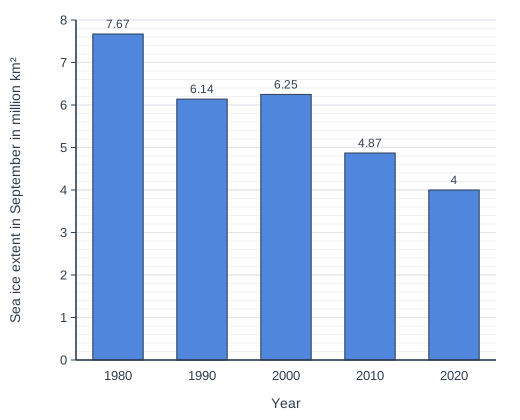
Arctic sea ice is frozen sea water that floats on the Arctic Ocean. Each year the area covered by the ice is smallest in September.

The bar chart shows the sea ice extent in September (the area of ocean where at least 15% of the surface is covered by ice), for five years from 1980 to 2020. (Data: US National Snow and Ice Data Center, Sea Ice Index version 4)

Calculate the percentage decrease in the sea ice extent from 1980 to 2020. Give your answer to 2 significant figures.

Suggest how this decrease is linked to the increasing levels of carbon dioxide and methane in the atmosphere.

Bar chart of Sea ice extent in September in million km² for each year: 1980 7.67, 1990 6.14, 2000 6.25, 2010 4.87, 2020 4.

Model answer

Decrease = 7.67 − 4.00 = 3.67 million km²
Percentage decrease = 3.67 ÷ 7.67 × 100 = 47.8 %
= 48 % (to 2 significant figures)

Carbon dioxide and methane are greenhouse gases. As their levels increase, more heat is trapped, so the Arctic gets warmer and more of the sea ice melts each summer.

Explanation

Percentage decrease = decrease ÷ starting value × 100, so the decrease (3.67) must be divided by the 1980 value (7.67), not the 2020 value. 47.8 % rounds to 48 % to 2 significant figures. Dividing 4.00 by 7.67 gives the percentage that is left (52 %), not the decrease. The loss of sea ice is one of the observed effects of the warming caused by extra greenhouse gases.

Mark scheme
  1. 1 mark

    decrease = 7.67 − 4.00 = 3.67 (million km²); or a correct final answer of 48 % or 47.8 % with no working

    An answer of 48 % with no working scores marking points 1 to 3 only. An answer of 47.8 % or 47.85 % with no working scores marking points 1 and 2 only. ALLOW 52 % or 52.2 % as the final answer for 1 mark (this is the percentage of the 1980 extent left in 2020: 4.00 ÷ 7.67 × 100). DO NOT ALLOW 3.67 ÷ 4.00 × 100 = 92 % (divided by the 2020 value).

  2. 1 mark

    percentage decrease = 3.67 ÷ 7.67 × 100 = 47.8 (%); or a correct final answer of 48 % or 47.8 % with no working

    ALLOW 47.85 (%). ALLOW 100 − (4.00 ÷ 7.67 × 100) = 47.8 (%). ALLOW ECF from a wrong decrease in point 1 if it is divided by 7.67 and multiplied by 100.

  3. 1 mark

    48 (%) (to 2 significant figures)

    ALLOW ECF for the rounding mark from a wrong percentage correctly rounded to 2 significant figures. DO NOT ALLOW 47.8 or 47.85 for this mark.

  4. 1 mark

    more carbon dioxide and methane (greenhouse gases) trap more heat, so the Arctic becomes warmer and more of the ice melts (in summer)

    ALLOW an increased greenhouse effect / global warming raises the temperature, which melts the sea ice. DO NOT ALLOW the gases melt the ice directly / the ozone hole melts the ice. IGNORE references to sea level rising.

Ready to try the rest? Every answer you write is marked against the mark scheme, so you can see exactly where the marks are.

Study Helper Hints first, answers after you try

Stuck on this one? Ask for a hint and I’ll point you in the right direction, without giving the answer away. Once you’ve checked your answer, I’ll show you how the marks are awarded.