
Level:
Correct: 0
Incorrect: 0
Marks: 0/0
Exam Practice
Course:
Topics:
Avg
score:
–
Topics
done:
0/23

Explaining and predicting group properties

Practise 15 exam-style questions on Explaining and predicting group properties for OCR GCSE Combined Science (Chemistry Paper 4). Write your answer as you would in the exam and get it marked in seconds against the mark scheme, point by point, with the Study Helper on hand if you get stuck.

  • 15 questions
  • 1–6 marks each
  • Instant marking
  • No sign-up needed
15 questions, marked as you go

Sample questions with model answers

Here are 4 of the questions in this topic, each with a model answer, an explanation of why it earns the marks and the mark scheme an examiner would use.

Question 1

1 mark

Lithium is in Group 1 and fluorine is in Group 7. Lithium reacts with fluorine to make lithium fluoride.

Electron arrangements: lithium 2.1   fluorine 2.7

What happens to the electrons when a lithium atom reacts with a fluorine atom?

Choose your answer.

  • A A pair of electrons is shared between the two atoms.
  • B One electron moves from the lithium atom to the fluorine atom.
  • C One electron moves from the fluorine atom to the lithium atom.
  • D Seven electrons move from the fluorine atom to the lithium atom.

Model answer

B (One electron moves from the lithium atom to the fluorine atom.)

Explanation

Group 1 atoms have one outer electron, which they lose easily, and Group 7 atoms have seven outer electrons, so they gain one more easily than they could lose seven. When they react, one electron is transferred from the metal atom to the halogen atom, and both end up with full outer shells as the ions Li⁺ and F⁻.

Mark scheme
  1. 1 mark

    B / one electron moves from the lithium atom to the fluorine atom

    The only correct answer is B: the lithium atom loses its single outer electron (2.1 becomes 2) and the fluorine atom gains it (2.7 becomes 2.8), so both form ions with full outer shells, Li⁺ and F⁻. A is not correct because sharing pairs of electrons (covalent bonding) happens between non-metal atoms, not between a Group 1 metal and a halogen; C is not correct because a Group 7 atom gains an electron when it reacts with a metal, it does not give one away; D is not correct because a fluorine atom fills its outer shell by gaining one electron, and it does not lose seven. ALLOW the letter or the option. If more than one option is given, do not award the mark.
Question 2

2 marks

Potassium is a Group 1 metal. It melts at 63 °C.

Rubidium is the element below potassium in Group 1.

A scientist puts a sealed glass tube containing a small piece of rubidium into a beaker of water at 70 °C. The water cannot reach the rubidium.

Predict whether the rubidium melts. Explain your prediction using the trend in a physical property of the Group 1 metals.

Model answer

The rubidium melts. The melting points of the Group 1 metals decrease going down the group, and rubidium is below potassium, so its melting point is lower than 63 °C. The water at 70 °C is hotter than this, so the rubidium melts.

Explanation

Going down Group 1 the melting points fall: lithium melts at 181 °C, sodium at 98 °C and potassium at 63 °C. So rubidium must melt below 63 °C (its measured melting point is 39 °C), and water at 70 °C is hot enough to melt it. The sealed tube keeps the water away from the rubidium, so the rubidium cannot react with it.

Mark scheme
  1. 1 mark

    the rubidium melts / turns into a liquid

    1 mark for each point. DO NOT ALLOW the rubidium stays solid.

  2. 1 mark

    the melting points of the Group 1 metals decrease going down the group, so rubidium has a lower melting point than potassium (lower than 63 °C, so lower than 70 °C)

    The idea that the melting point of rubidium is lower than that of potassium (63 °C) is needed. ALLOW any predicted melting point for rubidium below 63 °C (the measured value is 39 °C). This point can be given even if the prediction in point 1 is not stated. DO NOT ALLOW the melting points increase going down Group 1.

Question 3

2 marks

Francium is the element at the bottom of Group 1. Francium is very radioactive, and only tiny amounts of it have ever been made, so most of its properties have never been measured.

Scientists predict the properties of francium from the trends in the properties of the other Group 1 metals.

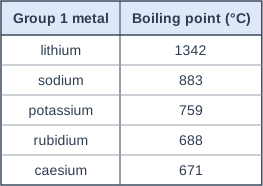
The table shows the boiling points of the other Group 1 metals, in order down the group.

Suggest two reasons why a prediction of the boiling point of francium might be wrong.

Table with columns "Group 1 metal", "Boiling point (°C)". Group 1 metal: lithium; Boiling point (°C): 1342 | Group 1 metal: sodium; Boiling point (°C): 883 | Group 1 metal: potassium; Boiling point (°C): 759 | Group 1 metal: rubidium; Boiling point (°C): 688 | Group 1 metal: caesium; Boiling point (°C): 671.

Model answer

The boiling points do not fall by the same amount each time: the falls get smaller (459 °C, then 124 °C, 71 °C and only 17 °C), so it is hard to know how much lower francium's boiling point will be.
Also, the prediction goes beyond the measured data: francium is at the bottom of the group, so the trend may not continue in the same way, and the prediction cannot easily be checked because only tiny amounts of radioactive francium have been made.

Explanation

Predictions from a trend are most reliable when the trend is regular and the new value lies between measured values. For francium, the falls in boiling point are getting smaller, and the value has to be extrapolated beyond caesium, so the prediction is uncertain. Its radioactivity means the prediction is hard to test by experiment.

Mark scheme
  1. 1 mark

    the boiling points do not fall by the same amount each time / the falls get smaller and smaller (459, 124, 71, then 17 °C), so it is hard to know how much lower the boiling point of francium is

    1 mark for any of points 1 to 3, max 2. If more than two answers are given, a wrong one cancels a right one. For point 1, ALLOW the trend is levelling off / the boiling point of francium might be about the same as that of caesium. IGNORE 'the trend is not perfect' with no detail from the table.

  2. 1 mark

    the prediction is outside the range of the measured data (an extrapolation), so the trend may not continue in the same way for francium

    ALLOW francium is the last element in the group, so there is no element below it to compare with / the value can only be estimated by continuing the trend.

  3. 1 mark

    the prediction cannot be checked by measuring it, because francium is radioactive / only tiny amounts have been made

    ALLOW there is not enough francium to measure its boiling point. IGNORE francium is dangerous, unless linked to not being able to measure or check the value.

Question 4

4 marks

Lithium and fluorine are both in Period 2. Lithium is in Group 1 and fluorine is in Group 7.

At room temperature, lithium is a solid that melts at 181 °C. Fluorine is a gas that boils at −188 °C.

Electron arrangements: lithium 2.1   fluorine 2.7

Explain this difference in physical properties. Use ideas about what happens to the outer electrons in each element and about the forces between the particles.

Model answer

Lithium is a metal. Each lithium atom loses its one outer electron, which becomes delocalised, so lithium has a giant structure of positive ions held together by a sea of delocalised electrons. The attraction between the ions and the electrons is strong, so a lot of energy is needed to melt lithium, and it is a solid at room temperature.
In fluorine, two atoms share a pair of electrons to make small F₂ molecules. The forces between these molecules are weak, so very little energy is needed to separate them: fluorine boils at −188 °C and is a gas at room temperature.

Explanation

The physical properties of an element depend on its structure. Group 1 metals give up their outer electrons to form a giant metallic structure, while Group 7 atoms share electrons to form small molecules with only weak forces between them. When fluorine boils, the covalent bonds inside the F₂ molecules do not break; only the weak forces between molecules are overcome.

Mark scheme
  1. 1 mark

    lithium is a metal: each atom loses its outer electron, which becomes delocalised / lithium has a giant structure of positive ions and delocalised electrons

    1 mark for each of points 1 to 4. ALLOW a sea of electrons / free electrons. DO NOT ALLOW lithium is ionic / has ionic bonds.

  2. 1 mark

    there is a strong attraction between the positive ions and the delocalised electrons (metallic bonding), so a lot of energy is needed to melt lithium

    ALLOW strong metallic bonds, so a high melting point.

  3. 1 mark

    two fluorine atoms share a pair of (outer) electrons, forming small F₂ molecules (a covalent bond)

    ALLOW fluorine is made of simple / small molecules.

  4. 1 mark

    the forces between the F₂ molecules (intermolecular forces) are weak, so little energy is needed to separate them / fluorine has a low boiling point

    The forces must be BETWEEN the molecules. DO NOT ALLOW the covalent bonds are weak / the covalent bonds break when fluorine boils.

Ready to try the rest? Every answer you write is marked against the mark scheme, so you can see exactly where the marks are.

Study Helper Hints first, answers after you try

Stuck on this one? Ask for a hint and I’ll point you in the right direction, without giving the answer away. Once you’ve checked your answer, I’ll show you how the marks are awarded.