
Level:
Correct: 0
Incorrect: 0
Marks: 0/0
Exam Practice
Course:
Topics:
Avg
score:
–
Topics
done:
0/27

Static electricity

Practise 14 exam-style questions on Static electricity for OCR GCSE Combined Science (Physics Paper 5). Write your answer as you would in the exam and get it marked in seconds against the mark scheme, point by point, with the Study Helper on hand if you get stuck.

  • 14 questions
  • 1–6 marks each
  • Instant marking
  • No sign-up needed
14 questions, marked as you go

Sample questions with model answers

Here are 4 of the questions in this topic, each with a model answer, an explanation of why it earns the marks and the mark scheme an examiner would use.

Question 1

1 mark

When two insulators are rubbed together, electrons are transferred from one object to the other. Protons are not transferred.

Which statement explains why?

Choose your answer.

  • A Electrons are heavier than protons, so they are easier to move.
  • B Electrons are outside the nucleus, but protons are held inside it.
  • C Protons are destroyed when two objects are rubbed together.
  • D Protons have no charge, so moving them would not charge an object.

Model answer

B - Electrons are outside the nucleus, but protons are held inside it.

Explanation

An atom has a nucleus containing protons (positive) and neutrons, with electrons (negative) around the outside. Rubbing can only move the outer electrons from one surface to the other. So an object becomes positive by losing electrons, never by gaining protons, and becomes negative by gaining electrons.

Mark scheme
  1. 1 mark

    B / Electrons are outside the nucleus, but protons are held inside it.

    The only correct answer is B: electrons are on the outside of atoms and some can be rubbed off one material onto another, but protons are held in the tiny nucleus at the centre of each atom. A is not correct because electrons have a much smaller mass than protons. C is not correct because protons are not destroyed: the number of protons in each object stays the same. D is not correct because protons are positively charged. ALLOW the letter or the option. If more than one option is given, do not award the mark.
Question 2

2 marks

A sheet of paper is uncharged.

A Perspex rod has been rubbed with a duster, and it is now positively charged.

For each object, compare the number of protons in it with the number of electrons in it.

Model answer

In the uncharged paper, the number of protons is the same as the number of electrons, so the positive and negative charges cancel.
In the positively charged Perspex rod, there are more protons than electrons, because the rod lost some electrons to the duster when it was rubbed.

Explanation

All matter contains positive protons and negative electrons. Most objects have equal numbers of each, so they have zero net charge, like the paper. The Perspex rod became positive by losing electrons; its protons did not change, so after rubbing it has more protons than electrons.

Mark scheme
  1. 1 mark

    paper: the number of protons is equal to the number of electrons (so the positive and negative charges cancel)

    ALLOW the paper has the same number of positive and negative charges. DO NOT ALLOW the paper has no protons or electrons / no charges. DO NOT ALLOW equal numbers of protons and neutrons.

  2. 1 mark

    Perspex rod: there are more protons than electrons / fewer electrons than protons (because it has lost electrons)

    ALLOW the rod has more positive charges than negative charges. DO NOT ALLOW the rod has gained protons. DO NOT ALLOW the rod has no electrons.

Question 3

2 marks

A student rubs a plastic ruler with a dry cloth. She holds the ruler a few centimetres above a table.

On the table there are some tiny polystyrene beads and an empty polystyrene cup. The beads and the cup are not charged.

The beads jump up to the ruler, but the cup stays on the table.

Explain why the beads jump up to the ruler but the cup stays on the table.

Model answer

Rubbing transfers electrons between the ruler and the cloth, so the ruler becomes charged. A charged object attracts uncharged objects without touching them, so there is an upward electrostatic force on the beads and on the cup. The beads are very light, so this force is bigger than their weight and they jump up. The cup is much heavier: its weight is bigger than the electrostatic force, so it stays on the table.

Explanation

Charged objects attract small uncharged objects, but the electrostatic force from a rubbed ruler is quite small. Whether an object is lifted depends on whether this force is bigger than its weight. Tiny beads have a very small weight, so they are lifted; the cup's weight is much larger than the force, so it stays where it is.

Mark scheme
  1. 1 mark

    the (rubbed) ruler is charged, and a charged object attracts uncharged objects / the ruler exerts an attractive electrostatic force on the beads (and the cup) without touching them

    ALLOW the ruler attracts the beads by static electricity. ALLOW the charged ruler makes the charges in each bead move slightly, so the side nearest the ruler has the opposite charge and is attracted. DO NOT ALLOW the beads are charged / have the opposite charge to the ruler (the beads are uncharged). DO NOT ALLOW the ruler is magnetic.

  2. 1 mark

    the beads are very light / have a very small weight, so the electrostatic force on them is bigger than their weight, but the cup is heavier, so its weight is bigger than the electrostatic force on it

    The idea of comparing the electrostatic force (pull) with the weight is needed. ALLOW the force is big enough to lift the light beads but not the heavier cup. ALLOW mass instead of weight. IGNORE 'the cup is bigger' with no reference to its weight or mass.

Question 4

3 marks

A student rubs a plastic rod with a cloth. She holds the rod close to a thin stream of water from a tap, and the stream bends towards the rod.

She holds the rod at different distances from the stream and measures how far the stream bends sideways each time. She rubs the rod in the same way before each reading.

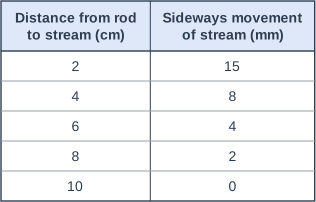
The table shows her results.

Describe the pattern in the results, and suggest what the results show about the force between the charged rod and the water.

Table with columns "Distance from rod to stream (cm)", "Sideways movement of stream (mm)". Distance from rod to stream (cm): 2; Sideways movement of stream (mm): 15 | Distance from rod to stream (cm): 4; Sideways movement of stream (mm): 8 | Distance from rod to stream (cm): 6; Sideways movement of stream (mm): 4 | Distance from rod to stream (cm): 8; Sideways movement of stream (mm): 2 | Distance from rod to stream (cm): 10; Sideways movement of stream (mm): 0.

Model answer

As the rod is held further from the stream, the stream bends less. At 2 cm the stream moves 15 mm sideways, at 4 cm it moves 8 mm, and at 10 cm it does not move at all. This suggests that the force of attraction between the charged rod and the water is bigger when they are closer together, and becomes smaller as the distance increases.

Explanation

Describe the trend (more distance, less bending) and back it up with values from the table. The bending is caused by the electrostatic force between the charged rod and the water, so a bigger bend means a bigger force. The force acts without contact and gets weaker with distance, until at 10 cm it is too small to see an effect.

Mark scheme
  1. 1 mark

    as the distance between the rod and the stream increases, the sideways movement (bend) of the stream decreases

    ORA (allow the reverse argument): the closer the rod, the more the stream bends. DO NOT ALLOW 'they are (inversely) proportional'.

  2. 1 mark

    use of data: for example the stream moves 15 mm when the rod is 2 cm away, but 0 mm when it is 10 cm away / the movement roughly halves for each extra 2 cm

    At least two pairs of values (distance and movement) are needed, or one pair with a comparison. ALLOW values quoted without units.

  3. 1 mark

    the force (of attraction) between the rod and the water is greater when they are closer together / the force decreases as the distance increases

    ORA (allow the reverse argument). ALLOW at 10 cm the force is too small to move the water (or there is no noticeable force). DO NOT ALLOW the force is repulsive.

Ready to try the rest? Every answer you write is marked against the mark scheme, so you can see exactly where the marks are.

Study Helper Hints first, answers after you try

Stuck on this one? Ask for a hint and I’ll point you in the right direction, without giving the answer away. Once you’ve checked your answer, I’ll show you how the marks are awarded.