
Level:
Correct: 0
Incorrect: 0
Marks: 0/0
Exam Practice
Course:
Topics:
Avg
score:
–
Topics
done:
0/27

Gravity, weight and free fall

Practise 14 exam-style questions on Gravity, weight and free fall for OCR GCSE Combined Science (Physics Paper 5). Write your answer as you would in the exam and get it marked in seconds against the mark scheme, point by point, with the Study Helper on hand if you get stuck.

  • 14 questions
  • 1–4 marks each
  • Instant marking
  • No sign-up needed
14 questions, marked as you go

Sample questions with model answers

Here are 4 of the questions in this topic, each with a model answer, an explanation of why it earns the marks and the mark scheme an examiner would use.

Question 1

1 mark

A sack of compost has a weight of 160 N.

Gravitational field strength = 10 N/kg

What is the mass of the sack of compost?

Use the equation: gravitational force = mass × gravitational field strength

Choose your answer.

  • A 1600 kg
  • B 150 kg
  • C 16 kg
  • D 1.6 kg

Model answer

C - 16 kg (mass = 160 ÷ 10 = 16 kg)

Explanation

Weight is a force, so it is the gravitational force in the equation. Rearrange gravitational force = mass × gravitational field strength to give mass = gravitational force ÷ gravitational field strength, so mass = 160 ÷ 10 = 16 kg. Multiplying by 10 gives 1600 kg, which is far too heavy for a sack anyone could carry.

Mark scheme
  1. 1 mark

    C / 16 kg

    The only correct answer is C: mass = gravitational force ÷ gravitational field strength = 160 ÷ 10 = 16 kg. A is not correct because it multiplies 160 by 10 instead of dividing. B is not correct because it subtracts 10 from 160 instead of dividing. D is not correct because it divides 160 by 100, not by 10. ALLOW the letter or the option. If more than one option is given, do not award the mark.
Question 2

2 marks

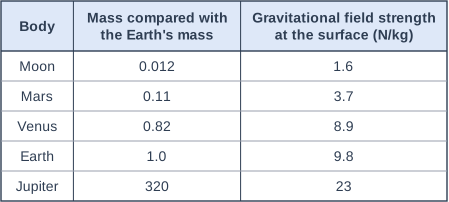
The table shows data from NASA's Planetary Fact Sheet (last updated in March 2025) for some bodies in the Solar System. The mass of each body is given as a multiple of the Earth's mass. The table gives the Earth's value as 9.8 N/kg, which is rounded to 10 N/kg in calculations.

Describe the pattern shown by the data.

Use data from the table in your answer.

Table with columns "Body", "Mass compared with the Earth's mass", "Gravitational field strength at the surface (N/kg)". Body: Moon; Mass compared with the Earth's mass: 0.012; Gravitational field strength at the surface (N/kg): 1.6 | Body: Mars; Mass compared with the Earth's mass: 0.11; Gravitational field strength at the surface (N/kg): 3.7 | Body: Venus; Mass compared with the Earth's mass: 0.82; Gravitational field strength at the surface (N/kg): 8.9 | Body: Earth; Mass compared with the Earth's mass: 1.0; Gravitational field strength at the surface (N/kg): 9.8 | Body: Jupiter; Mass compared with the Earth's mass: 320; Gravitational field strength at the surface (N/kg): 23.

Model answer

The more massive the body, the greater its gravitational field strength. For example, the Moon has the smallest mass (0.012 times the Earth's mass) and the smallest field strength, 1.6 N/kg, while Jupiter has the largest mass (320 times the Earth's mass) and the largest field strength, 23 N/kg.

Explanation

Read along each row: as the mass column goes up, the gravitational field strength column goes up too, so more massive bodies have stronger gravitational fields. A good description quotes pairs of values. The relationship is not direct proportion: multiplying the mass by about 320 (Earth to Jupiter) multiplies g by only about 2.3, because the size of the body matters as well.

Mark scheme
  1. 1 mark

    the greater the mass of the body, the greater the gravitational field strength (at its surface)

    ORA (allow the reverse argument): the smaller the mass, the smaller the gravitational field strength. ALLOW as the mass increases, the gravitational field strength increases. DO NOT ALLOW 'the gravitational field strength is (directly) proportional to the mass': Jupiter has about 320 times the Earth's mass but only about 2.3 times its gravitational field strength.

  2. 1 mark

    use of data from the table to support the pattern: for example the Moon has the smallest mass (0.012) and the smallest gravitational field strength (1.6 N/kg), and Jupiter has the largest mass (320) and the largest gravitational field strength (23 N/kg)

    At least two bodies must be compared, each with its mass and gravitational field strength, or a comparison using values such as 'Mars has a mass of 0.11 and g of 3.7 N/kg but Venus has a mass of 0.82 and g of 8.9 N/kg'. ALLOW values quoted without units. ALLOW 10 N/kg for the Earth.

Question 3

2 marks

Coastguards use a winch at the top of a cliff to lift a stretcher and a casualty, with a total mass of 80 kg, from the beach to the top of the cliff. The top of the cliff is 15 m above the beach.

Gravitational field strength = 10 N/kg

Calculate the increase in the gravitational potential energy of the stretcher and the casualty.

Use the equation: gravitational potential energy = mass × gravitational field strength × height

Model answer

gravitational potential energy = mass × gravitational field strength × height
= 80 × 10 × 15
= 12 000 J

Explanation

Substitute the mass in kilograms, g in N/kg and the height in metres, and the answer comes out in joules: 80 × 10 × 15 = 12 000 J. Check that all three values are multiplied: leaving out g gives 1200, which is ten times too small.

Mark scheme
  1. 1 mark

    substitution: 80 × 10 × 15; or a correct final answer of 12 000 J with no working

    An answer of 12 000 J with no working scores 2 marks. ALLOW 11 760 J or 12 000 J for 2 marks (9.8 N/kg used).

  2. 1 mark

    evaluation: 12 000 (J)

    IGNORE units unless the question asks for them. ALLOW 12 kJ.

Question 4

3 marks

A mountain goat of mass 50 kg climbs up a steep rock face.

The gravitational potential energy of the goat increases by 30 000 J.

Gravitational field strength = 10 N/kg

Calculate the vertical height that the goat climbs.

Model answer

gravitational potential energy = mass × gravitational field strength × height
30 000 = 50 × 10 × height
height = 30 000 ÷ 500 = 60 m

Explanation

Write down the equation, put in the values you know, then divide the energy by (mass × g) to find the height: 30 000 ÷ (50 × 10) = 60 m. A common slip is to divide by 50 and then multiply by 10, which gives 6000 m, much higher than any mountain in the UK.

Mark scheme
  1. 1 mark

    recall: gravitational potential energy = mass × gravitational field strength × height / GPE = m × g × h; or a correct final answer of 60 m with no working

    An answer of 60 m with no working scores 3 marks. ALLOW 61 m or 61.2 m for 3 marks (9.8 N/kg used).

  2. 1 mark

    rearrangement and substitution: height = 30 000 ÷ (50 × 10) / 30 000 ÷ 500; or a correct final answer of 60 m with no working

    ALLOW 30 000 = 50 × 10 × h. DO NOT ALLOW 30 000 ÷ 50 × 10 (which gives 6000 m).

  3. 1 mark

    evaluation: 60 (m)

    IGNORE units unless the question asks for them.

Ready to try the rest? Every answer you write is marked against the mark scheme, so you can see exactly where the marks are.

Study Helper Hints first, answers after you try

Stuck on this one? Ask for a hint and I’ll point you in the right direction, without giving the answer away. Once you’ve checked your answer, I’ll show you how the marks are awarded.