
Level:
Correct: 0
Incorrect: 0
Marks: 0/0
Exam Practice
Course:
Topics:
Avg
score:
–
Topics
done:
0/27

Gas pressure and temperature

Practise 13 exam-style questions on Gas pressure and temperature for OCR GCSE Combined Science (Physics Paper 5). Write your answer as you would in the exam and get it marked in seconds against the mark scheme, point by point, with the Study Helper on hand if you get stuck.

  • 13 questions
  • 1–4 marks each
  • Instant marking
  • No sign-up needed
13 questions, marked as you go

Sample questions with model answers

Here are 4 of the questions in this topic, each with a model answer, an explanation of why it earns the marks and the mark scheme an examiner would use.

Question 1

1 mark

A student measures the pressure of the air in a sealed, rigid flask at different temperatures from 0 °C to 100 °C. She plots a graph of pressure (on the y-axis) against temperature (on the x-axis).

Which describes the shape of her graph?

Choose your answer.

  • A a curve that rises and then falls
  • B a horizontal straight line
  • C a straight line that slopes downwards
  • D a straight line that slopes upwards

Model answer

D (a straight line that slopes upwards)

Explanation

When the air in a rigid, sealed flask is heated, its molecules move faster, so they hit the walls more often and harder, and the pressure rises. The pressure goes up by about the same amount for each degree, so the graph is a straight line sloping upwards. It does not pass through the origin, because the air still has a pressure at 0 °C.

Mark scheme
  1. 1 mark

    D / a straight line that slopes upwards

    The only correct answer is D: at constant volume, the pressure of a fixed mass of gas increases steadily as its temperature increases. A is not correct because the pressure never starts to fall while the temperature is still rising. B is not correct because a horizontal line would mean the pressure does not change with temperature. C is not correct because a line sloping downwards would mean the pressure decreases as the temperature increases. ALLOW the letter or the option. If more than one option is given, do not award the mark.
Question 2

2 marks

A sealed, rigid steel bottle of air is left in strong sunshine. A student writes five statements to explain why the pressure of the air in the bottle increases. One of the statements is wrong.

A The pressure of the air in the bottle increases.
B Energy is transferred to the air, so its temperature rises.
C The air molecules move faster.
D The air molecules expand.
E The air molecules hit the inside of the bottle more often and with more force.

Give the letter of the wrong statement. Then write the letters of the other four statements in the correct order.

Model answer

D is wrong: the molecules do not get bigger.

The correct order is B, C, E, A.

Explanation

Heating the air raises its temperature, so its molecules move faster. Faster molecules hit the inside of the bottle more often and harder, so the pressure increases. The molecules themselves do not get bigger when they are heated, and no air gets in or out of the sealed bottle.

Mark scheme
  1. 1 mark

    D (is wrong)

    ALLOW the statement that the molecules expand / get bigger identified as the wrong one. If more than one letter is given as the wrong statement, do not award the mark.

  2. 1 mark

    B, C, E, A (in this order)

    All four letters must be in this order. If D is also included in the sequence, IGNORE it for this mark when B, C, E and A are in this order.

Question 3

2 marks

A student puts two identical glass flasks of air into the same bath of hot water.

• Flask A is closed with a rubber bung, so no air can get into or out of it.
• Flask B has no bung.

As the air in the flasks warms up, the pressure of the air in flask A increases, but the pressure of the air in flask B does not.

Explain why. Use ideas about the air molecules.

Model answer

Flask A is sealed, so the same air molecules stay inside it. As the air warms up the molecules move faster, so they hit the walls of the flask more often and harder, and the pressure increases.

Flask B is open, so as its air warms up some of the air escapes from the flask. There are fewer molecules left inside to hit the walls, so the pressure of the air in flask B does not increase.

Explanation

The pressure of a gas rises with temperature only in a closed system, where the number of molecules stays the same. In the open flask the molecules also speed up, but some of them leave the flask, so fewer molecules are left to collide with the walls. The air in the open flask does warm up just as much; the difference is that it is not trapped.

Mark scheme
  1. 1 mark

    (flask A) the same air molecules stay in the flask and move faster as the air warms up, so they hit the walls more often / harder (so the pressure increases)

    ALLOW flask A is a closed system / sealed, so the number of molecules stays the same while they speed up. ALLOW 'the molecules have more kinetic energy' for 'move faster'. DO NOT ALLOW the molecules expand / get bigger. IGNORE hot air rises.

  2. 1 mark

    (flask B) some of the air (some molecules) escapes from / leaves the open flask as it warms up, so there are fewer molecules left inside to hit the walls (so the pressure does not increase)

    The idea that air (molecules) leaves flask B is needed for the mark. ALLOW flask B is not a closed system, so air can get out. ALLOW fewer collisions with the walls each second because there are fewer molecules in flask B. DO NOT ALLOW the heat escapes from flask B / the air in flask B does not warm up. DO NOT ALLOW the molecules in flask B stop moving / do not speed up.

Question 4

3 marks

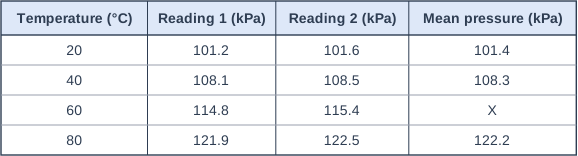
A student measures the pressure of the air in a sealed flask at four temperatures. She takes two readings at each temperature and calculates the mean.

The table shows her results.

Calculate the mean pressure X at 60 °C. Then describe the relationship between temperature and pressure shown by her results. Use data from the table.

Table with columns "Temperature (°C)", "Reading 1 (kPa)", "Reading 2 (kPa)", "Mean pressure (kPa)". Temperature (°C): 20; Reading 1 (kPa): 101.2; Reading 2 (kPa): 101.6; Mean pressure (kPa): 101.4 | Temperature (°C): 40; Reading 1 (kPa): 108.1; Reading 2 (kPa): 108.5; Mean pressure (kPa): 108.3 | Temperature (°C): 60; Reading 1 (kPa): 114.8; Reading 2 (kPa): 115.4; Mean pressure (kPa): X | Temperature (°C): 80; Reading 1 (kPa): 121.9; Reading 2 (kPa): 122.5; Mean pressure (kPa): 122.2.

Model answer

X = (114.8 + 115.4) ÷ 2 = 230.2 ÷ 2 = 115.1 kPa

The pressure increases as the temperature increases. It goes up steadily, by about 7 kPa for every 20 °C rise: 101.4 kPa at 20 °C, 108.3 kPa at 40 °C, 115.1 kPa at 60 °C and 122.2 kPa at 80 °C.

Explanation

The mean of two readings is their sum divided by 2. Describing the relationship needs both the direction (pressure increases with temperature) and the data to show it (about 7 kPa more for each 20 °C). The pressure is not directly proportional to the temperature in °C: doubling from 20 °C to 40 °C raises it only from 101.4 to 108.3 kPa.

Mark scheme
  1. 1 mark

    X = (114.8 + 115.4) ÷ 2 = 115.1 (kPa); or a correct final answer of 115.1 kPa with no working

    An answer of 115.1 kPa with no working scores marking point 1 only. IGNORE units.

  2. 1 mark

    the pressure increases as the temperature increases

    ALLOW positive correlation / the higher the temperature, the higher the pressure. ALLOW ORA (allow the reverse argument).

  3. 1 mark

    the (mean) pressure increases by about 7 kPa for every 20 °C rise / increases steadily (by about the same amount each time), using data from the table

    Data must be quoted, for example 101.4 kPa at 20 °C and 108.3 kPa at 40 °C. ALLOW increases of 6.8 to 7.1 kPa. ALLOW the relationship is linear, with data. DO NOT ALLOW the pressure is directly proportional to the temperature in °C (doubling the temperature from 20 °C to 40 °C does not double the pressure).

Ready to try the rest? Every answer you write is marked against the mark scheme, so you can see exactly where the marks are.

Study Helper Hints first, answers after you try

Stuck on this one? Ask for a hint and I’ll point you in the right direction, without giving the answer away. Once you’ve checked your answer, I’ll show you how the marks are awarded.