
Level:
Correct: 0
Incorrect: 0
Marks: 0/0
Exam Practice
Course:
Topics:
Avg
score:
–
Topics
done:
0/27

Force and extension

Practise 17 exam-style questions on Force and extension for OCR GCSE Combined Science (Physics Paper 5). Write your answer as you would in the exam and get it marked in seconds against the mark scheme, point by point, with the Study Helper on hand if you get stuck.

  • 17 questions
  • 1–6 marks each
  • Instant marking
  • No sign-up needed
17 questions, marked as you go

Sample questions with model answers

Here are 4 of the questions in this topic, each with a model answer, an explanation of why it earns the marks and the mark scheme an examiner would use.

Question 1

1 mark

A student hangs a load from a steel spring. The spring constant of the spring is 320 N/m.

The load stretches the spring by 0.050 m. The spring does not go past its elastic limit.

What is the energy stored in the spring?

Use the equation: energy transferred in stretching = ½ × spring constant × (extension)²

Choose your answer.

  • A 0.40 J
  • B 0.80 J
  • C 8.0 J
  • D 16 J

Model answer

A (½ × 320 × 0.050² = 0.40 J)

Explanation

Square the extension first: 0.050² = 0.0025. Then energy = ½ × 320 × 0.0025 = 0.40 J. Leaving out the ½, forgetting to square the extension, or doubling it instead of squaring it gives one of the wrong options.

Mark scheme
  1. 1 mark

    A / 0.40 J

    The only correct answer is A: energy = ½ × 320 × 0.050² = ½ × 320 × 0.0025 = 0.40 J. B is not correct because the ½ has been left out (320 × 0.050²); C is not correct because the extension has not been squared (½ × 320 × 0.050); D is not correct because the extension was multiplied by 2 instead of being squared (½ × 320 × 0.10). ALLOW the letter or the option. If more than one option is given, do not award the mark.
Question 2

2 marks

A toy dart launcher fires foam darts using a spring.

Before a dart is fired, the spring is compressed by 0.040 m. The spring constant of the spring is 450 N/m.

Calculate the force exerted by the compressed spring.

Model answer

force = spring constant × extension
= 450 × 0.040
= 18 N

Explanation

The equation force = spring constant × extension also works for a compressed spring, using how much it is compressed in place of the extension. The compression is already in metres, so the force is 450 × 0.040 = 18 N. Dividing the spring constant by the compression gives a huge, wrong value.

Mark scheme
  1. 1 mark

    force = spring constant × extension / 450 × 0.040; or a correct final answer of 18 N with no working

    An answer of 18 N with no working scores 2 marks. ALLOW F = k × x or F = kx for this mark, and ALLOW compression in place of extension. DO NOT ALLOW 450 ÷ 0.040 (= 11 250 N) or 0.040 ÷ 450 for either mark.

  2. 1 mark

    evaluation: 18 (N)

    IGNORE units unless the question asks for them.

Question 3

2 marks

A student hangs weights from a strip of rubber and measures its extension each time. Her results are:
• 1.0 N: 1.5 cm
• 2.0 N: 4.0 cm
• 3.0 N: 7.5 cm

She tries to find the spring constant of the rubber by calculating force ÷ extension for each result. She gets a different value each time.

Explain why she cannot find one value for the spring constant of the rubber. Use her results in your answer.

Model answer

The extension of the rubber is not proportional to the force: the relationship is non-linear. Each extra 1.0 N gives a bigger increase in extension (2.5 cm, then 3.5 cm), and doubling the force from 1.0 N to 2.0 N more than doubles the extension. So force ÷ extension keeps changing, and a single spring constant can only be found when the relationship is linear.

Explanation

A spring constant is the force needed for each unit of extension, so it has one value only when force and extension are directly proportional (a straight-line graph through the origin). For the rubber, the extension goes up by more for each extra newton, so force ÷ extension falls from 0.67 N/cm to 0.40 N/cm. Rubber has a non-linear force-extension relationship.

Mark scheme
  1. 1 mark

    the extension is not (directly) proportional to the force / the relationship between force and extension is non-linear (the force-extension graph would be a curve), and a spring constant can only be found for a linear relationship

    ALLOW 'the rubber does not obey Hooke's law'. ALLOW 'the gradient of the force-extension graph changes'.

  2. 1 mark

    use of data: equal increases of 1.0 N in force give unequal increases in extension (2.5 cm, then 3.5 cm) / doubling the force from 1.0 N to 2.0 N more than doubles the extension (1.5 cm to 4.0 cm)

    ALLOW correct values of force ÷ extension that change (0.67, 0.50 and 0.40 N/cm, or 67, 50 and 40 N/m). IGNORE 'the extension increases as the force increases' on its own.

Question 4

3 marks

A student makes a simple force meter from a spring, a pointer and a card scale.

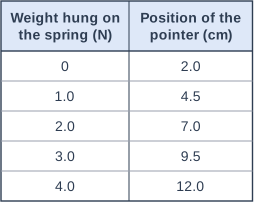
She hangs known weights from the spring and records the position of the pointer on the card each time. The table shows her results.

She then hangs a pencil case from the spring. The pointer is at 10.5 cm. The spring does not go past its elastic limit.

Calculate the weight of the pencil case.

Table with columns "Weight hung on the spring (N)", "Position of the pointer (cm)". Weight hung on the spring (N): 0; Position of the pointer (cm): 2.0 | Weight hung on the spring (N): 1.0; Position of the pointer (cm): 4.5 | Weight hung on the spring (N): 2.0; Position of the pointer (cm): 7.0 | Weight hung on the spring (N): 3.0; Position of the pointer (cm): 9.5 | Weight hung on the spring (N): 4.0; Position of the pointer (cm): 12.0.

Model answer

From the table, each 1.0 N moves the pointer 2.5 cm, starting from 2.0 cm.
Extension with the pencil case = 10.5 − 2.0 = 8.5 cm
Weight = 8.5 ÷ 2.5 = 3.4 N

Explanation

The spring obeys Hooke's law, so the extension goes up by the same amount (2.5 cm) for each newton. Measure the extension from the pointer's starting position at 0 N (2.0 cm), not from the top of the card: 10.5 − 2.0 = 8.5 cm, and 8.5 ÷ 2.5 = 3.4 N. Using 40 N/m and F = k × x gives the same answer.

Mark scheme
  1. 1 mark

    the extension is 2.5 cm for each 1.0 N / spring constant = 1.0 ÷ 0.025 = 40 N/m; or a correct final answer of 3.4 N with no working

    An answer of 3.4 N with no working scores 3 marks. If the pointer position (10.5 cm) is used as the extension, 10.5 ÷ 2.5 = 4.2 N scores 1 mark (marking point 1 only).

  2. 1 mark

    extension with the pencil case = 10.5 − 2.0 = 8.5 cm; or a correct final answer of 3.4 N with no working

    ALLOW 0.085 m. ALLOW 'the pointer is 1.0 cm below the 3.0 N mark (9.5 cm)'.

  3. 1 mark

    weight = 8.5 ÷ 2.5 = 3.4 (N)

    ALLOW 40 × 0.085 = 3.4 N. ALLOW 3.0 N + 1.0 ÷ 2.5 = 3.4 N. ALLOW ECF from a wrong extension per newton.

Ready to try the rest? Every answer you write is marked against the mark scheme, so you can see exactly where the marks are.

Study Helper Hints first, answers after you try

Stuck on this one? Ask for a hint and I’ll point you in the right direction, without giving the answer away. Once you’ve checked your answer, I’ll show you how the marks are awarded.