
Level:
Correct: 0
Incorrect: 0
Marks: 0/0
Exam Practice
Course:
Topics:
Avg
score:
–
Topics
done:
0/27

Newton's second law

Practise 12 exam-style questions on Newton's second law for OCR GCSE Combined Science (Physics Paper 5). Write your answer as you would in the exam and get it marked in seconds against the mark scheme, point by point, with the Study Helper on hand if you get stuck.

  • 12 questions
  • 1–4 marks each
  • Instant marking
  • No sign-up needed
12 questions, marked as you go

Sample questions with model answers

Here are 4 of the questions in this topic, each with a model answer, an explanation of why it earns the marks and the mark scheme an examiner would use.

Question 1

1 mark

A remote-controlled model car has a mass of 1.2 kg. The resultant force on the car is 3.0 N.

What is the acceleration of the car?

Use the equation: force = mass × acceleration

Choose your answer.

  • A 3.6 m/s²
  • B 2.5 m/s²
  • C 1.8 m/s²
  • D 0.40 m/s²

Model answer

B - 2.5 m/s²

acceleration = force ÷ mass = 3.0 ÷ 1.2 = 2.5 m/s²

Explanation

Rearrange force = mass × acceleration to give acceleration = force ÷ mass. Then 3.0 ÷ 1.2 = 2.5 m/s². Dividing the wrong way round (1.2 ÷ 3.0) gives 0.40 m/s², and multiplying the force by the mass gives 3.6, which is not an acceleration at all.

Mark scheme
  1. 1 mark

    B / 2.5 m/s²

    The only correct answer is B: acceleration = force ÷ mass = 3.0 ÷ 1.2 = 2.5 m/s². A is not correct because it multiplies the force by the mass (3.0 × 1.2). C is not correct because it subtracts the mass from the force (3.0 − 1.2). D is not correct because it divides the mass by the force (1.2 ÷ 3.0). ALLOW the letter or the option. If more than one option is given, do not award the mark.
Question 2

2 marks

A rowing boat has a crew of eight rowers. At the start of a race, the boat and crew have a total mass of 900 kg and an acceleration of 1.2 m/s².

Calculate the resultant force on the boat and crew.

Use the equation: force = mass × acceleration

Model answer

Force = mass × acceleration
= 900 × 1.2
= 1080 N

Explanation

Substitute the mass in kilograms and the acceleration in m/s² straight into force = mass × acceleration. The answer is in newtons. Dividing the mass by the acceleration (giving 750) is not a correct method.

Mark scheme
  1. 1 mark

    900 × 1.2; or a correct final answer of 1080 N / 1100 N with no working

    An answer of 1080 N or 1100 N with no working scores 2 marks. DO NOT ALLOW 900 ÷ 1.2 (750) or 1.2 ÷ 900.

  2. 1 mark

    1080 (N) / 1100 (N)

    ALLOW 1.08 kN / 1.1 kN. IGNORE units unless the question asks for them.

Question 3

2 marks

Two family cars, X and Y, are tested on a level track. Here are the mass of each car and the largest resultant force that can act on it.

Car X: mass 1500 kg, largest resultant force 4500 N
Car Y: mass 1100 kg, largest resultant force 3850 N

A student says: 'Car X can reach the greater acceleration, because the largest resultant force on it is greater.'

Use calculations to show whether the student is correct.

Model answer

Acceleration = force ÷ mass
Car X: 4500 ÷ 1500 = 3.0 m/s²
Car Y: 3850 ÷ 1100 = 3.5 m/s²
The student is wrong: car Y has the greater acceleration, even though the force on it is smaller, because its mass is much smaller.

Explanation

Acceleration depends on both the resultant force and the mass: acceleration = force ÷ mass. A larger force does not always mean a larger acceleration if the mass is also larger. Comparing the calculated accelerations, not the forces, decides the answer.

Mark scheme
  1. 1 mark

    acceleration of X = 4500 ÷ 1500 = 3.0 (m/s²) AND acceleration of Y = 3850 ÷ 1100 = 3.5 (m/s²)

    Both accelerations are needed for this mark. ALLOW 3 and 3.5. DO NOT ALLOW mass ÷ force for either car.

  2. 1 mark

    the student is wrong: car Y has the greater (largest) acceleration (because its mass is much smaller)

    ALLOW ECF from incorrectly calculated accelerations if the conclusion matches the student's own values. DO NOT ALLOW 'car Y' with no calculation (the question asks for calculations).

Question 4

3 marks

A student investigates how the mass of a trolley affects its acceleration.

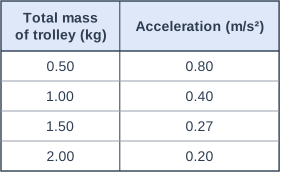
A small electric fan fixed to the trolley pushes it along a level runway with the same force each time. The runway has very little friction. She adds masses to the trolley and uses a light gate and data logger to measure the acceleration.

The table shows her results.

Use one of her results to calculate the force from the fan. Then describe how the acceleration changes as the total mass increases.

Use the equation: force = mass × acceleration

Table with columns "Total mass of trolley (kg)", "Acceleration (m/s²)". Total mass of trolley (kg): 0.50; Acceleration (m/s²): 0.80 | Total mass of trolley (kg): 1.00; Acceleration (m/s²): 0.40 | Total mass of trolley (kg): 1.50; Acceleration (m/s²): 0.27 | Total mass of trolley (kg): 2.00; Acceleration (m/s²): 0.20.

Model answer

Force = mass × acceleration
= 0.50 × 0.80
= 0.40 N
As the total mass increases, the acceleration decreases: doubling the mass from 0.50 kg to 1.00 kg halves the acceleration from 0.80 m/s² to 0.40 m/s².

Explanation

The fan gives the same resultant force each time, so any row gives the force: mass × acceleration is about 0.40 N in every row (1.50 × 0.27 = 0.405 because 0.27 is rounded). With the force fixed, a larger mass gives a smaller acceleration. A common slip is to divide instead of multiply.

Mark scheme
  1. 1 mark

    a correct mass × acceleration from one row, for example 0.50 × 0.80 / 1.00 × 0.40 / 2.00 × 0.20; or a correct final answer from 0.40 to 0.41 N with no working

    An answer from 0.40 to 0.41 N (0.40 N, or 0.405 N or 0.41 N from 1.50 × 0.27) with no working scores marking points 1 and 2 only. ALLOW 1.50 × 0.27. DO NOT ALLOW mass ÷ acceleration or acceleration ÷ mass.

  2. 1 mark

    0.40 (N) / 0.4 (N) / 0.405 (N) / 0.41 (N)

    ALLOW any value from 0.40 to 0.41 N. IGNORE units unless the question asks for them.

  3. 1 mark

    as the (total) mass increases, the acceleration decreases

    ALLOW doubling the mass halves the acceleration / the acceleration is inversely proportional to the mass. ORA (allow the reverse argument). IGNORE 'negative correlation' on its own. DO NOT ALLOW 'the acceleration is proportional to the mass'.

Ready to try the rest? Every answer you write is marked against the mark scheme, so you can see exactly where the marks are.

Study Helper Hints first, answers after you try

Stuck on this one? Ask for a hint and I’ll point you in the right direction, without giving the answer away. Once you’ve checked your answer, I’ll show you how the marks are awarded.