
Level:
Correct: 0
Incorrect: 0
Marks: 0/0
Exam Practice
Course:
Topics:
Avg
score:
–
Topics
done:
0/27

Deforming objects: elastic and plastic deformation

Practise 12 exam-style questions on Deforming objects: elastic and plastic deformation for OCR GCSE Combined Science (Physics Paper 5). Write your answer as you would in the exam and get it marked in seconds against the mark scheme, point by point, with the Study Helper on hand if you get stuck.

  • 12 questions
  • 1–3 marks each
  • Instant marking
  • No sign-up needed
12 questions, marked as you go

Sample questions with model answers

Here are 4 of the questions in this topic, each with a model answer, an explanation of why it earns the marks and the mark scheme an examiner would use.

Question 1

1 mark

Forces change the shape of each of these objects.

In which of these is the object being stretched?

Choose your answer.

  • A a car tyre where it presses on the road
  • B a diving board when a diver stands on its end
  • C a hammock rope when someone lies in the hammock
  • D a wet towel when it is wrung out

Model answer

C

Explanation

An object is stretched when forces pull its two ends in opposite directions, so it gets longer: the hammock rope is pulled by the hammock at one end and by its fixing at the other. The tyre is compressed, the diving board is bent and the towel is twisted. Each change of shape needs more than one force.

Mark scheme
  1. 1 mark

    C / a hammock rope when someone lies in the hammock

    The only correct answer is C: the hammock pulls on one end of the rope while the hook or tree pulls on the other end in the opposite direction, so the rope is stretched (made longer). A is not correct because the tyre is squashed (compressed) between the road and the wheel; B is not correct because the diving board is bent: it is pushed down at its free end and held at the other end; D is not correct because the towel is twisted, with its two ends turned in opposite directions. ALLOW the letter or the option. If more than one option is given, do not award the mark.
Question 2

2 marks

A student wants to find out whether a spring deforms elastically or plastically when a 5.0 N weight hangs from it.

The length of the spring before she adds the weight is 10.0 cm. With the weight hanging from it, the length of the spring is 14.0 cm.

She says: 'The spring is now longer than at the start, so it has deformed plastically.'

Explain why her conclusion is not valid, and describe what she should do to find out.

Model answer

Her conclusion is not valid because she measured the length while the weight was still hanging from the spring. Any spring is longer while a force stretches it, even if it deforms elastically. She should take the weight off and measure the length again. If the spring is back to 10.0 cm, it deformed elastically; if it is still longer than 10.0 cm, it deformed plastically.

Explanation

Elastic and plastic deformation are told apart by what happens after the force is removed. A length measured while the weight is on only shows that the spring has stretched. Comparing the length after the weight is removed with the starting length shows whether the change is permanent.

Mark scheme
  1. 1 mark

    she measured the length while the weight was still on the spring: any stretched spring is longer while the force acts, whether its deformation is elastic or plastic

    ALLOW 'a spring that deforms elastically is also longer while the weight is on it'. ALLOW 'the extension of 4.0 cm only shows that the spring stretched'.

  2. 1 mark

    she should remove the weight and measure the length again: if it is back to 10.0 cm the deformation is elastic, but if it is longer than 10.0 cm it is plastic

    The idea of measuring after the weight is removed is needed. ALLOW ORA (allow the reverse argument). IGNORE 'repeat the experiment' on its own.

Question 3

2 marks

A student says: 'An object that deforms elastically can never be deformed plastically.'

Use an example to explain why the student is wrong.

Model answer

A spring deforms elastically when small forces stretch it: it goes back to its original length when the forces are removed. But if it is stretched too far, past its elastic limit, it deforms plastically and stays longer. So whether an object deforms elastically or plastically depends on how large the forces are.

Explanation

Elastic and plastic are not fixed types of object: they describe what happens for a given stretching force. Most materials deform elastically for small forces, but past their elastic limit the change becomes permanent. A spring pulled too far is a good example, because it stays longer afterwards.

Mark scheme
  1. 1 mark

    an object that deforms elastically with small forces can deform plastically if the forces are large enough / if it is stretched too far (past its elastic limit)

    ALLOW 'it depends on the size of the force'. IGNORE 'some objects are both' with no reference to the size of the force or how far the object is stretched.

  2. 1 mark

    example: a spring that is stretched too far does not go back to its original length / stays longer when the force is removed

    1 mark for any one of marking points 2 to 4, max 1. If more than one example is given, a wrong one cancels a right one. ALLOW any other object that normally deforms elastically and stays deformed after being stretched or bent too far. DO NOT ALLOW an object that normally deforms plastically, such as modelling clay.

  3. 1 mark

    example: an elastic band / hair bobble that is stretched too far stays longer / looser when the force is removed

    ALLOW a rubber band or the elastic in clothing that has been stretched too far.

  4. 1 mark

    example: a metal ruler / strip that is bent too far stays bent when the force is removed

    ALLOW a plastic ruler bent too far that stays bent or a wire bent too far that stays bent.

Question 4

3 marks

A company makes garden trampolines. When people bounce on a trampoline, each spring around the edge of the mat is stretched by forces of up to 500 N.

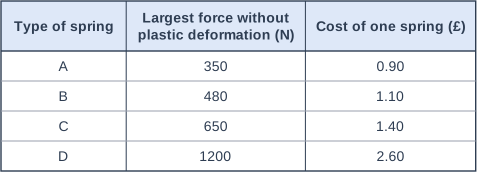
The company tests four types of spring, A, B, C and D. The table shows the largest force that stretches each type of spring without deforming it plastically, and the cost of one spring.

The company wants the cheapest spring that will always deform elastically when the trampoline is used.

Which type of spring should the company choose? Explain your answer using data from the table.

Table with columns "Type of spring", "Largest force without plastic deformation (N)", "Cost of one spring (£)". Type of spring: A; Largest force without plastic deformation (N): 350; Cost of one spring (£): 0.90 | Type of spring: B; Largest force without plastic deformation (N): 480; Cost of one spring (£): 1.10 | Type of spring: C; Largest force without plastic deformation (N): 650; Cost of one spring (£): 1.40 | Type of spring: D; Largest force without plastic deformation (N): 1200; Cost of one spring (£): 2.60.

Model answer

The company should choose spring C. The springs are stretched by forces of up to 500 N, which is less than 650 N, so spring C always deforms elastically and returns to its original length after each bounce. Springs A and B would be stretched by more than 350 N and 480 N, so they would deform plastically and stay longer, and the mat would sag. Spring D would also deform elastically, but it costs £2.60 instead of £1.40.

Explanation

A spring deforms elastically only while the stretching force is below the largest force it can take without plastic deformation. Spring B looks close, but 500 N is more than 480 N, so it would be permanently stretched. C is the cheapest spring whose value is above 500 N.

Mark scheme
  1. 1 mark

    spring C

    Marking point 1 is for the choice. Then 1 mark for each of marking points 2 to 4, max 2 (max 3 for the question). Data from the table must be used for marking points 2 and 3.

  2. 1 mark

    the forces on the springs (up to 500 N) are smaller than 650 N, so spring C always deforms elastically / returns to its original length after each bounce

    ALLOW '500 N is less than 650 N, so C is not deformed plastically'.

  3. 1 mark

    springs A and B would be stretched by more than 350 N / 480 N, so they would deform plastically / become permanently longer (and the mat would sag)

    ALLOW either A or B discussed with its value.

  4. 1 mark

    spring D would also deform elastically, but it costs more (£2.60 compared with £1.40)

    ALLOW 'D is more expensive than C' (the costs need not be quoted).

Ready to try the rest? Every answer you write is marked against the mark scheme, so you can see exactly where the marks are.

Study Helper Hints first, answers after you try

Stuck on this one? Ask for a hint and I’ll point you in the right direction, without giving the answer away. Once you’ve checked your answer, I’ll show you how the marks are awarded.