
Level:
Correct: 0
Incorrect: 0
Marks: 0/0
Exam Practice
Course:
Topics:
Avg
score:
–
Topics
done:
0/27

Newton's third law

Practise 9 exam-style questions on Newton's third law for OCR GCSE Combined Science (Physics Paper 5). Write your answer as you would in the exam and get it marked in seconds against the mark scheme, point by point, with the Study Helper on hand if you get stuck.

  • 9 questions
  • 1–3 marks each
  • Instant marking
  • No sign-up needed
9 questions, marked as you go

Sample questions with model answers

Here are 4 of the questions in this topic, each with a model answer, an explanation of why it earns the marks and the mark scheme an examiner would use.

Question 1

1 mark

Each option describes a pair of forces that are equal in size and act in opposite directions.

Which pair of forces is a Newton's third law pair?

Choose your answer.

  • A a car's driving force and the air resistance on the car, when the car moves at a steady speed
  • B a hammer's push on a nail and the nail's push on the hammer, while the hammer hits the nail
  • C a hanging lamp's weight and the pull of the cable on the lamp
  • D a resting book's weight and the push of the table on the book

Model answer

B (a hammer's push on a nail and the nail's push on the hammer)

Explanation

The two forces in a Newton's third law pair always act on two different objects and are the same type of force. In A, C and D both forces act on the same object, so they are balanced forces that keep that object at rest or at a steady speed. Equal and opposite forces are not enough on their own to make a third law pair.

Mark scheme
  1. 1 mark

    B / a hammer's push on a nail and the nail's push on the hammer

    The only correct answer is B: the two forces come from one interaction between two objects, they act on different objects (one on the nail, one on the hammer) and they are the same type of force (contact forces). A is not correct because both forces act on the same object, the car: they are balanced forces, not a third law pair. C is not correct because both forces act on the lamp, and they are different types of force (gravitational and contact). D is not correct because both forces act on the book: they are balanced forces, and the weight's third law partner is the pull of the book on the Earth. ALLOW the letter or the option. If more than one option is given, do not award the mark.
Question 2

2 marks

Two students, A and B, each hold a force sensor. The hooks of the two sensors are joined together. Sensor A measures the pull on student A. Sensor B measures the pull on student B.

Student B sits on a chair with wheels. Student A pulls student B across the laboratory floor.

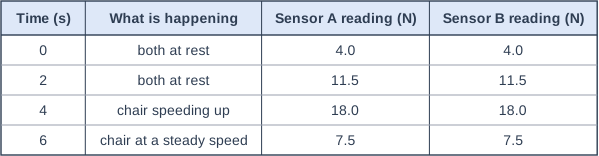
The table shows the readings of the two sensors at four times.

What do the results show about the forces that the two students exert on each other? Use data from the table in your answer.

Table with columns "Time (s)", "What is happening", "Sensor A reading (N)", "Sensor B reading (N)". Time (s): 0; What is happening: both at rest; Sensor A reading (N): 4.0; Sensor B reading (N): 4.0 | Time (s): 2; What is happening: both at rest; Sensor A reading (N): 11.5; Sensor B reading (N): 11.5 | Time (s): 4; What is happening: chair speeding up; Sensor A reading (N): 18.0; Sensor B reading (N): 18.0 | Time (s): 6; What is happening: chair at a steady speed; Sensor A reading (N): 7.5; Sensor B reading (N): 7.5.

Model answer

The two sensors always show the same reading, for example both read 11.5 N at 2 s and both read 18.0 N at 4 s. This is true when the students are at rest and when the chair is moving or speeding up, so each student always pulls on the other with a force of the same size.

Explanation

The two students interact through the joined sensors, so the force of A on B and the force of B on A are a Newton's third law pair. The data show the two forces are equal in size in every row, both when nothing is moving (equilibrium) and when the chair speeds up (non-equilibrium). Student B speeds up because of the forces acting on B, not because A's pull is bigger than B's.

Mark scheme
  1. 1 mark

    the two readings are (always) equal / the same at every time, with a correct example from the table (for example, both are 18.0 N at 4 s)

    A correct use of data is needed for this mark: 'the readings are the same' with no data scores 0 for this point but can still score point 2. ALLOW any correct pair of equal readings (4.0 N, 11.5 N, 18.0 N or 7.5 N). IGNORE descriptions of how the readings change with time.

  2. 1 mark

    the forces are equal (in size) both when the students are at rest and when they are moving / speeding up, so the force of each student on the other is always the same size (as Newton's third law says)

    The answer must link the equal readings to both situations: at rest AND moving (or speeding up). ALLOW equal and opposite forces at all times / whatever the motion. DO NOT ALLOW the forces cancel out / are balanced (they act on different students). DO NOT ALLOW student A pulls harder because she is winning.

Question 3

2 marks

A student puts a bag of rice on a top-pan balance that reads in newtons. The balance measures the downward force that the bag exerts on the pan. The reading is 12 N. The bag is at rest.

Explain why the reading on the balance is equal to the weight of the bag.

Model answer

The bag is at rest, so the forces on it are balanced: the pan pushes up on the bag with a force equal to its weight. By Newton's third law, the bag pushes down on the pan with a force of the same size, and this is the force the balance measures. So the reading, 12 N, equals the weight of the bag.

Explanation

Two different ideas are linked here. The bag is in equilibrium, so the upward push of the pan balances the bag's weight (two forces on the same object). The bag and the pan interact, so the bag pushes down on the pan with a force equal to the pan's push on the bag (a third law pair on different objects). Together these make the reading equal to the weight.

Mark scheme
  1. 1 mark

    the bag is at rest, so the forces on it are balanced: the pan pushes up on the bag with a force equal to the bag's weight (12 N)

    Both ideas are needed: the bag is at rest / in equilibrium AND the upward push of the pan on the bag equals its weight. ALLOW the resultant force on the bag is zero, so the normal contact force equals the weight.

  2. 1 mark

    (by Newton's third law) the bag pushes down on the pan with a force equal in size to the pan's push on the bag, so the reading (12 N) equals the weight

    ALLOW the push of the bag on the pan and the push of the pan on the bag are a third law pair / are equal and opposite. DO NOT ALLOW for this point: the weight of the bag and the push of the pan on the bag are a Newton's third law pair (they act on the same object, so they are not a third law pair).

Question 4

3 marks

A student jumps straight up from the floor. Just before her feet leave the floor, she pushes down on the floor with a force of 1100 N. Her weight is 500 N.

Find the resultant force on the student at this moment, and give its direction.

Model answer

By Newton's third law, the floor pushes up on the student with a force of 1100 N.
Resultant force = 1100 − 500 = 600 N
Direction: upwards

Explanation

The student pushes down on the floor, so the floor pushes up on her with a force of the same size, 1100 N. Two forces act on her: 1100 N upwards from the floor and her weight of 500 N downwards. They act in opposite directions, so subtract: the resultant is 600 N upwards, which makes her accelerate upwards. Adding the forces (1600 N) is wrong because they act in opposite directions.

Mark scheme
  1. 1 mark

    the floor pushes up on the student with a force of 1100 N (Newton's third law); or a correct final answer of 600 N with no working

    An answer of 600 N upwards with no working scores 3 marks. An answer of 600 N with no direction scores marking points 1 and 2 only. ALLOW the upward force on the student is 1100 N. DO NOT ALLOW 1600 N (1100 + 500: the weight acts downwards, against the floor's push) for points 1 and 2, but point 1 can still be given if the student states that the floor pushes up with 1100 N.

  2. 1 mark

    resultant force = 1100 − 500 = 600 (N); or a correct final answer of 600 N with no working

    ALLOW 600 N on its own for this point. DO NOT ALLOW 500 N (the weight alone) or 1100 N (the push alone).

  3. 1 mark

    upwards

    ALLOW away from the floor / vertically up. ALLOW this mark with a wrong value of the resultant force if the direction given is upwards. DO NOT ALLOW downwards.

Ready to try the rest? Every answer you write is marked against the mark scheme, so you can see exactly where the marks are.

Study Helper Hints first, answers after you try

Stuck on this one? Ask for a hint and I’ll point you in the right direction, without giving the answer away. Once you’ve checked your answer, I’ll show you how the marks are awarded.