
Level:
Correct: 0
Incorrect: 0
Marks: 0/0
Exam Practice
Course:
Topics:
Avg
score:
–
Topics
done:
0/25

Practical skills (chemistry PAGs C1-C5)

Practise 16 exam-style questions on Practical skills (chemistry PAGs C1-C5) for OCR GCSE Combined Science (Chemistry Paper 9). Write your answer as you would in the exam and get it marked in seconds against the mark scheme, point by point, with the Study Helper on hand if you get stuck.

  • 16 questions
  • 1–6 marks each
  • Instant marking
  • No sign-up needed
16 questions, marked as you go

Sample questions with model answers

Here are 4 of the questions in this topic, each with a model answer, an explanation of why it earns the marks and the mark scheme an examiner would use.

Question 1

1 mark

A student electrolyses copper(II) sulfate solution five times under the same conditions and weighs the copper deposited on the cathode each time. Her results, in g, are:

0.242   0.238   0.240   0.256   0.238

What is the median of her results?

Choose your answer.

  • A 0.238 g
  • B 0.240 g
  • C 0.243 g
  • D 0.247 g

Model answer

B (0.240 g)

In order: 0.238, 0.238, 0.240, 0.242, 0.256. The middle (third) value is 0.240 g.

Explanation

The median is the middle value when the results are put in order. It is less affected by an unusually high or low value (here 0.256 g) than the mean is. Do not confuse it with the mode, the most common value, or the mean, the total divided by the number of results.

Mark scheme
  1. 1 mark

    B / 0.240 g

    The only correct answer is B: in order the results are 0.238, 0.238, 0.240, 0.242, 0.256, and the middle value is 0.240 g. A is not correct because 0.238 g is the mode (the most common value); C is not correct because 0.243 g is the mean (1.214 ÷ 5 = 0.2428); D is not correct because 0.247 g is halfway between the lowest and highest values. ALLOW the letter or the option. If more than one option is given, do not award the mark.
Question 2

2 marks

A student electrolyses copper(II) sulfate solution using two copper electrodes. After 30 minutes the copper anode has lost 0.31 g.

Her friend says: 'The anode would lose mass anyway, because copper slowly dissolves in copper(II) sulfate solution even without a current.'

Describe a control experiment that would test her friend's idea, and explain how the results would show whether the friend is right.

Model answer

Control experiment: weigh a second copper electrode, identical to the anode, and stand it in the same volume of the same copper(II) sulfate solution for 30 minutes, but with no current flowing (the power supply is not connected). Then rinse, dry and reweigh it.

If its mass stays the same (or changes by much less than 0.31 g), the mass lost by the anode was caused by the electrolysis, so the friend is wrong. If it also loses about 0.31 g, the friend is right.

Explanation

A control experiment keeps everything the same except the one factor being tested, here the current. Comparing the result with and without the current shows whether that factor causes the change. A control should be described precisely: same solution, same electrode, same time, no current.

Mark scheme
  1. 1 mark

    weigh an identical copper electrode, leave it in the same copper(II) sulfate solution for the same time (30 minutes) with no current / with the power supply switched off, then reweigh it

    The ideas of no current and the same conditions (same solution and same time) are both needed for this mark. ALLOW 'set up the same apparatus but do not switch on the power'.

  2. 1 mark

    if its mass does not change (or changes much less than 0.31 g), the loss of mass is caused by the electrolysis and the friend is wrong / if it also loses about 0.31 g, the friend is right

    ALLOW either way round of the comparison. IGNORE 'compare the results' without saying what each result would show.

Question 3

3 marks

A student electrolyses sodium chloride solution using inert electrodes. She collects the gas from each electrode in an upside-down measuring cylinder for 5 minutes. She then repeats the experiment twice more with fresh solution.

The overall equation shows that equal volumes of hydrogen and chlorine should form.

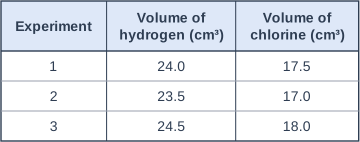
The table shows her results.

Explain whether the difference between the volumes of the two gases is due to random error or systematic error.

Suggest a cause of the error and one way to reduce it.

Table with columns "Experiment", "Volume of hydrogen (cm³)", "Volume of chlorine (cm³)". Experiment: 1; Volume of hydrogen (cm³): 24.0; Volume of chlorine (cm³): 17.5 | Experiment: 2; Volume of hydrogen (cm³): 23.5; Volume of chlorine (cm³): 17.0 | Experiment: 3; Volume of hydrogen (cm³): 24.5; Volume of chlorine (cm³): 18.0.

Model answer

It is a systematic error. In every experiment the volume of chlorine is about 6.5 cm³ less than the volume of hydrogen (for example 17.5 cm³ compared with 24.0 cm³), and the repeats are close to each other. A random error would make the results scatter, sometimes higher and sometimes lower.

The cause is that chlorine is quite soluble in water (and reacts with it), so some of the chlorine dissolves in the solution instead of collecting in the cylinder. Hydrogen is almost insoluble.

To reduce the error she could let the electrolysis run for a few minutes before collecting the gases, so that the solution is already saturated with chlorine.

Explanation

A systematic error shifts every result in the same direction by a similar amount, so repeating the experiment and taking a mean does not remove it. Random errors make repeats scatter on both sides of the true value. Here the consistent shortfall of chlorine points to a cause built into the method: chlorine dissolving in the solution.

Mark scheme
  1. 1 mark

    systematic error, because the volume of chlorine is lower than the volume of hydrogen by about the same amount (about 6.5 cm³) in every experiment / the results are consistently low but close to each other

    The idea of a consistent difference is needed for this mark; 'systematic' alone scores 0. ALLOW use of data, for example 17.5 cm³ compared with 24.0 cm³.

  2. 1 mark

    chlorine dissolves in the (water in the) solution / chlorine reacts with the water, but hydrogen is almost insoluble

    ALLOW 'some chlorine is absorbed by the solution'. DO NOT ALLOW 'chlorine escapes because it is a gas' unless a leak is described.

  3. 1 mark

    run the electrolysis for a few minutes before starting to collect the gas / saturate the solution with chlorine first

    ALLOW 'use a more concentrated (saturated) sodium chloride solution, in which less chlorine dissolves'. IGNORE 'repeat more times' (repeats do not reduce a systematic error).

Question 4

4 marks

A colorimeter measures how much light passes through a coloured solution. It displays the absorbance: the more concentrated the solution, the higher the absorbance.

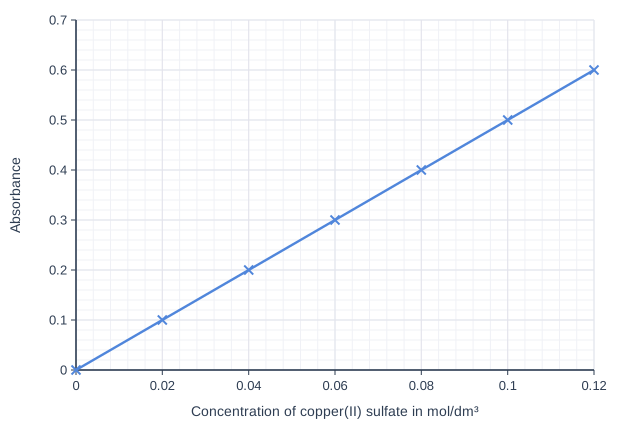
A student measures the absorbance of copper(II) sulfate solutions of known concentration and draws the calibration graph shown. She then measures a solution of unknown concentration. Its absorbance is 0.37.

Use the graph to find the concentration of the unknown solution in mol/dm³. Then calculate this concentration in g/dm³.

Relative formula mass (Mr): CuSO₄ = 159.6

Another copper(II) sulfate solution has an absorbance of 0.95, which is higher than any absorbance on the graph. Suggest how she could find its concentration.

Line graph of absorbance (y-axis, 0 to 0.7) against concentration of copper(II) sulfate in mol/dm³ (x-axis, 0 to 0.12). The line joins the points (0, 0), (0.02, 0.1), (0.04, 0.2), (0.06, 0.3), (0.08, 0.4), (0.1, 0.5), (0.12, 0.6).

Model answer

From the graph, an absorbance of 0.37 corresponds to a concentration of 0.074 mol/dm³.
Concentration in g/dm³ = 0.074 × 159.6 = 11.8 g/dm³

For the solution with absorbance 0.95, she should dilute it by a known amount, for example by mixing 10.0 cm³ of it with 10.0 cm³ of distilled water. She measures the absorbance of the diluted solution, which should now be on the graph, reads off its concentration, and multiplies by 2 to get the concentration of the original solution.

Explanation

Read across from 0.37 on the absorbance axis to the line, then down to the concentration axis: the reading is between the plotted points, at about 0.074 mol/dm³. To convert mol/dm³ to g/dm³, multiply by the Mr. A calibration graph should only be used inside the range of the standards: the relationship may not stay a straight line beyond it, so a reading outside the range is brought into range by a known dilution (or the graph is extended with more standards).

Mark scheme
  1. 1 mark

    concentration read from the graph = 0.074 (mol/dm³); or a correct final answer of 11.8 g/dm³ (or any answer from 11.5 to 12.1 g/dm³) with no working

    An answer of 11.8 g/dm³ (or any answer from 11.5 to 12.1 g/dm³) with no working scores marking points 1, 2 and 3. ALLOW a reading from 0.072 to 0.076 mol/dm³.

  2. 1 mark

    (concentration in g/dm³ =) 0.074 × 159.6; or a correct final answer of 11.8 g/dm³ (or any answer from 11.5 to 12.1 g/dm³) with no working

    ALLOW ECF from the student's own reading. DO NOT ALLOW division by 159.6.

  3. 1 mark

    11.8 (g/dm³)

    ALLOW 11.5 to 12.1 g/dm³ from a reading in the allowed range. ALLOW 12 g/dm³. ALLOW ECF from the student's own reading.

  4. 1 mark

    dilute the solution by a known amount (for example mix a measured volume with an equal volume of distilled water), measure the absorbance of the diluted solution, read its concentration from the graph and multiply by the dilution factor / make more standard solutions of higher concentration and extend the calibration graph

    ALLOW either method. DO NOT ALLOW simply extending (extrapolating) the line beyond the plotted points without measuring more standards. DO NOT ALLOW diluting without saying that the result must be scaled up (or that the dilution must be known).

Ready to try the rest? Every answer you write is marked against the mark scheme, so you can see exactly where the marks are.

Study Helper Hints first, answers after you try

Stuck on this one? Ask for a hint and I’ll point you in the right direction, without giving the answer away. Once you’ve checked your answer, I’ll show you how the marks are awarded.