
Level:
Correct: 0
Incorrect: 0
Marks: 0/0
Exam Practice
Course:
Topics:
Avg
score:
–
Topics
done:
0/25

Formulations and separation techniques

Practise 16 exam-style questions on Formulations and separation techniques for OCR GCSE Combined Science (Chemistry Paper 9). Write your answer as you would in the exam and get it marked in seconds against the mark scheme, point by point, with the Study Helper on hand if you get stuck.

  • 16 questions
  • 1–6 marks each
  • Instant marking
  • No sign-up needed
16 questions, marked as you go

Sample questions with model answers

Here are 4 of the questions in this topic, each with a model answer, an explanation of why it earns the marks and the mark scheme an examiner would use.

Question 1

1 mark

A student uses simple distillation to obtain pure water from salty water. Cold water flows through the condenser. The student heats the flask strongly.

When she evaporates a few drops of the liquid she has collected, a tiny white solid is left.

What is the most likely reason?

Choose your answer.

  • A Salt evaporated with the water at 100 °C.
  • B The cooling water in the condenser was too cold.
  • C The flask was not heated for long enough.
  • D Drops of the salty water splashed up into the side arm.

Model answer

D

Explanation

In simple distillation the dissolved salt stays in the flask, because only the water evaporates. Salt can only get into the distillate if liquid, not vapour, reaches the condenser, which happens when the flask is heated so strongly that the liquid boils violently. Gentle heating, with anti-bumping granules, prevents this.

Mark scheme
  1. 1 mark

    D / drops of the salty water splashed up into the side arm

    The only correct answer is D: salt does not boil at the temperature of the flask, so only water vapour should reach the condenser; strong heating makes the liquid boil violently (bump), and drops of the salty liquid can be carried over into the side arm and the condenser. A is not correct because salt (sodium chloride) has a very high boiling point and does not evaporate at 100 °C; B is not correct because colder cooling water only makes the water vapour condense more completely; C is not correct because heating for a shorter time gives less distillate but cannot put salt into it. ALLOW the letter or the statement. If more than one option is given, do not award the mark.
Question 2

2 marks

Pewter is an alloy used to make drinking tankards. One type of pewter contains 92% tin by mass. The rest is copper and antimony.

A metalworker has 4.6 kg of pure tin.

Calculate the mass of copper and antimony that must be mixed with the tin to make this pewter.

Model answer

Tin is 92% of the alloy, so 4.6 kg is 92% of the total mass.
Total mass of alloy = 4.6 × 100 ÷ 92 = 5.0 kg
Mass of copper and antimony = 5.0 − 4.6 = 0.40 kg

Explanation

The 4.6 kg of tin must be 92% of the finished alloy, so the total mass is 4.6 × 100 ÷ 92 = 5.0 kg. The other metals make up the rest (8%), so their mass is 0.40 kg. A common error is to work out 8% of 4.6 kg, as if 4.6 kg were the mass of the alloy rather than the mass of tin.

Mark scheme
  1. 1 mark

    total mass of alloy = 4.6 × 100 ÷ 92 = 5.0 (kg) / copper and antimony : tin = 8 : 92, so 4.6 × 8 ÷ 92; or a correct final answer of 0.40 kg with no working

    An answer of 0.40 kg (or 400 g) with no working scores 2 marks. ALLOW 1 mark for 5.0 kg (the total mass of the alloy) given as the final answer.

  2. 1 mark

    0.40 (kg) / 400 g

    ALLOW 0.4 kg. IGNORE units if the value is 0.40 or 400 with the matching unit implied. DO NOT ALLOW 0.37 kg or 0.368 kg (8% of 4.6 kg) or 4.2 kg (92% of 4.6 kg).

Question 3

3 marks

Oral rehydration salts are a formulation. In the formula recommended by the World Health Organization (WHO), the powder used to make one litre of oral rehydration solution contains:

glucose: 13.5 g
sodium chloride: 2.6 g
sodium citrate: 2.9 g
potassium chloride: 1.5 g

Calculate the percentage by mass of glucose in the powder. Give your answer to 3 significant figures.

Suggest why the powder must contain these exact amounts, rather than as much of each component as possible.

Model answer

Total mass of powder = 13.5 + 2.6 + 2.9 + 1.5 = 20.5 g
Percentage of glucose = 13.5 ÷ 20.5 × 100 = 65.85...% = 65.9% (3 significant figures)
The amounts are chosen so that the solution has the right concentration of each substance to replace the water, salts and sugar the body has lost. Too much salt or glucose could harm the patient, and too little would not work.

Explanation

First add the masses of all four components to find the total mass of powder, then divide the mass of glucose by the total. Dividing by the mass of the other components only (7.0 g) is a common error. In a formulation, each component is present in a measured amount because the product only works properly, and safely, with those amounts.

Mark scheme
  1. 1 mark

    total mass = 13.5 + 2.6 + 2.9 + 1.5 = 20.5 (g) and 13.5 ÷ 20.5 × 100; or a correct final answer of 65.9 % with no working

    An answer of 65.9 % with no working scores marking points 1 and 2. DO NOT ALLOW 192.9 % (13.5 ÷ 7.0 × 100: glucose divided by the other components only, not by the total).

  2. 1 mark

    65.9 (%)

    ALLOW ECF for the significant-figure mark from a valid calculation. ALLOW 1 mark for 65.85 or 66 given as the final answer (not to 3 significant figures). IGNORE units.

  3. 1 mark

    the amounts are chosen so the solution has the right concentration of each substance for the body / too much of a component (for example salt) could harm the patient or make the dehydration worse / too little would not replace what the body has lost

    ALLOW 'each component must be in the right proportion to do its job'. IGNORE 'to make it taste nice'. IGNORE 'to save money' unless linked to the right amount.

Question 4

4 marks

A student makes a very fine precipitate of calcium carbonate by mixing two solutions. The particles of precipitate range from about 3 μm to 15 μm across. She wants to collect all of the precipitate by filtration.

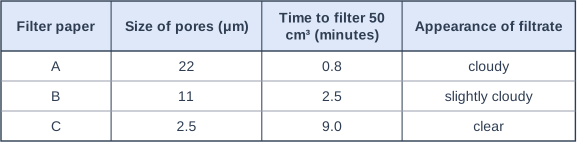
She filters 50 cm³ of the mixture through each of three types of filter paper, A, B and C. The table shows her results.

Explain the results, and evaluate which filter paper the student should use.

Table with columns "Filter paper", "Size of pores (μm)", "Time to filter 50 cm³ (minutes)", "Appearance of filtrate". Filter paper: A; Size of pores (μm): 22; Time to filter 50 cm³ (minutes): 0.8; Appearance of filtrate: cloudy | Filter paper: B; Size of pores (μm): 11; Time to filter 50 cm³ (minutes): 2.5; Appearance of filtrate: slightly cloudy | Filter paper: C; Size of pores (μm): 2.5; Time to filter 50 cm³ (minutes): 9.0; Appearance of filtrate: clear.

Model answer

Paper A has pores (22 μm) that are larger than all of the particles, so the particles pass through with the liquid and the filtrate is cloudy. Paper B traps the larger particles, but particles smaller than 11 μm pass through, so the filtrate is slightly cloudy. Paper C has pores (2.5 μm) smaller than all of the particles, so all the precipitate is trapped and the filtrate is clear. The smaller the pores, the more slowly the liquid passes through, so paper C is the slowest (9.0 minutes).
The student should use paper C. It is slow, but it is the only paper that collects all of the precipitate, which is what she wants.

Explanation

Filtration separates an insoluble solid from a liquid because the solid particles are too large to pass through the pores in the paper, while the liquid and anything dissolved in it pass through. A fine precipitate needs a paper with very small pores, and the price is slower filtering. A common weakness is to choose the fastest paper without looking at whether the filtrate is clear.

Mark scheme
  1. 1 mark

    (in paper A) the pores / holes are larger than the particles, so the particles pass through and the filtrate is cloudy

    ALLOW 'all the particles are smaller than 22 μm'. ALLOW the idea that some particles pass through paper B because some are smaller than 11 μm.

  2. 1 mark

    (in paper C) the pores are smaller than (all of) the particles, so all the precipitate is trapped (as residue) and the filtrate is clear

    ALLOW 'the particles are bigger than 2.5 μm'.

  3. 1 mark

    the smaller the pores, the more slowly the liquid passes through, so the filtering takes longer

    ORA (allow the reverse argument). ALLOW use of the times (paper A 0.8 minutes, paper C 9.0 minutes).

  4. 1 mark

    use paper C, because it is the only paper that collects all of the precipitate / gives a clear filtrate, even though it is slowest

    The choice must be justified. DO NOT ALLOW paper A because it is fastest. ALLOW 'paper C; the extra time does not matter because she wants all of the precipitate'.

Ready to try the rest? Every answer you write is marked against the mark scheme, so you can see exactly where the marks are.

Study Helper Hints first, answers after you try

Stuck on this one? Ask for a hint and I’ll point you in the right direction, without giving the answer away. Once you’ve checked your answer, I’ll show you how the marks are awarded.