
Level:
Correct: 0
Incorrect: 0
Marks: 0/0
Exam Practice
Course:
Topics:
Avg
score:
–
Topics
done:
0/25

Electrolysis of aqueous solutions

Practise 18 exam-style questions on Electrolysis of aqueous solutions for OCR GCSE Combined Science (Chemistry Paper 9). Write your answer as you would in the exam and get it marked in seconds against the mark scheme, point by point, with the Study Helper on hand if you get stuck.

  • 18 questions
  • 1–6 marks each
  • Instant marking
  • No sign-up needed
18 questions, marked as you go

Sample questions with model answers

Here are 4 of the questions in this topic, each with a model answer, an explanation of why it earns the marks and the mark scheme an examiner would use.

Question 1

1 mark

Copper(II) sulfate solution is electrolysed using inert electrodes.

These are the half equations for the reactions at the electrodes:

Cu²⁺ + 2e⁻ → Cu
4OH⁻ → O₂ + 2H₂O + 4e⁻

How many moles of copper are deposited for each mole of oxygen, O₂, given off?

Choose your answer.

  • A 0.25 mol
  • B 0.5 mol
  • C 1 mol
  • D 2 mol

Model answer

D (2 mol)

The same number of electrons is lost at the anode as is gained at the cathode. 1 mol of O₂ releases 4 mol of electrons, which deposit 4 ÷ 2 = 2 mol of Cu.

Explanation

In electrolysis the electrons lost at the anode equal the electrons gained at the cathode, so compare the products using the number of electrons in each half equation. Oxygen needs 4 electrons per molecule and copper needs 2 electrons per atom, so the ratio Cu : O₂ is 2 : 1. A common error is to assume a 1 : 1 ratio.

Mark scheme
  1. 1 mark

    D / 2 mol

    The only correct answer is D: making 1 mol of O₂ releases 4 mol of electrons, and each mole of copper needs 2 mol of electrons, so 4 ÷ 2 = 2 mol of copper are deposited. A is not correct because 0.25 is the moles of O₂ formed per mole of electrons, not the moles of copper; B is not correct because it inverts the ratio (0.5 mol is the oxygen formed per mole of copper); C is not correct because it assumes a 1 : 1 ratio without balancing the electrons. ALLOW the letter or the option. If more than one option is given, do not award the mark.
Question 2

2 marks

Dilute hydrochloric acid is electrolysed using inert electrodes. Hydrogen forms at the cathode and chlorine forms at the anode.

The pH of the solution is measured before and after the electrolysis.

Predict how the pH changes. Explain your answer in terms of ions.

Model answer

The pH increases. At the cathode H⁺ ions gain electrons and are given off as hydrogen gas, so the concentration of hydrogen ions in the solution decreases, and the solution becomes less acidic.

Explanation

pH depends on the concentration of hydrogen ions: the lower the concentration of H⁺, the higher the pH. Here the H⁺ ions are discharged at the cathode and the Cl⁻ ions at the anode, so the hydrochloric acid is gradually used up. Saying 'the pH goes down because hydrogen is made' is a common mistake.

Mark scheme
  1. 1 mark

    the pH increases / rises (towards 7)

    ALLOW 'the solution becomes less acidic'. If the pH is said to decrease, do not award the second mark either (contradiction).

  2. 1 mark

    hydrogen ions / H⁺ ions are removed (discharged as hydrogen gas at the cathode), so the concentration of H⁺ ions decreases

    ALLOW 'there are fewer hydrogen ions in the solution'. ALLOW '(the) hydrochloric acid is used up / becomes more dilute' with H⁺ ions mentioned. IGNORE references to chloride ions being removed.

Question 3

3 marks

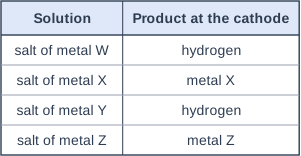
A scientist electrolyses solutions of salts of four metals, W, X, Y and Z, using inert electrodes. The table shows the product at the cathode for each solution.

What do the results show about the reactivity of each metal compared with hydrogen? Explain your answer in terms of the ions in the solutions.

Can the results be used to put the four metals in order of reactivity? Give a reason.

Table with columns "Solution", "Product at the cathode". Solution: salt of metal W; Product at the cathode: hydrogen | Solution: salt of metal X; Product at the cathode: metal X | Solution: salt of metal Y; Product at the cathode: hydrogen | Solution: salt of metal Z; Product at the cathode: metal Z.

Model answer

Each solution contains H⁺ ions from the water as well as the metal ions, and both kinds of positive ion are attracted to the cathode.
X and Z are less reactive than hydrogen: their metal ions gain electrons more readily than H⁺ ions, so the metal is deposited.
W and Y are more reactive than hydrogen: H⁺ ions are discharged instead, so hydrogen forms and the W and Y ions stay in the solution.
The results cannot put the four metals in order. They only show which side of hydrogen each metal is, so they do not tell us whether X is more reactive than Z, or whether W is more reactive than Y.

Explanation

At the cathode the metal ions compete with the hydrogen ions from water, and the ion of the less reactive element is discharged. So a metal product means the metal is below hydrogen in the reactivity series, and hydrogen as the product means the metal is above hydrogen. This test sorts metals into two groups only, so a different kind of experiment would be needed to order the metals within each group.

Mark scheme
  1. 1 mark

    X and Z are less reactive than hydrogen, because their (metal) ions are discharged / gain electrons in preference to hydrogen ions (from the water)

    Both metals and the reason needed for the mark. ALLOW 'X and Z are below hydrogen in the reactivity series, so the metal ions are discharged instead of H⁺ ions'.

  2. 1 mark

    W and Y are more reactive than hydrogen, because hydrogen ions are discharged instead (and the metal ions stay in solution)

    Both metals and the reason needed for the mark. DO NOT ALLOW 'W and Y ions form hydrogen'.

  3. 1 mark

    no, the results only show whether each metal is more or less reactive than hydrogen / they cannot show the order of X and Z or of W and Y

    ALLOW 'no: X and Z give the same type of result, so we cannot tell which of them is more reactive'. DO NOT ALLOW 'yes' with any reason.

Question 4

4 marks

Two electrolysis cells are connected in series, so the same number of electrons flows through both cells.

• Cell 1 contains copper(II) sulfate solution. Copper is deposited at the cathode.
• Cell 2 contains sodium chloride solution. Chlorine forms at the anode.

After some time, 0.508 g of copper has been deposited in cell 1.

Calculate the mass of chlorine, Cl₂, formed in cell 2 in the same time.

Relative atomic mass (Ar): Cl = 35.5 Cu = 63.5

Model answer

Moles of Cu = 0.508 ÷ 63.5 = 0.00800 mol
Cu²⁺ + 2e⁻ → Cu, so moles of electrons = 2 × 0.00800 = 0.0160 mol
2Cl⁻ → Cl₂ + 2e⁻, so moles of Cl₂ = 0.0160 ÷ 2 = 0.00800 mol
Mr of Cl₂ = 71.0, so mass of Cl₂ = 0.00800 × 71.0 = 0.568 g

Explanation

The link between the two cells is the number of electrons. Use the half equations: depositing one Cu atom takes 2 electrons, and making one Cl₂ molecule releases 2 electrons, so the moles of Cl₂ equal the moles of Cu. Common errors are using 35.5 instead of 71.0 for Cl₂, or making twice as many moles of Cl₂ as of copper.

Mark scheme
  1. 1 mark

    (moles of Cu =) 0.508 ÷ 63.5 = 0.00800 (mol); or a correct final answer of 0.568 g with no working

    An answer of 0.568 g with no working scores 4 marks. ALLOW 0.57 g. ALLOW 3 marks for 0.284 g (35.5 used as the Mr of Cl₂). ALLOW 2 marks for 1.14 g (moles of Cl₂ taken as twice the moles of copper).

  2. 1 mark

    both half equations involve 2 electrons (Cu²⁺ + 2e⁻ → Cu and 2Cl⁻ → Cl₂ + 2e⁻) / moles of electrons = 2 × 0.00800 = 0.0160 (mol); or a correct final answer of 0.568 g with no working

    ALLOW a statement that 1 mol of Cu and 1 mol of Cl₂ each need 2 mol of electrons.

  3. 1 mark

    (moles of Cl₂ = 0.00800 mol, so mass =) 0.00800 × 71.0; or a correct final answer of 0.568 g with no working

    ALLOW 0.0160 ÷ 2 = 0.00800 mol of Cl₂. ALLOW ECF from a wrong number of moles.

  4. 1 mark

    0.568 (g) / 0.57 (g)

    IGNORE units unless the question asks for them.

Ready to try the rest? Every answer you write is marked against the mark scheme, so you can see exactly where the marks are.

Study Helper Hints first, answers after you try

Stuck on this one? Ask for a hint and I’ll point you in the right direction, without giving the answer away. Once you’ve checked your answer, I’ll show you how the marks are awarded.