
Level:
Correct: 0
Incorrect: 0
Marks: 0/0
Exam Practice
Course:
Topics:
Avg
score:
–
Topics
done:
0/25

Chromatography

Practise 17 exam-style questions on Chromatography for OCR GCSE Combined Science (Chemistry Paper 9). Write your answer as you would in the exam and get it marked in seconds against the mark scheme, point by point, with the Study Helper on hand if you get stuck.

  • 17 questions
  • 1–6 marks each
  • Instant marking
  • No sign-up needed
17 questions, marked as you go

Sample questions with model answers

Here are 4 of the questions in this topic, each with a model answer, an explanation of why it earns the marks and the mark scheme an examiner would use.

Question 1

1 mark

A student uses paper chromatography to separate the dyes in an ink. The centre of spot X moved 2.5 times as far from the start line as the centre of spot Y.

The Rf value of the dye in spot X is 0.70.

What is the Rf value of the dye in spot Y?

Choose your answer.

  • A 0.28
  • B 0.30
  • C 0.40
  • D 1.75

Model answer

A

Explanation

Rf = distance moved by the substance ÷ distance moved by the solvent. On one chromatogram the solvent distance is the same for every spot, so a spot that moved 2.5 times less far has an Rf value 2.5 times smaller: 0.70 ÷ 2.5 = 0.28. Check that any Rf value is between 0 and 1.

Mark scheme
  1. 1 mark

    A / 0.28

    The only correct answer is A: both spots are on the same chromatogram, so they share the same solvent distance and their Rf values are in the same ratio as the distances they moved: 0.70 ÷ 2.5 = 0.28. B is not correct because it assumes the two Rf values add up to 1 (1 − 0.70); C is not correct because it is 1 ÷ 2.5, which ignores the Rf value of X; D is not correct because it multiplies by 2.5 instead of dividing, and an Rf value cannot be greater than 1. ALLOW the letter or the value. If more than one option is given, do not award the mark.
Question 2

2 marks

A student finds that a blue dye has an Rf value of 0.62 on chromatography paper, but an Rf value of 0.35 on a TLC plate coated with silica. The same solvent was used each time.

Explain why the two Rf values are different.

Model answer

The stationary phase is different: paper in one experiment and silica in the other. The dye is attracted more strongly to silica than to the paper, so on the TLC plate it spends more of its time in the stationary phase. The distribution of the dye between the two phases is different, so on the TLC plate it moves a smaller fraction of the distance moved by the solvent and has a smaller Rf value.

Explanation

An Rf value depends on the distribution of the substance between the mobile and the stationary phase, so it changes if either phase changes. That is why a table of Rf values is only useful if it states the solvent and the type of paper or plate used. Saying only 'TLC is a different method' does not explain the difference.

Mark scheme
  1. 1 mark

    the stationary phase is different (paper in one, silica in the other)

    ALLOW the paper and the silica are different materials / the plate and the paper are different stationary phases. IGNORE the plate is made of glass or plastic. DO NOT ALLOW the mobile phase / solvent is different (the question says it is the same).

  2. 1 mark

    the dye is attracted more strongly to the silica (than to the paper), so it spends more time in the stationary phase / its distribution between the phases is different, so it moves a smaller fraction of the distance moved by the solvent on the TLC plate

    ORA (allow the reverse argument): the dye is attracted less strongly to the paper, so it spends more time in the mobile phase on the paper. ALLOW the dye is distributed differently between the mobile and stationary phases in the two methods. IGNORE TLC is faster / gives better separation.

Question 3

3 marks

A chemist converts compound A into compound B by heating A with a catalyst.

Every 10 minutes the chemist spots a small sample of the reaction mixture onto a TLC plate, next to spots of pure A and pure B. The plate is run in a solvent and then viewed under UV light.

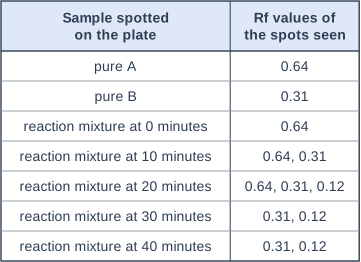
The table shows the Rf values of the spots seen.

Use the results to describe how the composition of the reaction mixture changes, and explain whether the mixture at 40 minutes is pure B.

Table with columns "Sample spotted on the plate", "Rf values of the spots seen". Sample spotted on the plate: pure A; Rf values of the spots seen: 0.64 | Sample spotted on the plate: pure B; Rf values of the spots seen: 0.31 | Sample spotted on the plate: reaction mixture at 0 minutes; Rf values of the spots seen: 0.64 | Sample spotted on the plate: reaction mixture at 10 minutes; Rf values of the spots seen: 0.64, 0.31 | Sample spotted on the plate: reaction mixture at 20 minutes; Rf values of the spots seen: 0.64, 0.31, 0.12 | Sample spotted on the plate: reaction mixture at 30 minutes; Rf values of the spots seen: 0.31, 0.12 | Sample spotted on the plate: reaction mixture at 40 minutes; Rf values of the spots seen: 0.31, 0.12.

Model answer

At 0 minutes the mixture contains only A (one spot at Rf 0.64). From 10 minutes a spot at Rf 0.31 appears, the same as pure B, so B is forming, and the A spot has gone by 30 minutes, so all of A has reacted. However, from 20 minutes a third spot at Rf 0.12 appears, which is neither A nor B. At 40 minutes there are still two spots, at 0.31 and 0.12, so the mixture is not pure B: it contains B and another substance.

Explanation

TLC is a quick way to follow a reaction: the starting material's spot fades and the product's spot appears. Comparing each lane with the pure A and pure B lanes identifies the spots. Many answers stop at 'all the A has gone, so it is pure B' and miss the extra spot at Rf 0.12, which shows a by-product.

Mark scheme
  1. 1 mark

    A is used up / no A is left by 30 minutes (the spot at Rf 0.64 is not seen at 30 or 40 minutes)

    Max 3. Max 2 if no Rf values or times from the table are used. ALLOW all of A has reacted between 20 and 30 minutes.

  2. 1 mark

    B is formed from 10 minutes onwards / B is present from 10 minutes (spot at Rf 0.31, the same as pure B)

    ALLOW the product B appears after 0 minutes and is still there at 40 minutes.

  3. 1 mark

    (another) substance with Rf 0.12 forms from 20 minutes (that is not A or B)

    ALLOW a by-product / an impurity / a third substance forms.

  4. 1 mark

    so the mixture at 40 minutes is not pure B: it contains B and the substance with Rf 0.12 / it gives two spots

    DO NOT ALLOW the mixture is pure because there is no A left. DO NOT ALLOW it contains A.

Question 4

4 marks

A student uses paper chromatography to find out which sugars are in a fruit juice. Sugars are colourless, so after the paper dries the student sprays it with a locating agent and warms it. The sugars show up as brown spots.

The student put spots of the juice and of pure glucose on the start line, but forgot to mark the solvent front before the paper dried.

The glucose spot is 3.6 cm from the start line. The Rf value of glucose in this solvent is 0.30.

The juice gave two spots: one 3.6 cm and one 5.4 cm from the start line.

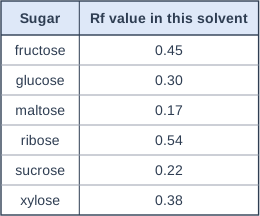
The table shows the Rf values of six sugars in the same solvent.

Calculate the Rf value of the spot 5.4 cm from the start line, and identify the sugar it contains.

Table with columns "Sugar", "Rf value in this solvent". Sugar: fructose; Rf value in this solvent: 0.45 | Sugar: glucose; Rf value in this solvent: 0.30 | Sugar: maltose; Rf value in this solvent: 0.17 | Sugar: ribose; Rf value in this solvent: 0.54 | Sugar: sucrose; Rf value in this solvent: 0.22 | Sugar: xylose; Rf value in this solvent: 0.38.

Model answer

Rf of glucose = distance moved by glucose ÷ distance moved by solvent
so distance moved by solvent = 3.6 ÷ 0.30 = 12 cm

Rf of the second spot = 5.4 ÷ 12 = 0.45

This matches fructose (Rf 0.45), so the juice contains fructose. (The spot at 3.6 cm is glucose.)

Explanation

The glucose spot is a reference: because its Rf value is known, rearranging Rf = distance moved by substance ÷ distance moved by solvent gives the lost solvent distance (3.6 ÷ 0.30 = 12 cm). The Rf value of the other spot then follows (5.4 ÷ 12 = 0.45). A shortcut is that Rf values on one chromatogram are in proportion to the distances moved. A common error is to divide 5.4 by 3.6 and give 1.5 as the Rf value: no Rf value can be greater than 1.

Mark scheme
  1. 1 mark

    distance moved by solvent = 3.6 ÷ 0.30; or a correct final answer of 0.45 with no working

    An answer of 0.45 and fructose with no working scores 4 marks. ALLOW the ratio method for marking points 1 and 2: the Rf values on one chromatogram are in the same ratio as the distances, so Rf = 0.30 × (5.4 ÷ 3.6) = 0.30 × 1.5 (scores marking points 1 and 2).

  2. 1 mark

    = 12 (cm); or a correct final answer of 0.45 with no working

    ALLOW 12.0 cm. ALLOW 1.5 (ratio of the distances 5.4 ÷ 3.6) for this mark in the ratio method.

  3. 1 mark

    evaluation: Rf = 5.4 ÷ 12 = 0.45

    ALLOW ECF from a wrong solvent distance shown in the working. DO NOT ALLOW a value greater than 1 (for example 1.5 from 5.4 ÷ 3.6 given as the Rf value).

  4. 1 mark

    fructose

    ALLOW ECF: the sugar in the table whose Rf value matches a wrongly calculated Rf value between 0 and 1. If more than one sugar is given, do not award this mark.

Ready to try the rest? Every answer you write is marked against the mark scheme, so you can see exactly where the marks are.

Study Helper Hints first, answers after you try

Stuck on this one? Ask for a hint and I’ll point you in the right direction, without giving the answer away. Once you’ve checked your answer, I’ll show you how the marks are awarded.