
Level:
Correct: 0
Incorrect: 0
Marks: 0/0
Exam Practice
Course:
Topics:
Avg
score:
–
Topics
done:
0/25

Ionic, covalent and metallic bonding

Practise 16 exam-style questions on Ionic, covalent and metallic bonding for OCR GCSE Combined Science (Chemistry Paper 9). Write your answer as you would in the exam and get it marked in seconds against the mark scheme, point by point, with the Study Helper on hand if you get stuck.

  • 16 questions
  • 1–6 marks each
  • Instant marking
  • No sign-up needed
16 questions, marked as you go

Sample questions with model answers

Here are 4 of the questions in this topic, each with a model answer, an explanation of why it earns the marks and the mark scheme an examiner would use.

Question 1

1 mark

Silicon dioxide, SiO₂, has a giant covalent structure.

In the structure, each silicon atom is joined by single covalent bonds to four oxygen atoms.

How many silicon atoms is each oxygen atom joined to?

Choose your answer.

  • A 1
  • B 2
  • C 4
  • D 8

Model answer

B

Explanation

Use the formula as a ratio: for every silicon atom there are four Si–O bonds and two oxygen atoms, so each oxygen atom has 4 ÷ 2 = 2 bonds. This also fits the electron arrangement of oxygen (2.6), which needs two more electrons and so forms two covalent bonds. Each oxygen atom links two silicon atoms, which is why the bonds continue through the whole crystal.

Mark scheme
  1. 1 mark

    B / 2

    The only correct answer is B: the formula SiO₂ shows there are twice as many oxygen atoms as silicon atoms, so the four Si–O bonds of each silicon atom are shared between two oxygen atoms, giving each oxygen atom two bonds, each to a different silicon atom (an oxygen atom, with six outer electrons, shares two pairs). A is not correct because if each oxygen atom were joined to only one silicon atom, there would be four oxygen atoms for each silicon atom (SiO₄), and the structure would not be giant; C is not correct because it assumes the oxygen atoms bond in the same way as the silicon atoms; D is not correct because it multiplies 4 by 2 instead of sharing the bonds out. ALLOW the letter or the number. If more than one option is given, do not award the mark.
Question 2

2 marks

Solid iodine is made of iodine molecules, I₂, arranged in a regular pattern.

A student says: 'Solid iodine is held together by covalent bonds.'

Explain why the student's statement is only partly correct.

Model answer

The student is right that there are covalent bonds in iodine: in each I₂ molecule the two iodine atoms are joined by a covalent bond (a shared pair of electrons). But the molecules are not joined to each other by covalent bonds. Neighbouring I₂ molecules are held in the regular pattern only by weak intermolecular forces.

Explanation

A simple molecular solid has two kinds of attraction: strong covalent bonds inside each molecule, and weak intermolecular forces between the molecules. The answer needs both ideas. A common error is to write 'weak covalent bonds between the molecules': covalent bonds are strong and only join the atoms within a molecule.

Mark scheme
  1. 1 mark

    (a covalent bond / a shared pair of electrons) joins the two iodine atoms within each I₂ molecule

    ALLOW covalent bonds are only inside the molecules / between the atoms in a molecule.

  2. 1 mark

    the molecules are held to each other by (weak) intermolecular forces (not by covalent bonds)

    ALLOW (weak) forces (of attraction) between molecules. DO NOT ALLOW covalent bonds between molecules, ionic bonds or electrostatic attraction between ions.

Question 3

2 marks

White phosphorus is made of P₄ molecules. In each molecule, every phosphorus atom is joined by a single covalent bond to each of the other three phosphorus atoms.

The electron arrangement of a phosphorus atom is 2.8.5.

Explain why each phosphorus atom forms three covalent bonds.

Deduce the number of covalent bonds in one P₄ molecule.

Model answer

A phosphorus atom (2.8.5) has five electrons in its outer shell. It needs three more to fill its outer shell with eight, so it shares three pairs of electrons, forming three covalent bonds.

There are four atoms, each with three bonds, which gives 4 × 3 = 12 bond ends. Each bond joins two atoms, so there are 12 ÷ 2 = 6 covalent bonds in one P₄ molecule.

Explanation

The number of covalent bonds an atom forms is the number of electrons it needs to fill its outer shell: 8 − 5 = 3 for phosphorus. When counting bonds in a molecule, remember each bond is shared by two atoms, so divide the total of bonds-per-atom by two. The most common wrong answer is 12, which counts every bond twice.

Mark scheme
  1. 1 mark

    a phosphorus atom has five outer (shell) electrons, so it needs three more electrons to fill its outer shell (eight), so it shares three pairs of electrons

    ALLOW it needs 3 more electrons (for a full outer shell / a stable arrangement), so it forms three shared pairs. DO NOT ALLOW it gains / loses three electrons (transfer).

  2. 1 mark

    6 (covalent bonds)

    ALLOW six. The working is 4 × 3 ÷ 2 = 6, because each bond joins two atoms. DO NOT ALLOW 12 (each bond counted twice) or 3.

Question 4

5 marks

X-ray crystallography can show how the electrons are spread out in a solid.

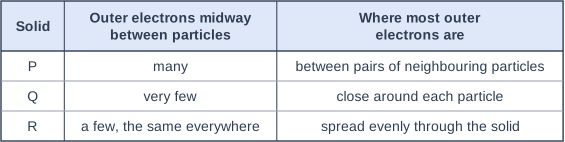
A scientist studied three solids: aluminium, potassium chloride and silicon. The table describes how the outer electrons are spread out in each solid. The solids are labelled P, Q and R.

In solid Q, some of the particles have more electrons than their atoms and some have fewer.

Identify which solid is P, which is Q and which is R.

Explain each answer using ideas about the bonding in the solid.

Table with columns "Solid", "Outer electrons midway between particles", "Where most outer electrons are". Solid: P; Outer electrons midway between particles: many; Where most outer electrons are: between pairs of neighbouring particles | Solid: Q; Outer electrons midway between particles: very few; Where most outer electrons are: close around each particle | Solid: R; Outer electrons midway between particles: a few, the same everywhere; Where most outer electrons are: spread evenly through the solid.

Model answer

P is silicon. Silicon atoms are joined by covalent bonds, and each covalent bond is a pair of electrons shared between two neighbouring atoms. The shared pair sits between the two nuclei, so the electron density is high on the line between each pair of neighbouring atoms.

Q is potassium chloride. In potassium chloride, each potassium atom has transferred its outer electron to a chlorine atom, so the K⁺ ions have fewer electrons than potassium atoms and the Cl⁻ ions have more electrons than chlorine atoms. Each ion holds its own electrons and nothing is shared, so there are almost no electrons in the space between the ions.

R is aluminium. In a metal, each atom gives up its outer electrons (three for aluminium), and these electrons are delocalised: they are free to move through the whole metal. So the outer electrons are spread evenly between all the positive ions, with the same low density everywhere.

Explanation

Each bonding model predicts where the outer electrons are: shared pairs between two particular atoms (covalent), held on separate ions after transfer (ionic), or delocalised evenly through the lattice (metallic). Match each description to a model and then name the solid. Weaker answers identify the solids correctly but do not explain how the type of bonding leads to the electron pattern described.

Mark scheme
  1. 1 mark

    P is silicon

    Max 5. Each explanation mark (marking points 2, 4 and 6) can only be awarded if the solid it explains is identified correctly. If a solid is given for more than one letter, do not award the identification mark for either letter. ALLOW Si.

  2. 1 mark

    (in silicon) the atoms share pairs of electrons / form covalent bonds, and each shared pair is between two neighbouring atoms, so the electron density is high between each pair of atoms

    ALLOW covalent bonds are shared pairs of electrons located between the two nuclei. IGNORE 'silicon is giant covalent' on its own, with no idea of where the shared electrons are.

  3. 1 mark

    Q is potassium chloride

    ALLOW KCl.

  4. 1 mark

    (in potassium chloride) electrons have been transferred from potassium to chlorine, so the K⁺ ions have fewer and the Cl⁻ ions more electrons than their atoms, and each ion keeps its own electrons, so there are (almost) no electrons between the ions

    ALLOW the electrons belong to / are held by separate ions, not shared or delocalised. ALLOW ionic bonding is attraction between ions, not shared electrons, as part of this point if transfer of electrons is also given.

  5. 1 mark

    R is aluminium

    ALLOW Al.

  6. 1 mark

    (in aluminium) the outer electrons are delocalised / free to move through the whole metal, so they are spread evenly between all the positive ions

    ALLOW a sea of electrons around the positive ions. DO NOT ALLOW electrons shared between pairs of atoms.

Ready to try the rest? Every answer you write is marked against the mark scheme, so you can see exactly where the marks are.

Study Helper Hints first, answers after you try

Stuck on this one? Ask for a hint and I’ll point you in the right direction, without giving the answer away. Once you’ve checked your answer, I’ll show you how the marks are awarded.