
Level:
Correct: 0
Incorrect: 0
Marks: 0/0
Exam Practice
Course:
Topics:
Avg
score:
–
Topics
done:
0/25

Formulae and balanced equations

Practise 17 exam-style questions on Formulae and balanced equations for OCR GCSE Combined Science (Chemistry Paper 9). Write your answer as you would in the exam and get it marked in seconds against the mark scheme, point by point, with the Study Helper on hand if you get stuck.

  • 17 questions
  • 1–6 marks each
  • Instant marking
  • No sign-up needed
17 questions, marked as you go

Sample questions with model answers

Here are 4 of the questions in this topic, each with a model answer, an explanation of why it earns the marks and the mark scheme an examiner would use.

Question 1

1 mark

Element Q is a metal. It forms a compound with phosphorus that has the formula Q₃P₂.

Phosphorus is in Group 5 of the Periodic Table.

Which group of the Periodic Table is element Q in?

Choose your answer.

  • A Group 1
  • B Group 2
  • C Group 3
  • D Group 7

Model answer

B (Group 2)

Explanation

Work out the charge on the phosphide ion from its group: a Group 5 atom gains 3 electrons, so the ion is P³⁻. The compound has no overall charge, so two P³⁻ ions (6−) must be balanced by three Q ions (6+), which is 2+ each, the charge on Group 2 ions. A common error is to read the small number 3 as the group number.

Mark scheme
  1. 1 mark

    B / Group 2

    The only correct answer is B: phosphorus (Group 5) gains 3 electrons to form P³⁻ ions; two P³⁻ ions have a total charge of 6−, so the three Q ions must have a total charge of 6+, which is 2+ each, and metals that form 2+ ions are in Group 2. A is not correct because Group 1 metals form 1+ ions, which would give the formula Q₃P; C is not correct because Group 3 metals form 3+ ions, which would give QP (the 3 in Q₃P₂ is the number of Q ions, not the group number); D is not correct because Group 7 elements are non-metals that form 1− ions. ALLOW the letter or the group. If more than one option is given, do not award the mark.
Question 2

2 marks

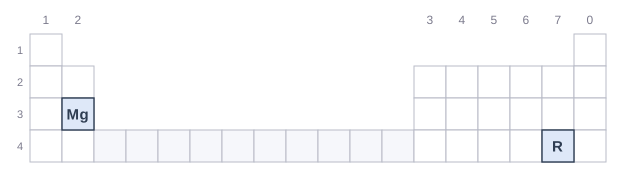
The diagram shows the positions of element R and of magnesium, Mg, in the Periodic Table.

Element R reacts with magnesium to form an ionic compound.

Identify element R.

Give the formula of the compound formed when R reacts with magnesium.

Outline of the periodic table (groups 1-7 and 0 numbered across the top, periods down the side) with these boxes filled in: Mg in period 3, group 2; R in period 4, group 7.

Model answer

R is in Period 4 and Group 7, so R is bromine, Br.
Magnesium forms Mg²⁺ ions and bromine forms Br⁻ ions, so the formula is MgBr₂.

Explanation

Find the element from its period (row) and its group (column): Period 4, Group 7 is bromine. Group 2 metals form 2+ ions and Group 7 elements form 1− ions, so two bromide ions are needed for each magnesium ion. A common error is to write MgBr, which ignores the charges on the ions.

Mark scheme
  1. 1 mark

    bromine / Br

    R is in Period 4 and Group 7. ALLOW Br₂. DO NOT ALLOW bromide.

  2. 1 mark

    MgBr₂

    Magnesium (Group 2) forms Mg²⁺ ions and bromine (Group 7) forms Br⁻ ions, so two Br⁻ ions balance one Mg²⁺ ion. ALLOW MgBr2 typed with a plain number. ALLOW MgR₂. ALLOW ECF for MgX₂, where X is a different Group 7 element named in the first marking point (for example MgCl₂ if chlorine was named). DO NOT ALLOW MgBr, Mg₂Br or MgBr₂ written with incorrect capital letters (for example MGBr2).

Question 3

2 marks

Iron pyrite, FeS₂, was once roasted (heated strongly in air) to make sulfur dioxide for the manufacture of sulfuric acid. The products of the reaction are iron(III) oxide, Fe₂O₃, and sulfur dioxide.

Write the balanced equation for this reaction.

Model answer

4FeS₂ + 11O₂ → 2Fe₂O₃ + 8SO₂
Check: Fe 4 = 2 × 2; S 8 = 8; O 22 = 6 + 16

Explanation

Write the formulae first: oxygen is O₂ and sulfur dioxide is SO₂. Balance iron (Fe₂O₃ needs 2FeS₂), then sulfur (4 S needs 4SO₂), then oxygen (3 + 8 = 11 oxygen atoms, which is 5½O₂), and finally double everything to remove the half. A common error is to forget the oxygen atoms in the iron(III) oxide.

Mark scheme
  1. 1 mark

    correct formulae: FeS₂ + O₂ → Fe₂O₃ + SO₂

    The balanced equation is 4FeS₂ + 11O₂ → 2Fe₂O₃ + 8SO₂. A correct balanced equation scores both marks. Typed forms: ALLOW plain numbers for subscripts (4FeS2 + 11O2 -> 2Fe2O3 + 8SO2) and -> or = for →. DO NOT ALLOW 'and' or '&' instead of '+'. DO NOT ALLOW O or 2O for oxygen.

  2. 1 mark

    balancing: 4FeS₂ + 11O₂ → 2Fe₂O₃ + 8SO₂

    ALLOW any correct multiple, including fractions (2FeS₂ + 5½O₂ → Fe₂O₃ + 4SO₂ or FeS₂ + 2¾O₂ → ½Fe₂O₃ + 2SO₂). The balancing mark needs the correct formulae, but ALLOW this mark for a correctly balanced equation with one minor error in the case of a symbol (for example 4FeS2 + 11O2 -> 2Fe2O3 + 8So2).

Question 4

3 marks

Red fireworks contain strontium nitrate. Strontium is in Group 2 of the Periodic Table. The formula of the nitrate ion is NO₃⁻.

When the firework is lit, strontium nitrate decomposes to form strontium oxide, SrO, nitrogen dioxide, NO₂, and oxygen, O₂.

Write the formula of strontium nitrate.

Write the balanced equation for the decomposition of strontium nitrate.

Model answer

Strontium is in Group 2, so it forms Sr²⁺ ions; two NO₃⁻ ions balance one Sr²⁺ ion: Sr(NO₃)₂

2Sr(NO₃)₂ → 2SrO + 4NO₂ + O₂
Check: Sr 2 = 2; N 4 = 4; O 12 = 2 + 8 + 2

Explanation

Use brackets when more than one compound ion is needed in a formula. To balance, start with nitrogen (each Sr(NO₃)₂ gives two NO₂), then use O₂ to balance the remaining oxygen; doubling everything removes the ½O₂. A common error is to forget the oxygen in the strontium oxide when counting oxygen atoms.

Mark scheme
  1. 1 mark

    Sr(NO₃)₂

    Strontium forms Sr²⁺ ions (Group 2), so two NO₃⁻ ions are needed. ALLOW Sr(NO3)2 typed with plain numbers. DO NOT ALLOW SrNO₃, SrNO₃₂ or Sr₂NO₃.

  2. 1 mark

    correct formulae in the equation: Sr(NO₃)₂ → SrO + NO₂ + O₂

    Typed forms: ALLOW plain numbers for subscripts and -> or = for →. DO NOT ALLOW 'and' or '&' instead of '+'.

  3. 1 mark

    balancing: 2Sr(NO₃)₂ → 2SrO + 4NO₂ + O₂

    ALLOW any correct multiple, including fractions (Sr(NO₃)₂ → SrO + 2NO₂ + ½O₂). ALLOW ECF for this mark from an incorrect formula of strontium nitrate if the equation is correctly balanced for that formula.

Ready to try the rest? Every answer you write is marked against the mark scheme, so you can see exactly where the marks are.

Study Helper Hints first, answers after you try

Stuck on this one? Ask for a hint and I’ll point you in the right direction, without giving the answer away. Once you’ve checked your answer, I’ll show you how the marks are awarded.