
Level:
Correct: 0
Incorrect: 0
Marks: 0/0
Exam Practice
Course:
Topics:
Avg
score:
–
Topics
done:
0/25

Bonding, states and bulk properties of materials

Practise 17 exam-style questions on Bonding, states and bulk properties of materials for OCR GCSE Combined Science (Chemistry Paper 9). Write your answer as you would in the exam and get it marked in seconds against the mark scheme, point by point, with the Study Helper on hand if you get stuck.

  • 17 questions
  • 1–6 marks each
  • Instant marking
  • No sign-up needed
17 questions, marked as you go

Sample questions with model answers

Here are 4 of the questions in this topic, each with a model answer, an explanation of why it earns the marks and the mark scheme an examiner would use.

Question 1

1 mark

Liquid nitrogen boils at −196 °C. A scientist cools small samples of three substances in sealed tubes by standing the tubes in liquid nitrogen until each sample reaches −196 °C.

The table shows the melting points and boiling points of the three substances.

Which row shows the states of argon, neon and oxygen at −196 °C?

Choose your answer.

  • A argon gas; neon gas; oxygen liquid
  • B argon liquid; neon gas; oxygen liquid
  • C argon solid; neon gas; oxygen gas
  • D argon solid; neon gas; oxygen liquid
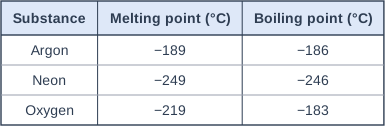
Table with columns "Substance", "Melting point (°C)", "Boiling point (°C)". Substance: Argon; Melting point (°C): −189; Boiling point (°C): −186 | Substance: Neon; Melting point (°C): −249; Boiling point (°C): −246 | Substance: Oxygen; Melting point (°C): −219; Boiling point (°C): −183.

Model answer

D

Explanation

Compare −196 °C with each pair of values. A substance is solid below its melting point, liquid between its melting point and boiling point, and a gas above its boiling point. With negative temperatures, a bigger number after the minus sign is colder: −196 °C is colder than −189 °C (so argon is solid) but warmer than −219 °C (so oxygen has melted).

Mark scheme
  1. 1 mark

    D / argon solid; neon gas; oxygen liquid

    The only correct answer is D: −196 °C is below the melting point of argon (−189 °C), above the boiling point of neon (−246 °C), and between the melting point (−219 °C) and boiling point (−183 °C) of oxygen. A is not correct because argon boils at −186 °C and melts at −189 °C, so at −196 °C it is not a gas; it is a solid. B is not correct because −196 °C is below the melting point of argon, so argon is solid, not liquid. C is not correct because oxygen does not boil until −183 °C, so it is a liquid at −196 °C. ALLOW the letter or the option. If more than one option is given, do not award the mark.
Question 2

2 marks

Some new buildings have wall panels that contain a wax. The wax melts at 23 °C. On a warm day the wax melts. At night, as the room cools, the wax turns back into a solid, and this helps to keep the room warm.

Explain how the wax turning back into a solid helps to keep the room warm. Use ideas about the forces between the wax molecules and energy.

Model answer

When the liquid wax cools to 23 °C and turns into a solid, the wax molecules move closer together and the forces of attraction between them form again, holding the molecules in fixed positions. Forming these forces releases energy, the same energy that was taken in when the wax melted. This energy is transferred to the room, so the room cools down more slowly at night.

Explanation

Melting takes in energy to overcome the forces between particles, and solidifying gives the same energy out again as the forces form. The wax stores energy during the warm day and releases it at night. The covalent bonds inside the wax molecules are not broken or made in a change of state.

Mark scheme
  1. 1 mark

    as the wax solidifies, forces of attraction (intermolecular forces) form again between the wax molecules / the molecules are pulled into fixed positions, which releases energy

    ALLOW solidifying / freezing is exothermic, or the energy taken in when the wax melted is given out again, only if linked to the forces between the molecules forming again / the molecules being held in fixed positions. DO NOT ALLOW covalent bonds form / bonds inside the molecules form.

  2. 1 mark

    this energy is transferred to the room / the air, so the room cools down more slowly

    ALLOW the wax gives out heat to the room. IGNORE 'the wax is warm' with no idea of energy being transferred.

Question 3

2 marks

Poly(propene) is a polymer made of very long chains of carbon atoms with hydrogen atoms attached.

Poly(propene) melts at about 165 °C. If it is heated above about 350 °C, it does not boil. Instead, its chains break down into smaller molecules.

Suggest why poly(propene) breaks down rather than boils.

Model answer

For poly(propene) to boil, each whole chain would have to be pulled away from the chains around it. Because the chains are so long, the intermolecular forces all along a chain add up to a very large total, so a huge amount of energy would be needed to separate the chains completely. Before that much energy is supplied, some of the covalent bonds within the chains break, so the polymer breaks down into smaller molecules instead of boiling.

Explanation

Intermolecular forces are weak for each part of a molecule, but along a chain of thousands of atoms they add up. The energy needed to separate whole chains becomes greater than the energy needed to break a covalent bond in a chain, so the polymer decomposes first. This is why polymers can be melted and moulded but not boiled.

Mark scheme
  1. 1 mark

    to boil, whole chains would have to be separated from each other, overcoming the intermolecular forces all along each (very long) chain

    ALLOW 'the forces between the long chains are very strong in total / add up because the chains are so long'. DO NOT ALLOW 'the covalent bonds between the chains are strong'.

  2. 1 mark

    this would need more energy than breaking some of the covalent bonds within the chains, so the chains break (decompose) before they can separate (boil)

    ALLOW 'the covalent bonds in the chain break at a lower temperature than the temperature needed to separate the chains'. The idea of comparing the two amounts of energy is needed for this mark.

Question 4

4 marks

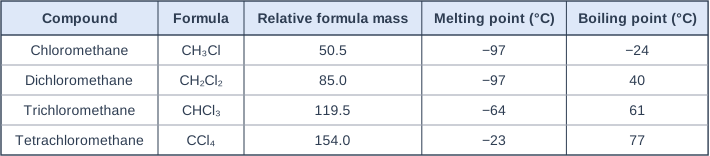
The table shows data for four compounds. Each one is a simple molecular substance.

Give the state of each compound at 50 °C.

Bromochloromethane, CH₂BrCl, is another simple molecular substance. Its relative formula mass is 129.4.

Predict the boiling point of bromochloromethane. Explain your prediction using the data and ideas about intermolecular forces.

Table with columns "Compound", "Formula", "Relative formula mass", "Melting point (°C)", "Boiling point (°C)". Compound: Chloromethane; Formula: CH₃Cl; Relative formula mass: 50.5; Melting point (°C): −97; Boiling point (°C): −24 | Compound: Dichloromethane; Formula: CH₂Cl₂; Relative formula mass: 85.0; Melting point (°C): −97; Boiling point (°C): 40 | Compound: Trichloromethane; Formula: CHCl₃; Relative formula mass: 119.5; Melting point (°C): −64; Boiling point (°C): 61 | Compound: Tetrachloromethane; Formula: CCl₄; Relative formula mass: 154.0; Melting point (°C): −23; Boiling point (°C): 77.

Model answer

At 50 °C:
chloromethane - gas (boiling point −24 °C is below 50 °C)
dichloromethane - gas (boiling point 40 °C is below 50 °C)
trichloromethane - liquid (50 °C is between −64 °C and 61 °C)
tetrachloromethane - liquid (50 °C is between −23 °C and 77 °C)

Prediction: about 70 °C (between 61 °C and 77 °C).
The relative formula mass of bromochloromethane, 129.4, is between those of trichloromethane (119.5) and tetrachloromethane (154.0). The larger the molecules, the stronger the intermolecular forces between them, so the intermolecular forces in bromochloromethane should be stronger than in trichloromethane but weaker than in tetrachloromethane. When it boils, only these forces are overcome, not the covalent bonds, so the energy needed, and the boiling point, should be between theirs.

Explanation

To find each state, compare 50 °C with the melting point and boiling point: dichloromethane catches people out because it boils at 40 °C, below 50 °C. For the prediction, place the new compound in the pattern: the boiling point rises with relative formula mass because larger molecules have stronger intermolecular forces, so 129.4 puts it between 61 °C and 77 °C (its real boiling point is 68 °C). Writing that covalent bonds break on boiling loses the explanation mark.

Mark scheme
  1. 1 mark

    chloromethane and dichloromethane are gases (at 50 °C)

    Both compounds must be correct for this mark. ALLOW formulae. If a compound is given two different states, do not award the mark for that pair (contradictory answers).

  2. 1 mark

    trichloromethane and tetrachloromethane are liquids (at 50 °C)

    Both compounds must be correct for this mark. ALLOW formulae.

  3. 1 mark

    a boiling point between 61 °C and 77 °C

    ALLOW any value from 62 °C to 76 °C, or a range inside these limits (for example 65 °C to 70 °C). The real boiling point is 68 °C. DO NOT ALLOW a range that goes outside 61 °C to 77 °C.

  4. 1 mark

    its relative formula mass (129.4) is between those of trichloromethane (119.5) and tetrachloromethane (154.0), so its intermolecular forces are stronger than in trichloromethane but weaker than in tetrachloromethane, so the energy needed to overcome them (and its boiling point) is in between

    ALLOW 'larger molecules / higher relative formula mass means stronger intermolecular forces, so more energy is needed to overcome them' linked to the position of bromochloromethane in the data. DO NOT ALLOW 'more covalent bonds to break' or 'stronger covalent bonds' (only intermolecular forces are overcome when it boils).

Ready to try the rest? Every answer you write is marked against the mark scheme, so you can see exactly where the marks are.

Study Helper Hints first, answers after you try

Stuck on this one? Ask for a hint and I’ll point you in the right direction, without giving the answer away. Once you’ve checked your answer, I’ll show you how the marks are awarded.