
Level:
Correct: 0
Incorrect: 0
Marks: 0/0
Exam Practice
Course:
Topics:
Avg
score:
–
Topics
done:
0/25

Carbon compounds and giant carbon structures

Practise 17 exam-style questions on Carbon compounds and giant carbon structures for OCR GCSE Combined Science (Chemistry Paper 9). Write your answer as you would in the exam and get it marked in seconds against the mark scheme, point by point, with the Study Helper on hand if you get stuck.

  • 17 questions
  • 1–6 marks each
  • Instant marking
  • No sign-up needed
17 questions, marked as you go

Sample questions with model answers

Here are 4 of the questions in this topic, each with a model answer, an explanation of why it earns the marks and the mark scheme an examiner would use.

Question 1

1 mark

Graphite and diamond both have very high melting points.

Which statement explains this?

Choose your answer.

  • A Both have many strong covalent bonds that must be broken to melt them.
  • B Both have delocalised electrons that hold the atoms together.
  • C Both have strong intermolecular forces between their molecules.
  • D Both have layers of atoms that are held together by covalent bonds.

Model answer

A

Explanation

Both forms of carbon are giant covalent structures. To melt them, covalent bonds throughout the structure must be broken, and this needs a very large amount of energy. A common mistake is to talk about intermolecular forces, which apply only to substances made of separate molecules.

Mark scheme
  1. 1 mark

    A / Both have many strong covalent bonds that must be broken to melt them.

    The only correct answer is A: graphite and diamond are both giant covalent structures, so melting them means breaking a very large number of strong covalent bonds, which needs a lot of energy. B is not correct because diamond has no delocalised electrons, and the atoms in graphite are held by covalent bonds, not by its delocalised electrons. C is not correct because neither substance is made of separate molecules, so intermolecular forces do not decide their melting points. D is not correct because diamond has no layers, and the layers in graphite are held together by weak forces, not covalent bonds. ALLOW the letter or the option. If more than one option is given, do not award the mark.
Question 2

2 marks

Hexane and cyclohexane are compounds of carbon and hydrogen. Each of their molecules contains six carbon atoms.

In hexane, C₆H₁₄, the carbon atoms are joined in a chain.
In cyclohexane, C₆H₁₂, the carbon atoms are joined in a ring.

In both compounds the carbon atoms are joined by single covalent bonds, and each hydrogen atom forms one covalent bond.

Explain why a molecule of cyclohexane has two fewer hydrogen atoms than a molecule of hexane.

Use ideas about the number of covalent bonds that a carbon atom forms.

Model answer

Each carbon atom forms four covalent bonds. In cyclohexane every carbon atom is bonded to two other carbon atoms in the ring, so it has two bonds left for hydrogen atoms: 6 × 2 = 12. In hexane the two carbon atoms at the ends of the chain are bonded to only one other carbon atom, so each of them bonds to three hydrogen atoms: 2 × 3 + 4 × 2 = 14. Closing the ring uses one extra C–C bond in place of two C–H bonds.

Explanation

Count bonds around each carbon atom: there must always be four. In a ring there are no ends, so every carbon uses two bonds for carbon neighbours; in a chain the end atoms have only one carbon neighbour. Do not say that carbon forms fewer bonds in the ring - the number of hydrogen atoms changes, not the number of bonds each carbon atom forms.

Mark scheme
  1. 1 mark

    each carbon atom forms four covalent bonds, and in the ring every carbon atom is bonded to two other carbon atoms, so it bonds to two hydrogen atoms (6 × 2 = 12)

    The idea that carbon forms four bonds must be stated or clearly used (for example 2 bonds to carbon + 2 bonds to hydrogen = 4). ALLOW 'in cyclohexane every carbon has two carbon neighbours, leaving two bonds for hydrogen atoms'. IGNORE 'carbon has four outer electrons' on its own.

  2. 1 mark

    in the chain the two end carbon atoms are bonded to only one other carbon atom, so each bonds to three hydrogen atoms (2 × 3 + 4 × 2 = 14) / closing the chain into a ring makes one extra carbon-carbon bond, which replaces one carbon-hydrogen bond on each end carbon atom

    ALLOW 'the ring has no ends'. ALLOW a correct count of hydrogen atoms in hexane linked to the end carbon atoms. DO NOT ALLOW 'carbon forms fewer bonds in a ring' (every carbon atom still forms four bonds).

Question 3

3 marks

Carbon forms a huge number of natural and synthetic compounds.

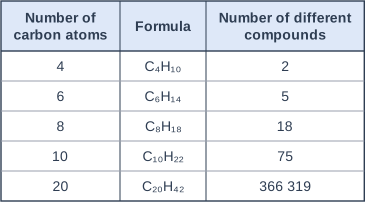
In the compounds in the table, each carbon atom forms four single covalent bonds, each hydrogen atom forms one, and the carbon atoms are joined in chains. A chain can be straight or branched, so one formula can belong to several different compounds.

The table shows how many different compounds have each formula.

Use the table and your knowledge of the bonding of carbon to explain why there are millions of different carbon compounds.

Table with columns "Number of carbon atoms", "Formula", "Number of different compounds". Number of carbon atoms: 4; Formula: C₄H₁₀; Number of different compounds: 2 | Number of carbon atoms: 6; Formula: C₆H₁₄; Number of different compounds: 5 | Number of carbon atoms: 8; Formula: C₈H₁₈; Number of different compounds: 18 | Number of carbon atoms: 10; Formula: C₁₀H₂₂; Number of different compounds: 75 | Number of carbon atoms: 20; Formula: C₂₀H₄₂; Number of different compounds: 366 319.

Model answer

Each carbon atom can form four covalent bonds, including strong bonds to other carbon atoms. So carbon atoms can join together in chains of almost any length, in branched chains and in rings. The table shows that the number of possible arrangements rises very quickly as the number of carbon atoms increases: only 2 compounds have the formula C₄H₁₀, but 75 have the formula C₁₀H₂₂ and 366 319 have the formula C₂₀H₄₂. Carbon can also bond to other elements such as oxygen and nitrogen, giving families of similar compounds, so millions of different compounds are possible.

Explanation

The key idea is that carbon bonds strongly to itself, so its atoms can make chains, branches and rings in many different ways. The table shows how fast the number of possible arrangements grows with chain length, so you should quote numbers from it to back up your explanation. Simply copying the table without describing the trend does not score.

Mark scheme
  1. 1 mark

    carbon atoms can form (strong) covalent bonds to other carbon atoms

    Max 3. Max 2 if no data from the table are used. ALLOW 'carbon atoms can bond to each other'. ALLOW 'each carbon atom can form four covalent bonds' as part of this point. DO NOT ALLOW ionic bonds.

  2. 1 mark

    (so) carbon atoms can join in chains of different lengths / in branched chains / in rings

    ALLOW 'long chains' or 'chains of any length'. Any one of chains, branched chains or rings, linked to the variety of compounds.

  3. 1 mark

    the number of possible compounds increases (very) rapidly as the number of carbon atoms increases, quoting data (for example 2 compounds with 4 carbon atoms but 366 319 with 20 carbon atoms)

    Data must be quoted or correctly compared for this mark (for example '75 with 10 carbon atoms'). ALLOW 'more carbon atoms means more ways of arranging them'. IGNORE a bare repeat of the table without a trend.

  4. 1 mark

    carbon atoms can also bond to atoms of other elements (such as oxygen, nitrogen or chlorine)

    ALLOW 'other atoms can replace some hydrogen atoms'. IGNORE 'carbon is found in all living things'.

  5. 1 mark

    carbon forms families of similar compounds

    ALLOW 'groups of compounds with similar structures, such as chains that differ only in length'.

Question 4

4 marks

Carbon nanotubes are fullerenes shaped like very long, thin, hollow tubes. In a nanotube, each carbon atom is covalently bonded to three other carbon atoms.

Poly(propene) is a polymer. It is an electrical insulator.

When a small amount of carbon nanotubes is mixed into poly(propene), the nanotubes form a network of tubes that touch each other all through the plastic. The plastic now conducts electricity. It is used to make packaging for electronic parts, so that static charge cannot build up.

Explain why poly(propene) on its own does not conduct electricity, but the plastic containing the nanotubes does.

Model answer

In poly(propene) the atoms in the long chains are joined by covalent bonds, and all the outer electrons are held in these bonds. There are no delocalised electrons and no ions, so nothing can move to carry a charge. In a nanotube each carbon atom forms only three covalent bonds, so one outer electron from each atom is delocalised. These electrons can move along the tubes. Because the tubes touch each other all through the plastic, the electrons have a continuous path from one side to the other, so the plastic conducts.

Explanation

To conduct, a material needs charged particles that can move. The polymer has none, because every outer electron is used in a covalent bond and there are no ions. The nanotubes supply delocalised electrons, and the touching network gives them a path through the whole piece of plastic. Ions play no part here.

Mark scheme
  1. 1 mark

    in poly(propene) all the outer electrons are held in covalent bonds / poly(propene) has no delocalised (free) electrons

    Max 4. Max 3 if the answer states that ions carry the charge in the nanotubes. ALLOW 'the electrons in the polymer chains are not free to move'.

  2. 1 mark

    poly(propene) has no ions / no charged particles that are free to move

    ALLOW 'polymer molecules have no overall charge'. IGNORE 'it is a non-metal'.

  3. 1 mark

    in a nanotube each carbon atom has one (outer) electron that is delocalised (because it forms only three bonds)

    ALLOW 'nanotubes have delocalised electrons'.

  4. 1 mark

    the delocalised electrons can move along (the length of) the tubes (and carry charge)

    The idea of electrons moving is needed. DO NOT ALLOW 'the nanotubes move'.

  5. 1 mark

    the tubes touch each other, so there is a continuous path for the electrons through the plastic

    ALLOW 'the network connects one side of the plastic to the other'.

Ready to try the rest? Every answer you write is marked against the mark scheme, so you can see exactly where the marks are.

Study Helper Hints first, answers after you try

Stuck on this one? Ask for a hint and I’ll point you in the right direction, without giving the answer away. Once you’ve checked your answer, I’ll show you how the marks are awarded.