Level:
Correct: 0
Incorrect: 0
Marks: 0/0
Exam Practice
Course:
Topics:
Avg
score:
–
Topics
done:
0/25

Dot and cross diagrams and models of bonding

Practise 14 exam-style questions on Dot and cross diagrams and models of bonding for OCR GCSE Combined Science (Chemistry Paper 9). Write your answer as you would in the exam and get it marked in seconds against the mark scheme, point by point, with the Study Helper on hand if you get stuck.

  • 14 questions
  • 1–6 marks each
  • Instant marking
  • No sign-up needed
14 questions, marked as you go

Sample questions with model answers

Here are 4 of the questions in this topic, each with a model answer, an explanation of why it earns the marks and the mark scheme an examiner would use.

Question 1

1 mark

Lithium sulfide, Li₂S, is an ionic compound.

Electron arrangements: lithium 2.1; sulfur 2.8.6

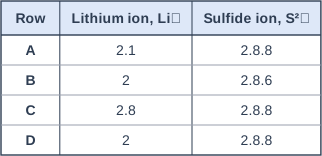
The table shows four possible pairs of electron arrangements for the ions in a dot and cross diagram of lithium sulfide.

Which row is correct?

Choose your answer.

  • A row A
  • B row B
  • C row C
  • D row D
Table with columns "Row", "Lithium ion, Li⁺", "Sulfide ion, S²⁻". Row: A; Lithium ion, Li⁺: 2.1; Sulfide ion, S²⁻: 2.8.8 | Row: B; Lithium ion, Li⁺: 2; Sulfide ion, S²⁻: 2.8.6 | Row: C; Lithium ion, Li⁺: 2.8; Sulfide ion, S²⁻: 2.8.8 | Row: D; Lithium ion, Li⁺: 2; Sulfide ion, S²⁻: 2.8.8.

Model answer

D

Explanation

A metal atom loses its outer electrons, so a lithium ion is left with only its first shell of two electrons. A non-metal atom gains electrons until its outer shell is full, so a sulfide ion is 2.8.8. A common mistake is to give the lithium ion eight electrons in its outer shell: its only remaining shell is full with two.

Mark scheme
  1. 1 mark

    D / row D

    The only correct answer is D: a lithium atom loses its one outer electron, so Li⁺ is 2 (a full first shell), and a sulfur atom gains two electrons, so S²⁻ is 2.8.8. A is not correct because 2.1 is the lithium atom, which still has its outer electron; B is not correct because 2.8.6 is the sulfur atom, which has not gained any electrons; C is not correct because a lithium ion does not gain electrons to make a full shell of eight: it loses its one outer electron. ALLOW the letter or the row. If more than one option is given, do not award the mark.
Question 2

2 marks

Silicon tetrachloride, SiCl₄, is a simple molecular compound.

Electron arrangements: silicon 2.8.4; chlorine 2.8.7

A dot and cross diagram of one SiCl₄ molecule shows only the outer shell electrons.

Give the number of shared pairs of electrons in the diagram and the number of pairs of electrons that are not used in bonding (non-bonding pairs).

Model answer

Silicon has four outer electrons and shares one with each chlorine atom, so there are 4 shared pairs. Each chlorine atom has seven outer electrons: one is in its shared pair and the other six form 3 non-bonding pairs. The silicon atom has none left, so there are 4 × 3 = 12 non-bonding pairs.

Explanation

Work atom by atom: an atom's outer electrons are either in shared pairs or in non-bonding pairs. Check: 4 + 4 × 7 = 32 outer electrons = 16 pairs, and 4 shared + 12 non-bonding = 16. A common slip is to give the non-bonding pairs on only one chlorine atom (3).

Mark scheme
  1. 1 mark

    4 shared pairs

    ALLOW four (single covalent) bonds. The silicon atom shares one pair with each of the four chlorine atoms.

  2. 1 mark

    12 non-bonding pairs

    Three non-bonding pairs on each chlorine atom and none on the silicon atom: 4 × 3 = 12. ALLOW twelve. DO NOT ALLOW 3 (one chlorine atom only) or 24 (electrons instead of pairs) unless the answer clearly says 24 electrons in 12 pairs.

Question 3

2 marks

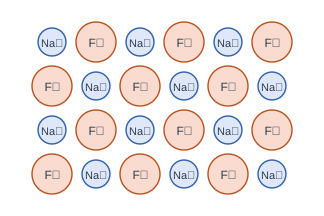
The diagram shows one flat layer of the ions in a sodium fluoride crystal, NaF.

Give the number of oppositely charged ions next to an ion in the middle of the layer.

In a real sodium fluoride crystal, each ion is next to six oppositely charged ions. Explain why this is more than the number shown in the diagram.

Part of a giant ionic lattice: a regular grid of alternating small Na⁺ ions and larger F⁻ ions.

Model answer

An ion in the middle of the layer is next to 4 oppositely charged ions: one on each side, one above it and one below it in the diagram.

The diagram is two-dimensional, but the real crystal is three-dimensional, with more layers in front of and behind this one. Each ion also has an oppositely charged ion directly in front of it and one directly behind it, so it is next to 4 + 2 = 6 oppositely charged ions.

Explanation

This is a limitation of two-dimensional representations of a three-dimensional lattice. In one layer, each ion touches four oppositely charged ions; stacking the layers so that each ion sits over an ion of opposite charge adds one more neighbour on each side of the layer, giving six. The diagonal neighbours in the layer have the same charge, so they do not count.

Mark scheme
  1. 1 mark

    4 / four

    DO NOT ALLOW 8 (the diagonal neighbours have the same charge).

  2. 1 mark

    the real crystal is three-dimensional / has more layers on both sides of this one, so each ion also has one oppositely charged ion in the layer on each side (in front and behind) (4 + 2 = 6)

    ALLOW layers above and below / one ion above and one below. ALLOW the diagram shows only one layer, but the lattice continues in all three directions. IGNORE 'the diagram shows only a few ions' on its own.

Question 4

4 marks

Element Z forms an ionic compound with sodium and a covalent compound with hydrogen.

In a dot and cross diagram of the ionic compound, each ion of Z has eight electrons in its outer shell: six dots (from Z) and two crosses (from sodium).

Deduce:
• the group of the Periodic Table that Z is in
• the formula of the compound of Z with sodium
• the formula of the compound of Z with hydrogen
• the number of shared pairs and the number of non-bonding pairs on the atom of Z, in a dot and cross diagram of the compound of Z with hydrogen.

Model answer

The six dots are the atom's own outer electrons, so Z has six outer electrons and is in Group 6.
Z gains two electrons, and each sodium atom can give only one, so two sodium ions are needed for each Z ion: Na₂Z.
With hydrogen, Z needs two more electrons, so it shares one pair with each of two hydrogen atoms: H₂Z.
In H₂Z, the atom of Z has 2 shared pairs, and its other four outer electrons form 2 non-bonding pairs.

Explanation

Translate the diagram into numbers: the dots are Z's own electrons (six), so Z is in Group 6 and needs two more electrons. With a metal it gains them (two Na atoms, Na₂Z); with hydrogen it shares them (two bonds, H₂Z), keeping its remaining four outer electrons as two non-bonding pairs. Group 6 elements such as oxygen and sulfur behave like this (Na₂O and H₂O, Na₂S and H₂S).

Mark scheme
  1. 1 mark

    Group 6

    ALLOW Group 16. The atom of Z has six outer electrons (the six dots).

  2. 1 mark

    Na₂Z

    ALLOW Na2Z. Each sodium atom transfers one electron and the Z ion has gained two, so there are two sodium ions for each Z ion. ALLOW ECF from a wrong group: Na followed by the correct number for that group's ion charge.

  3. 1 mark

    H₂Z

    ALLOW H2Z or ZH₂. ALLOW ECF from a wrong group, consistent with marking point 2.

  4. 1 mark

    2 shared pairs and 2 non-bonding pairs

    Both numbers are needed for the mark. ALLOW ECF from a wrong group if the numbers add up to that group's outer electrons correctly (shared pairs + 2 × non-bonding pairs = outer electrons).

Ready to try the rest? Every answer you write is marked against the mark scheme, so you can see exactly where the marks are.

Study Helper Hints first, answers after you try

Stuck on this one? Ask for a hint and I’ll point you in the right direction, without giving the answer away. Once you’ve checked your answer, I’ll show you how the marks are awarded.