
Level:
Correct: 0
Incorrect: 0
Marks: 0/0
Exam Practice
Course:
Topics:
Edexcel GCSE Business (Paper 2) Smart practice A mixed round aimed at your weak spots
Unit 1
Growing the business
Unit 2
Making marketing decisions
Unit 3
Making operational decisions
Unit 4
Making financial decisions
Business calculations
Understanding business performance
Unit 5
Making human resource decisions
Avg
score:
–
Topics
done:
0/24

Using the marketing mix to make business decisions

Practise 18 exam-style questions on Using the marketing mix to make business decisions for Edexcel GCSE Business (Paper 2). Write your answer as you would in the exam and get it marked in seconds against the mark scheme, point by point, with the Study Helper on hand if you get stuck.

  • 18 questions
  • 1–12 marks each
  • Instant marking
  • No sign-up needed
18 questions, marked as you go

Sample questions with model answers

Here are 4 of the questions in this topic, each with a model answer, an explanation of why it earns the marks and the mark scheme an examiner would use.

Question 1

1 mark

Pigmentry Ltd makes artists' watercolour paints in a workshop in Bath. Each colour is made in small batches from ground minerals and plant pigments, and a 15 ml tube sells for £12, about three times the price of mass-market brands. Pigmentry sells through 70 specialist art shops, whose staff are trained to explain its colours, and through its own website. Each tube comes with a card describing where its pigment comes from, and many professional artists post videos online of paintings made with Pigmentry colours.

State one way Pigmentry's marketing mix gives it a competitive advantage over mass-market watercolour brands.

Model answer

Its paints are made in small batches from ground minerals and plant pigments.

Explanation

Any element of the mix that makes customers prefer Pigmentry can be stated: the product, the specialist shops where staff explain the colours, or the videos made by professional artists. A 'State' question needs one short point from the case. The high price is a result of the advantage rather than the advantage itself, so it needs to be linked to quality to score.

Mark scheme
  1. 1 mark

    Award 1 mark for stating one way Pigmentry's marketing mix gives it a competitive advantage over mass-market watercolour brands.

    To award 1 mark there must be evidence of application. Examples that score: paints made in small batches from ground minerals and plant pigments (1); a card with each tube describing where its pigment comes from (1); sold in specialist art shops whose staff are trained to explain the colours (1); professional artists posting videos of paintings made with its colours (1). Answers taken from the case are already in context. Do not accept the £12 price on its own, because a price three times higher than rivals' is not in itself a reason customers choose it (accept it only if linked to the quality image, e.g. 'its high price makes the hand-made paints seem exclusive'). Do not accept generic answers with no link to the case, such as 'better quality' or 'good promotion'.
Question 2

2 marks

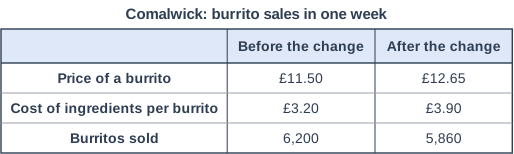
Comalwick Ltd runs 18 Mexican restaurants in city centres in the south-west of England and Wales. In January it changed its burritos: it switched to tortillas pressed by hand and better ingredients, which raised the cost of the ingredients in each burrito, and it put up the price. The table shows information about burrito sales in one week before and one week after the change.

Using the information in the table, calculate, in pounds, the change in Comalwick's weekly profit from burritos after the cost of ingredients, and say whether this profit rose or fell. You are advised to show your workings.

Comalwick: burrito sales in one week. Table with columns (row headings), "Before the change", "After the change". Price of a burrito; Before the change: £11.50; After the change: £12.65 | Cost of ingredients per burrito; Before the change: £3.20; After the change: £3.90 | Burritos sold; Before the change: 6,200; After the change: 5,860.

Model answer

Profit after ingredient costs before the change = 6,200 × (£11.50 - £3.20) = 6,200 × £8.30 = £51,460
Profit after ingredient costs after the change = 5,860 × (£12.65 - £3.90) = 5,860 × £8.75 = £51,275
Change = £51,275 - £51,460 = -£185 (a fall of £185)

Explanation

For each week, the profit on one burrito (price minus ingredient cost) is multiplied by the number sold, and the two weeks are compared. Revenue rose by £2,829, but ingredient costs rose by £3,014, so profit after ingredient costs fell by £185: the extra 45p profit on each burrito did not make up for selling 340 fewer. This shows how a change to the product affects costs, and why revenue is not the same as profit.

Mark scheme
  1. 1 mark

    Fully correct working, e.g. 5,860 × (£12.65 - £3.90) - 6,200 × (£11.50 - £3.20) = £51,275 - £51,460; or a correct final answer of a fall of £185 (-£185 or (£185)) with no working

    An answer of a fall of £185 (-£185 or (£185)) with no working scores 2 marks. If the final answer is wrong, award this mark only for fully correct working; a formula alone or partly correct working scores 0. Also accept working that finds revenue and ingredient costs for each week: (£74,129 - £22,854) - (£71,300 - £19,840). If several different final answers are given, award 0. Max 1 if the answer does not show that profit fell (e.g. '£185' with no minus sign, brackets or word such as 'fall').

  2. 1 mark

    A fall of £185 (-£185)

    Accept -185, (185), 'decrease of £185' or 'fell by 185', with or without the £ sign. Do not accept +£2,829 (the change in revenue, with ingredient costs left out), £51,275 or £51,460 (one week's profit only) or £0.45 (the rise in profit on one burrito).

Question 3

3 marks

Explain one way the nature of a product can influence the method of distribution a business uses.

Model answer

If a product is perishable, such as fresh flowers, it can only be kept for a few days before it goes off. Therefore it must reach customers quickly. This means it is usually sold through local shops or delivered by the business's own vans rather than sent by ordinary post.

Explanation

One element of the marketing mix shapes another: what the product is like, for example perishable, bulky, fragile, technical or digital, affects which methods of distribution are practical. One mark is for the way and two are for linked strands that explain how the product affects the choice. Describing places to sell with no link to the product does not answer the question.

Mark scheme
  1. 1 mark

    Award 1 mark for identification of a way the nature of a product can influence the method of distribution a business uses.

    Answers that list more than one way with no explanation will be awarded a maximum of 1 mark. Accept any other appropriate response. Valid ways include: a perishable product, such as fresh food or flowers, must reach customers quickly, so it is sold through local shops or delivered fast rather than sent by ordinary post; a large, heavy or fragile product, such as a sofa or glassware, is expensive or risky to post, so it may be sold through shops or showrooms and delivered by the seller's own vans; a product that customers want to try, touch or have fitted, such as shoes, beds or glasses, is often sold through shops; a technical or expensive product that needs explaining may be sold through specialist retailers with trained staff; a digital product, such as music, software or an e-book, can be sold online and downloaded, with no shop or delivery needed; a small, light product is cheap to post, so it suits selling online as an e-tailer. This is a 'way' question, so the strands must explain HOW the product affects the choice of distribution; strands that only say 'this increases sales' are not credited. Do not accept answers about place with no link to the product, or answers about price.

  2. 2 marks

    Award up to 2 further marks for explaining this way (1 mark for each linked strand of development).

    Examples: If a product is perishable, such as fresh flowers (1), it can only be kept for a few days before it goes off (1). Therefore it must be sold through local shops or delivered quickly by the business's own vans rather than sent by ordinary post (1). / If a product is large and heavy, such as a sofa (1), it is expensive to send through a parcel service and may be damaged on the way (1). This means it is usually sold through showrooms or shops and delivered by the retailer's own lorries, rather than by an e-tailer that posts its orders (1). A restatement of the way, a definition of product or place, or an example on its own is not a strand.

Question 4

6 marks

Strapworth Luggage Ltd, based in Paisley, designs suitcases and travel bags, which are made for it by a factory abroad. For 20 years most of its sales have been large wheeled suitcases for family holidays, sold for £90 to £150 through department stores and its own website. Its adverts show families on beach holidays, and its busiest months are April to August.

Sales of holiday suitcases have stopped growing, so the directors plan to target business travellers who make short trips by air and by train. Strapworth will launch a range of cabin-size cases with a padded laptop section, priced at £180 to £260. It will open its own small shops at airports and large railway stations, and a new sales team will sell the cases to companies for their staff. It will advertise the range on business news websites.

Analyse the impact on Strapworth Luggage Ltd of changing its marketing mix to target business travellers.

Model answer

Targeting business travellers means changing all four elements of Strapworth's marketing mix. At the moment most of its sales are large family suitcases sold between April and August, but business travellers make short trips all year round. Therefore the new cabin cases with a padded laptop section should sell in every month, not just before the summer holidays. As a result, Strapworth's revenue and cash flow would be spread more evenly across the year, and with prices of £180 to £260, well above the £90 to £150 of its family suitcases, each sale would bring in more revenue.

However, the new mix will add to Strapworth's costs. It must pay rent for shops at airports and railway stations, which are expensive sites, and salaries for a new sales team to sell to companies. Its brand is also known for family beach holidays, so business travellers may not see it as worth £260 and may buy cases from brands they already trust. This means sales of the new range could be lower than planned, so Strapworth may not cover the extra costs and its profit could fall, at least until its adverts on business news websites build a more professional image for the brand.

Explanation

A top answer shows how targeting a new segment changes the product, price, place and promotion together, and how they must fit with each other, using details such as the £180 to £260 prices, the airport and station shops and the family image of the current adverts. About five linked strands from one or two impacts are needed. A generic answer about market segments cannot score more than 3 marks.

Mark scheme
  1. 6 marks

    Levels of response (6 marks).
    Level 3 (5-6 marks): Detailed application of knowledge and understanding of business concepts and issues to the business context throughout (AO2). Deconstructs business information and/or issues, finding detailed interconnected points with logical chains of reasoning (AO3a).
    Level 2 (3-4 marks): Sound application of knowledge and understanding of business concepts and issues to the business context although there may be some inconsistencies (AO2). Deconstructs business information and/or issues, finding interconnected points with chains of reasoning, although there may be some logical inconsistencies (AO3a).
    Level 1 (1-2 marks): Limited application of knowledge and understanding of business concepts and issues to the business context (AO2). Attempts to deconstruct business information and/or issues, finding limited connections between points (AO3a).
    0 marks: No rewardable material.

    Indicative content (not a checklist; credit other valid points):
    - The change affects every element of the mix: cabin-size cases with a padded laptop section (product), £180 to £260 instead of £90 to £150 (price), shops at airports and railway stations and a sales team selling to companies (place), and adverts on business news websites instead of adverts showing family beach holidays (promotion) (AO2).
    - Strapworth's current customers are families buying large suitcases, mostly between April and August, and these sales have stopped growing (AO2).
    - Business travellers make short trips all year round. Therefore the new range should sell in every month, not just before the summer holidays, so Strapworth's revenue and cash flow are spread more evenly across the year and it depends less on one market segment that is no longer growing (AO3a).
    - Each case sells for £180 to £260, well above the price of its family suitcases, and the sales team may win large orders from companies buying cases for many staff. As a result, revenue per sale rises and sales could grow quickly (AO3a).
    - However, shops at airports and railway stations are expensive to rent, and the new sales team must be paid salaries, so Strapworth's costs rise before the range has sold anything (AO3a).
    - However, Strapworth's brand is known for family beach holidays, so business travellers may not see it as worth £260 and may buy from brands they already trust. This means sales may be lower than planned, so the extra costs may not be covered and profit could fall; the elements of the mix must also fit together, so promotion has to build a premium, business image to match the higher price (AO3a).
    Marking notes: only the best two points are credited; Level 3 for AO3a needs about five linked strands from one or two points. An impact can be positive, negative or both, and good answers show how a change in one element affects others. Context only counts inside a valid point, and copying the case or using the business name or words from the question ('marketing mix', 'business travellers') is not application; 'luggage' on its own does not count because it is in the business name. A generic answer with no application to Strapworth cannot score more than 3 marks. Evaluation is not required and is not credited.

Ready to try the rest? Every answer you write is marked against the mark scheme, so you can see exactly where the marks are.

Study Helper Hints first, answers after you try

Stuck on this one? Ask for a hint and I’ll point you in the right direction, without giving the answer away. Once you’ve checked your answer, I’ll show you how the marks are awarded.