
Level:
Correct: 0
Incorrect: 0
Marks: 0/0
Exam Practice
Course:
Topics:
Edexcel GCSE Business (Paper 2) Smart practice A mixed round aimed at your weak spots
Unit 1
Growing the business
Unit 2
Making marketing decisions
Unit 3
Making operational decisions
Unit 4
Making financial decisions
Business calculations
Understanding business performance
Unit 5
Making human resource decisions
Avg
score:
–
Topics
done:
0/24

The product life cycle

Practise 19 exam-style questions on The product life cycle for Edexcel GCSE Business (Paper 2). Write your answer as you would in the exam and get it marked in seconds against the mark scheme, point by point, with the Study Helper on hand if you get stuck.

  • 19 questions
  • 1–12 marks each
  • Instant marking
  • No sign-up needed
19 questions, marked as you go

Sample questions with model answers

Here are 4 of the questions in this topic, each with a model answer, an explanation of why it earns the marks and the mark scheme an examiner would use.

Question 1

1 mark

Define the term 'extension strategy'.

Model answer

An extension strategy is an action a business takes to lengthen the life cycle of a product, such as updating it or selling it in new markets, so that its sales do not fall into decline.

Explanation

The mark needs the idea of lengthening a product's life cycle or delaying its decline so that sales continue. A common error is to think it means making the product more durable, which scores 0. Giving an example such as new packaging is not enough on its own.

Mark scheme
  1. 1 mark

    A definition showing that an extension strategy is an action a business takes to lengthen the life cycle of a product / to delay the decline phase, so that its sales are kept up or increased

    Accept, for example: 'a way of making a product's life cycle last longer'; 'a method used to stop the sales of a product falling when it reaches maturity or decline'; 'a plan to keep a product selling for longer, for example by updating it or selling it in new markets'. An example on its own (e.g. 'new packaging') is not a definition. Do not accept answers about making the product itself last longer or be more durable (e.g. 'making a product stronger so it does not break'), or 'a strategy to extend the business' with no reference to a product's sales or life cycle.
Question 2

2 marks

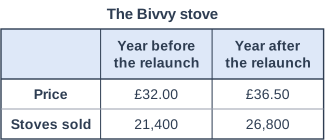
Pannikin Stoves Ltd, based in Hathersage, makes small gas stoves for campers and hikers. Sales of its Bivvy stove, launched in 2016, had stopped growing. In 2025 Pannikin used an extension strategy: it relaunched the Bivvy as a lighter model with a built-in igniter and raised its price. The relaunch, including new packaging and advertising, cost £45,000. The table shows information about the Bivvy in the year before and the year after the relaunch.

Using the information in the table, calculate the increase in sales revenue from the Bivvy in the year after the relaunch. You are advised to show your workings.

The Bivvy stove. Table with columns (row headings), "Year before the relaunch", "Year after the relaunch". Price; Year before the relaunch: £32.00; Year after the relaunch: £36.50 | Stoves sold; Year before the relaunch: 21,400; Year after the relaunch: 26,800.

Model answer

Revenue before = 21,400 × £32.00 = £684,800
Revenue after = 26,800 × £36.50 = £978,200
Increase = £978,200 - £684,800 = £293,400

Explanation

Revenue is price multiplied by the number sold, so work out the revenue in each year and find the difference. The £45,000 relaunch cost is a cost, not revenue, so it is not used here. Multiplying only the 5,400 extra stoves by the new price misses the higher price paid for all the other stoves.

Mark scheme
  1. 1 mark

    Fully correct working, e.g. (26,800 × £36.50) - (21,400 × £32.00); or a correct final answer of £293,400 with no working

    An answer of £293,400 with no working scores 2 marks. If the final answer is wrong, award this mark only for fully correct working (revenue before 21,400 × £32.00 = £684,800 and revenue after 26,800 × £36.50 = £978,200, then the difference); a formula alone or partly correct working scores 0. If several different final answers are given, award 0.

  2. 1 mark

    £293,400

    Accept 293400 or 293,400 without the £ sign, or £293.4 thousand. Do not accept £248,400 (the £45,000 relaunch cost subtracted; this question asks for revenue, not profit), £197,100 (only the 5,400 extra stoves multiplied by £36.50) or £978,200 (revenue after the relaunch, not the increase).

Question 3

3 marks

Explain one reason why a business may make a loss on a product during the introduction phase of its life cycle.

Model answer

In the introduction phase few customers know about the product, so its sales are low. However, the business must spend heavily on advertising to make customers aware of it. As a result, its costs are higher than the revenue the product earns, so it makes a loss on the product.

Explanation

One mark is for a reason, such as high promotion costs or low sales, and two more are for two linked steps that explain why costs are greater than revenue. Each step must add something new. Reasons that belong to other phases, such as falling sales, do not answer the question.

Mark scheme
  1. 1 mark

    Award 1 mark for identification of a reason why a business may make a loss on a product in the introduction phase.

    Answers that list more than one reason with no explanation will be awarded a maximum of 1 mark. Accept any other appropriate response. Valid reasons include: high spending on promotion to make customers aware of the product; low sales while few customers know about it; fixed costs spread over few units, so the cost per unit is high; development costs still to be recovered; a low launch price (penetration pricing) used to attract customers. Do not accept reasons that belong to other phases, such as falling sales or rivals leaving the market.

  2. 2 marks

    Award up to 2 further marks for explaining this reason (1 mark for each linked strand of development).

    Examples: In the introduction phase few customers know about the product, so sales are low (1). However, the business must spend heavily on advertising to make customers aware of it (1). As a result, its costs are higher than the revenue the product earns, so it makes a loss on it (1). / Output is low when a product is first launched (1). This means its fixed costs, such as the machinery used to make it, are spread over only a few units (1). Therefore the cost of making each unit is high, and may be more than the price customers will pay (1). A restatement of the reason, a definition, an example or the words of the question is not a linked strand, and vague endings such as 'the business will be more successful' are not credited.

Question 4

6 marks

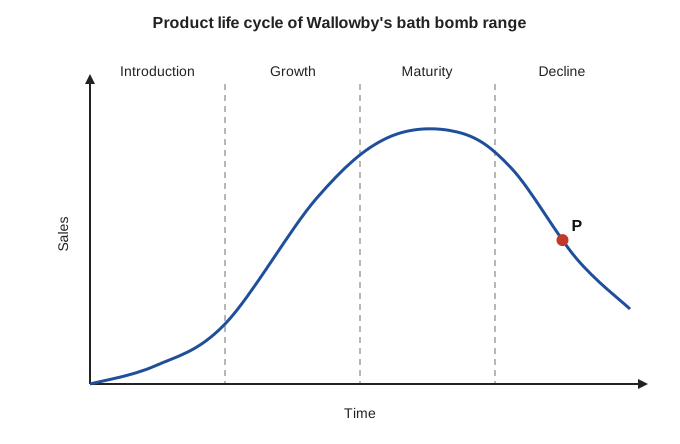
Wallowby Ltd, based in Brighton, makes bath bombs, soaps and body scrubs, which it sells in its 22 shops and on its website. Bath bombs have been its main product since it opened in 2012, and in 2021 they made up 60% of its revenue. The diagram shows the product life cycle of Wallowby's bath bomb range. Point P shows where the range is now, in the decline phase.

Sales of Wallowby's bath bombs have fallen by about 15% in each of the past three years. Many customers now take showers instead of baths to save energy and water, and supermarkets sell bath bombs for less than half of Wallowby's price of £5.50. Wallowby's body scrubs, launched in 2023, are selling well.

Analyse the impact on Wallowby Ltd of its bath bomb range being in the decline phase of its product life cycle.

A product life cycle diagram with sales on the vertical axis and time on the horizontal axis. The diagram is titled 'Product life cycle of Wallowby's bath bomb range'. Dashed lines divide the curve into four phases, labelled from left to right Introduction, Growth, Maturity and Decline. Sales start at zero, rise slowly in the introduction phase and steeply in the growth phase, reach a peak in the maturity phase and fall in the decline phase. Point P is marked on the falling part of the curve in the decline phase.

Model answer

Bath bombs made up 60% of Wallowby's revenue in 2021, and their sales have fallen by about 15% a year for three years because many customers now take showers instead of baths. Because bath bombs are such a large part of the business, this decline cuts Wallowby's total revenue sharply. However, many of its costs, such as the rent and staff for its 22 shops, do not fall when sales fall. Therefore its profit is likely to fall even faster than its revenue, and some shops may start to make a loss, so Wallowby may have to close them.

Supermarkets now sell bath bombs for less than half of Wallowby's £5.50 price. To slow the decline, Wallowby may have to cut its price, but this would reduce the profit it makes on each bath bomb. The decline also means Wallowby is likely to move shelf space and promotion away from bath bombs towards its body scrubs, which have sold well since their launch in 2023. As a result, rising sales of scrubs could replace some of the revenue lost from bath bombs, so Wallowby relies less on a product whose sales are falling.

Explanation

A Level 3 answer develops one or two impacts of the decline, such as falling revenue and profit in the 22 shops or pressure to cut the £5.50 price, with about five linked strands. Context such as the 60% share of revenue, the 15% yearly fall and the body scrubs must be used throughout. Recommending what Wallowby should do earns no extra marks in an 'Analyse' question unless it is part of the analysis of the impact.

Mark scheme
  1. 6 marks

    Levels of response (6 marks).
    Level 3 (5-6 marks): Detailed application of knowledge and understanding of business concepts and issues to the business context throughout (AO2). Deconstructs business information and/or issues, finding detailed interconnected points with logical chains of reasoning (AO3a).
    Level 2 (3-4 marks): Sound application of knowledge and understanding of business concepts and issues to the business context although there may be some inconsistencies (AO2). Deconstructs business information and/or issues, finding interconnected points with chains of reasoning, although there may be some logical inconsistencies (AO3a).
    Level 1 (1-2 marks): Limited application of knowledge and understanding of business concepts and issues to the business context (AO2). Attempts to deconstruct business information and/or issues, finding limited connections between points (AO3a).
    0 marks: No rewardable material.

    Indicative content (not a checklist; credit other valid points):
    - Bath bombs made up 60% of Wallowby's revenue in 2021, and their sales have fallen by about 15% a year for three years (AO2).
    - Customers are taking showers to save energy and water, supermarkets sell bath bombs for less than half of the £5.50 price, and the body scrubs launched in 2023 are selling well (AO2).
    - Because bath bombs are such a large share of revenue, a 15% yearly fall cuts Wallowby's total revenue sharply. Its costs, such as rent and staff for 22 shops, do not fall with sales, so its profit falls faster than its revenue and it may need to close shops (AO3a).
    - To slow the decline Wallowby may cut its price closer to supermarket prices, which lowers its profit on each bath bomb; alternatively it can move shelf space and promotion from bath bombs to body scrubs, so revenue from the growing range replaces lost bath bomb sales (AO3a).
    Marking notes: only the best two points are credited; Level 3 for AO3a needs about five linked strands from one or two points. Context only counts inside a valid point, and copying the case or using the business name or words from the question is not application. A generic answer with no application to Wallowby Ltd cannot score more than 3 marks. Evaluation is not required and is not credited. The impact can be positive, negative or both.

Ready to try the rest? Every answer you write is marked against the mark scheme, so you can see exactly where the marks are.

Study Helper Hints first, answers after you try

Stuck on this one? Ask for a hint and I’ll point you in the right direction, without giving the answer away. Once you’ve checked your answer, I’ll show you how the marks are awarded.