Level:
Correct: 0
Incorrect: 0
Marks: 0/0
Exam Practice
Course:
Topics:
Edexcel GCSE Business (Paper 2) Smart practice A mixed round aimed at your weak spots
Unit 1
Growing the business
Unit 2
Making marketing decisions
Unit 3
Making operational decisions
Unit 4
Making financial decisions
Business calculations
Understanding business performance
Unit 5
Making human resource decisions
Avg
score:
–
Topics
done:
0/24

Changes in business aims and objectives

Practise 20 exam-style questions on Changes in business aims and objectives for Edexcel GCSE Business (Paper 2). Write your answer as you would in the exam and get it marked in seconds against the mark scheme, point by point, with the Study Helper on hand if you get stuck.

  • 20 questions
  • 1–12 marks each
  • Instant marking
  • No sign-up needed
20 questions, marked as you go

Sample questions with model answers

Here are 4 of the questions in this topic, each with a model answer, an explanation of why it earns the marks and the mark scheme an examiner would use.

Question 1

1 mark

Give one way the objectives of a business may change as the business evolves.

Model answer

Entering a new market.

Explanation

The specification lists the ways objectives change as a business evolves: a focus on survival or growth, entering or exiting markets, growing or reducing the workforce, and increasing or decreasing the product range. A 'Give' question tests recall, so no context is needed, but the answer must be one of these ways rather than a reason for the change, such as new technology.

Mark scheme
  1. 1 mark

    Award 1 mark for giving one way the objectives of a business may change as it evolves.

    Answers that score (each 1 mark; award only the first answer given): a change of focus to survival; a change of focus to growth; entering a new market; exiting a market; growing the workforce; reducing the workforce; increasing the product range; decreasing the product range. Award any other close interpretation of these, e.g. 'moving from survival to growth', 'selling in another country', 'stopping selling a product range', 'taking on more staff', 'making redundancies'. Also accept a change of focus from one named objective to another, e.g. 'from growth to making a profit' or 'to increasing market share'. Do not accept reasons why objectives change (e.g. 'new technology', 'new laws', 'competition') or vague answers such as 'bigger objectives' or 'more profit' that do not say how the focus of the objectives changes.

Question 2

2 marks

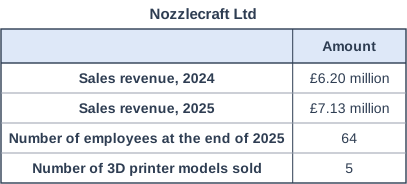
Nozzlecraft Ltd designs and makes 3D printers for schools, colleges and engineering firms in Milton Keynes. After two difficult years, in 2024 its directors changed its main objective from survival to growth. The new objective is to increase its sales revenue by 30% between 2024 and 2026. The table shows information about Nozzlecraft Ltd.

Using the information in the table, calculate how much more sales revenue, in pounds, Nozzlecraft Ltd must earn in 2026 than it earned in 2025 to meet its objective. You are advised to show your workings.

Nozzlecraft Ltd. Table with columns (row headings), "Amount". Sales revenue, 2024; Amount: £6.20 million | Sales revenue, 2025; Amount: £7.13 million | Number of employees at the end of 2025; Amount: 64 | Number of 3D printer models sold; Amount: 5.

Model answer

Target revenue for 2026 = £6.20m × 1.30 = £8.06m
Increase needed from 2025 = £8.06m - £7.13m = £0.93m = £930,000

Explanation

The 30% increase is measured from 2024, so the 2026 target is £6.20 million × 1.3 = £8.06 million. Nozzlecraft has already grown to £7.13 million in 2025, so it needs only a further £930,000. Applying 30% to the 2025 revenue, or giving the target itself, are the common errors; the employee and model numbers are not needed.

Mark scheme
  1. 1 mark

    Fully correct working, e.g. (£6.20m × 1.30) - £7.13m; or a correct final answer of £930,000 with no working

    An answer of £930,000 with no working scores 2 marks. If the final answer is wrong, award this mark only for fully correct working (target revenue for 2026 = £6.20m × 1.3 = £8.06m, then £8.06m - £7.13m); a formula alone or partly correct working scores 0. If several different final answers are given, award 0.

  2. 1 mark

    £930,000

    Accept £0.93 million, £0.93m or 930,000 without the £ sign. Do not accept £8,060,000 (the 2026 target, not the increase needed), £1,860,000 (30% of the 2024 revenue, the total increase from 2024 to 2026), £2,139,000 (30% wrongly applied to the 2025 revenue) or an answer that uses the number of employees or models.

Question 3

3 marks

Explain one reason why a business that has achieved all of its objectives may set new, different objectives.

Model answer

Once its objectives are met, the business has nothing new to aim for. Without new targets, managers and employees may lose motivation. Therefore the business sets new objectives, such as a higher market share, so that everyone keeps working towards improving it.

Explanation

Performance is one of the reasons objectives change: a business that has hit its targets usually sets new ones rather than standing still. One mark is for the reason and two more are for linked strands explaining why it leads to new objectives. Answers about a business that has failed to meet its objectives do not fit this question.

Mark scheme
  1. 1 mark

    Award 1 mark for identification of a reason why a business that has achieved all of its objectives may set new, different objectives.

    Answers that list more than one reason with no explanation will be awarded a maximum of 1 mark. Accept any other appropriate response. Valid reasons include: the old objectives no longer give the business anything to aim for, so new targets are needed to keep it improving; employees and managers need new targets to stay motivated; good performance means the business has the profit or cash to aim higher, for example to enter a new market; the owners or shareholders expect continued growth; conditions in the market have changed since the old objectives were set. Do not accept reasons that only apply when a business has missed its objectives, such as 'it is making a loss'.

  2. 2 marks

    Award up to 2 further marks for explaining this reason (1 mark for each linked strand of development).

    Examples: Once its objectives are met, the business has nothing new to aim for (1). Without new targets, managers and employees may lose motivation (1). Therefore setting new objectives, such as a higher market share, keeps everyone working towards improving the business (1). / Meeting its objectives may mean the business has made more profit than it needed (1). This gives it retained profit to invest (1). As a result, it can set a more ambitious objective, such as entering a new market or increasing its product range (1). A restatement of the reason, an example or a definition is not a strand. Vague endings such as 'the business will be more successful' are not credited.

Question 4

9 marks

Aperwick Cameras Ltd designs and makes action cameras, small tough cameras that people fix to helmets, bikes and surfboards, at a factory in Livingston and sells them through electronics retailers and its own website. Its sales have fallen by 40% in five years as two much larger rivals have cut the prices of their action cameras, and in 2025 it made a loss of £1.6 million. Its main objective is now survival.

Aperwick sells 32 camera models. Its six diving and wildlife cameras, which the two large rivals do not make, still sell well and provide half of its revenue. Many of the other models sell only a few hundred a year, but each needs its own parts, packaging and marketing. Cutting the range to ten models would reduce costs by about £1.9 million a year, but revenue would also fall by about £0.8 million a year, and some retailers might give Aperwick less shelf space.

A water company has offered Aperwick a two-year contract to buy about 2,000 inspection cameras a year at £450 each, if Aperwick can design a tough, waterproof camera that its engineers can push through drains and sewers to find leaks and blockages. Aperwick could later sell the camera to other water companies and drainage firms. Designing it would cost about £600,000 and take a year, and Aperwick has never sold to business customers before.

In order to survive, Aperwick Cameras Ltd is considering two options:
Option 1: reduce its product range
Option 2: enter the market for inspection cameras.

Justify which one of these two options Aperwick Cameras Ltd should choose.

Model answer

Aperwick Cameras should choose Option 1, reducing its product range.

Cutting the range from 32 models to ten would reduce costs by about £1.9 million a year, because Aperwick would no longer need parts, packaging and marketing for 22 models that each sell only a few hundred a year. Revenue would fall by about £0.8 million, but profit would still improve by about £1.1 million. Therefore the £1.6 million loss would fall to about £0.5 million, so Aperwick would lose far less cash while it tries to survive. As a result, it could concentrate on its six diving and wildlife cameras, which already bring in half of its revenue because the two large rivals do not make them.

However, Aperwick would still be making a loss of about £0.5 million, and retailers might give it less shelf space if it offers fewer models, which could reduce sales of the cameras it keeps. Cutting the range also does nothing about the main problem: the two large rivals may keep cutting their prices, so sales of its remaining cameras could keep falling.

Overall, Option 1 is better because survival depends on cutting the loss quickly, while the inspection camera would cost £600,000 and bring in no revenue for a year at a time when Aperwick is already losing money. However, it depends on how quickly the smaller range cuts Aperwick's losses. If the savings arrive as planned, Aperwick could use some of them to develop the inspection camera next year and ask the water company to start the two-year contract then, giving it a market where it does not have to compete on price with the two large rivals.

Explanation

The best answers choose one option and weigh its benefits and drawbacks with the case figures: £1.9 million of savings against £0.8 million of lost revenue, the six diving and wildlife cameras that provide half of revenue, and the £600,000 and one-year wait for an inspection camera that might bring in £900,000 a year. A strong conclusion adds something new, such as using the savings from a smaller range to develop the inspection camera later. Either option can score full marks.

Mark scheme
  1. 9 marks

    Levels of response (9 marks).
    Level 3 (7-9 marks): Detailed application of knowledge and understanding of business concepts and issues to the business context throughout (AO2). Deconstructs business information and/or issues, finding detailed interconnected points with logical chains of reasoning (AO3a). Makes a judgement, providing a clear justification based on a thorough evaluation of business information and issues relevant to the choice made (AO3b).
    Level 2 (4-6 marks): Sound application of knowledge and understanding of business concepts and issues to the business context although there may be some inconsistencies (AO2). Deconstructs business information and/or issues, finding interconnected points with chains of reasoning, although there may be some logical inconsistencies (AO3a). Makes a judgement, providing a justification based on sound evaluation of business information and issues relevant to the choice made (AO3b).
    Level 1 (1-3 marks): Limited application of knowledge and understanding of business concepts and issues to the business context (AO2). Attempts to deconstruct business information and/or issues, finding limited connections between points (AO3a). Makes a judgement, providing a simple justification based on limited evaluation of business information and issues relevant to the choice made (AO3b).
    0 marks: No rewardable material.

    Indicative content (not a checklist; credit other valid points):
    - Option 1: cutting the range from 32 to ten models reduces costs by about £1.9 million a year but revenue by about £0.8 million, so profit improves by about £1.1 million and the £1.6 million loss falls to about £0.5 million; the six diving and wildlife cameras already provide half of revenue (AO2).
    - Option 2: the water company offers a two-year contract for about 2,000 cameras a year at £450, about £900,000 of revenue a year, with the chance to sell to other water companies and drainage firms; designing the camera costs about £600,000 and takes a year, and Aperwick has no experience of business customers (AO2).
    - Option 1: with fewer models, Aperwick needs fewer different parts and less packaging and marketing, so its costs fall quickly and it loses far less cash while it tries to survive. It can concentrate on the diving and wildlife cameras that the two large rivals do not make, so the models it keeps are the ones most likely to go on selling (AO3a).
    - Option 2: inspection cameras are a market where Aperwick would not have to compete on price with the two large rivals, so its revenue would not be squeezed by their price cuts. Aperwick can use its skills in tough, waterproof cameras, and the two-year contract makes about £900,000 a year of revenue fairly certain; if other water companies and drainage firms buy too, revenue could grow further, reducing its reliance on a shrinking consumer market (AO3a).
    - However, with Option 1 Aperwick would still lose about £0.5 million a year, retailers might give it less shelf space and sell fewer of its remaining cameras, and it does nothing about the price cuts by the two large rivals, which may continue (AO3b).
    - However, with Option 2 Aperwick would spend £600,000 while already making a loss of £1.6 million, and earn nothing from inspection cameras for a year, so it might run out of cash first; it has never sold to business customers, the contract depends on the camera doing what the water company needs, it would depend on one customer at first, and £900,000 of revenue is not £900,000 of profit (AO3b).
    Marking notes: either option can score full marks. Only the best two points are credited; Level 3 for AO3a needs about five linked strands. Context only counts inside a valid point; copying the case or using the business name or words from the question is not application. The strongest answers choose one option and weigh its benefits and drawbacks. Covering the benefits of both options with no contrast, or only the drawbacks of the rejected option, gives no evaluation (AO3b). A one-sided answer cannot reach Level 2 for AO3b. Level 3 needs a conclusion that adds something new, such as a developed 'it depends' factor (e.g. whether Aperwick can design a camera that meets the water company's needs within a year, or how quickly Aperwick could run out of cash), and uses the context. Points must be about survival; do not credit the claim that £900,000 of revenue is the same as £900,000 of profit.

Ready to try the rest? Every answer you write is marked against the mark scheme, so you can see exactly where the marks are.

Study Helper Hints first, answers after you try

Stuck on this one? Ask for a hint and I’ll point you in the right direction, without giving the answer away. Once you’ve checked your answer, I’ll show you how the marks are awarded.